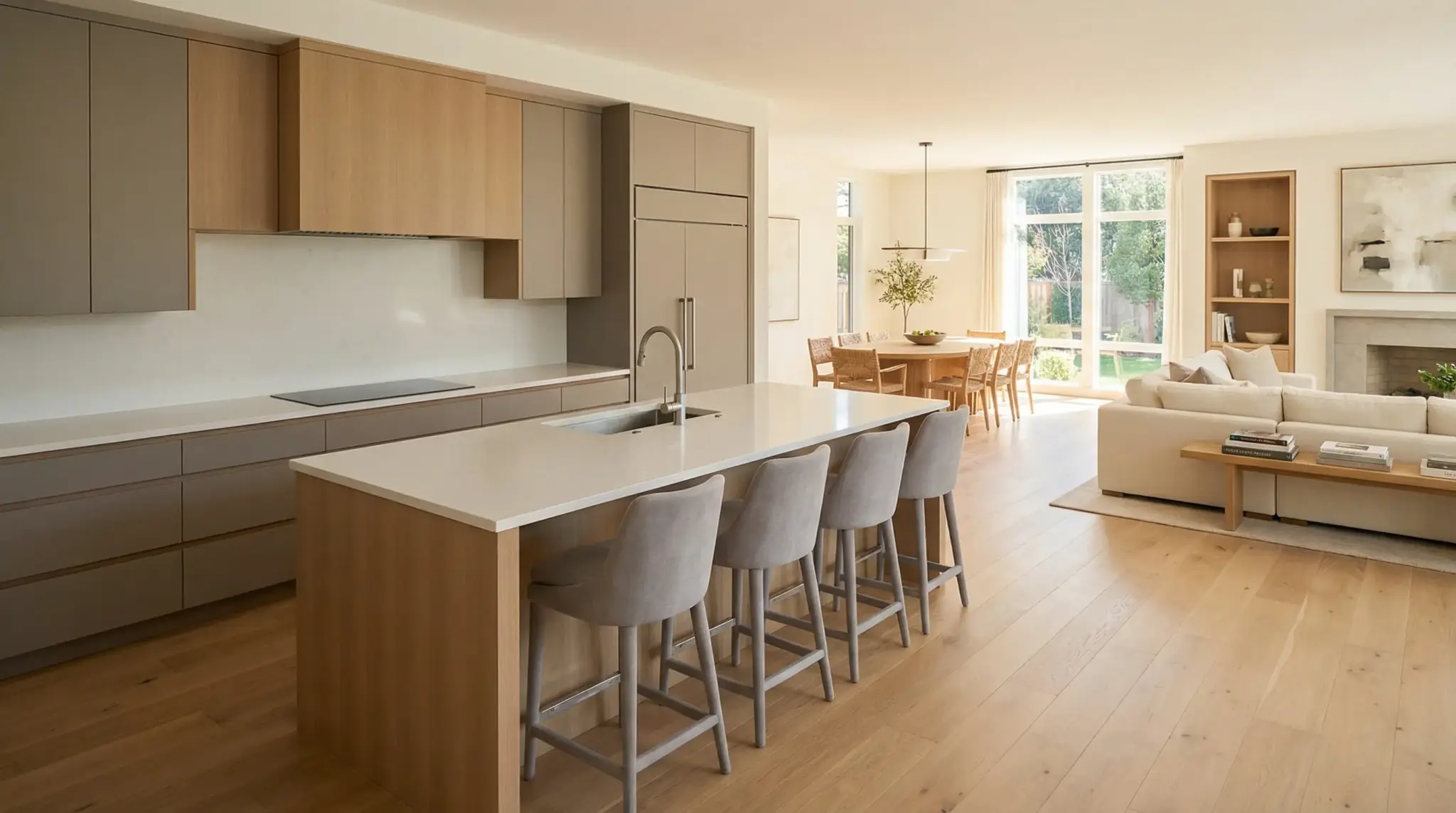
Open-concept kitchens are designed so that cooking, dining, and living are in one continuous space. This design enhances interaction and visibility. However, it must be thoughtfully designed to ensure order and efficiency.
A poorly designed open kitchen doesn’t work in the long run. It soon becomes messy and inefficient.
Here is what works and what doesn’t.
What Works: Designated Areas Within an Open Plan
Your kitchen should have functional areas even without walls. Preparation, cooking, and storage spaces should be logically organized. This is necessary to facilitate workflow.
Position key elements strategically. This includes the:
- Sink
- Stove
- Refrigerator.
They should form a work triangle so that movement between them is efficient.
You can use an island as a focal point. It helps to separate the kitchen from the surrounding space. It also increases the working area and storage.
What Works: Customized Cabinetry and Storage
Cabinetry is always visible in open layouts. This means that functionality and aesthetics are important.
Custom cabinet solutions enable you to create storage that fits your specific layout. You can minimize visual clutter with built-in features like:
- Pull-out drawers
- Built-in appliances
- Hidden spaces.
This is a way of making sure storage is efficient without interfering with the open and clean feel.
What Works: Consistent Design Elements
There must be consistency in an open-concept kitchen. This is because it links various areas of the home.
The cabinets must match the immediate space in terms of the:
- Colors
- Materials
- Finishes.
Also, use neutral palettes. They are more effective because they do not make the kitchen the main focus of the design.
What Does Not Work: Lack of Storage Planning
In the absence of proper cabinetry, objects lie on countertops. That leaves the space in a state of chaos. Open shelving can add to this issue when not handled strategically.
Consider closed storage. This will ensure that the kitchen looks clean but still functional.
What Does Not Work: Ineffective Layouts
An open concept design may fail when the design is not optimized. Common errors include:
- Having too much space between the appliances
- Not establishing logical work areas
- Oversized islands
- Misplaced islands.
Such elements hinder movement. Hence, diminished efficiency.
All components must contribute to an efficient workflow.
What Does Not Work: Incompatible Design Styles
The fact that the kitchen occupies a larger space makes inconsistent design choices noticeable. Some design mistakes include having too many:
- Finishes
- Colors
- Materials.
As a result, the space loses its cohesiveness.
It is important to have a consistent style throughout:
- Cabinetry
- Countertops
- Surrounding furniture.
What Does Not Work: Excessive Clutter
An open kitchen does not give much opportunity to conceal mess. In the absence of appropriate organization systems, everyday objects can easily become distracting.
To ensure order, consider:
- Effective cabinetry
- Internal organizers
- Hidden storage.
The Bottom Line
Open concept kitchens work well when there is a balance between openness and structure.