

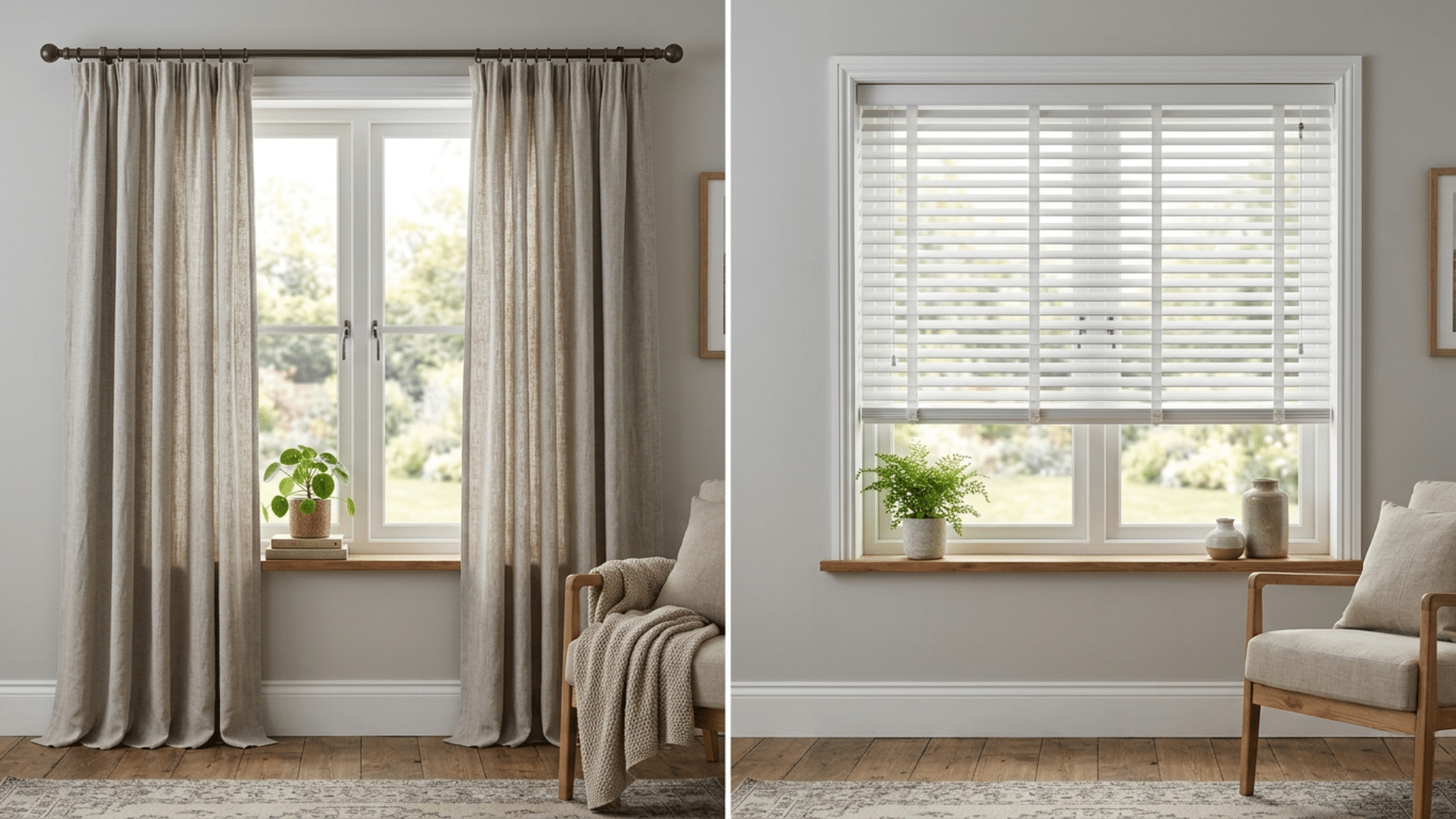
I’ve spent a lot of time figuring out the best window coverings for different spaces, and I know how confusing it can get.
When you compare curtains vs blinds, there isn’t one clear winner.
It really depends on your style, budget, and how you use your room day to day.
In this blog, I’ll explain the key differences in a simple way. You’ll learn how each option works, where they fit best, and what to expect in terms of cost, cleaning, and light control.
I’ll also share when one makes more sense than the other, so you can choose the option that actually works for your home.
By the end, you’ll have a clear idea of what suits your needs without overthinking it.
What Are Blinds and How Do They Work?
Blinds are window coverings made of slats or panels that can be tilted, raised, or lowered. They are designed to give better control over light and privacy.
You can fully open them, close them, or adjust the slats to let in a soft amount of light.
There are different types of blinds, such as vertical, horizontal, roller, and Roman styles.
Each type works in a slightly different way but serves the same purpose. Most blinds are operated using a cord, chain, or wand.
Blinds are usually made from materials like wood, plastic, or metal, which makes them durable and easy to maintain.
They are a great option for creating a clean and modern look while keeping light and privacy under control
What Are Curtains and How Are They Used?
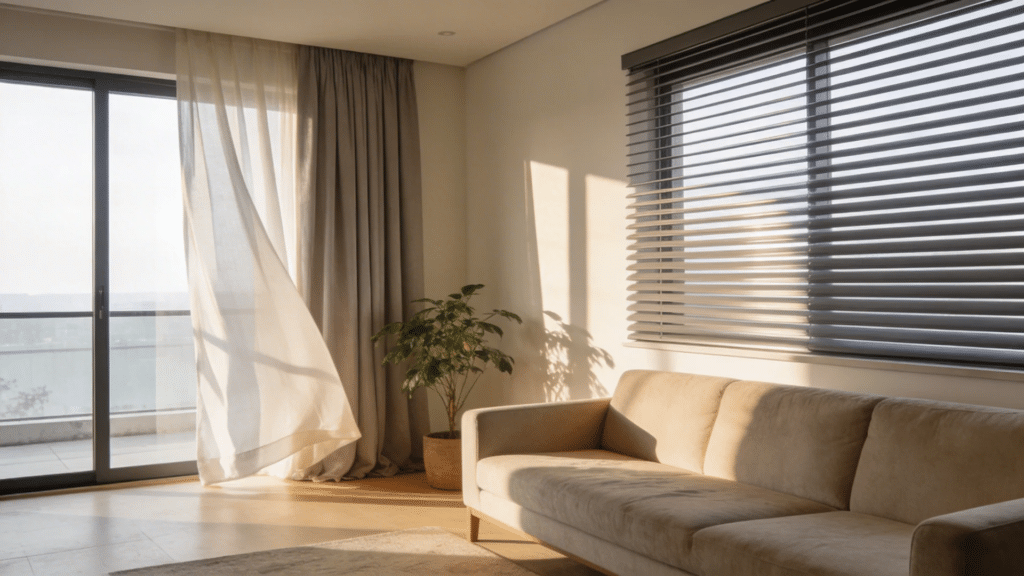
Curtains are fabric panels that hang from a rod above a window. They are among the most common window coverings and add both style and function to a room.
Curtains can be opened or closed easily by pulling them along the rod.
They come in many fabrics, colors, and lengths, which makes them easy to match with different room designs.
Some curtains are light and airy, while others are thick and block out light completely. Curtains are mainly used to control light, improve privacy, and add warmth to a space.
They can also help reduce noise and keep rooms cooler or warmer.
Overall, curtains are a simple and flexible option for both decoration and everyday use.
Curtains vs Blinds Pros and Cons at a Glance
This quick comparison makes it easier to see how each option performs. It helps in choosing what fits your space and daily needs better.
| Feature | Curtains (Pros) | Curtains (Cons) | Blinds (Pros) | Blinds (Cons) |
| Design | Soft look, adds warmth and style | Can feel heavy in small spaces | Clean and modern appearance | Limited style compared to fabric options |
| Privacy | Strong coverage with full closure | Needs full closing for privacy | Easy to adjust for partial privacy | Not fully sealed like curtains |
| Cost | Wide range from low to high | High-end options can be costly | Budget-friendly options available | Custom blinds can be expensive |
| Durability | Long-lasting with care | May fade in sunlight | More resistant to sunlight and wear | Slats can bend or break |
| Installation | Simple and quick setup | Requires rods and fittings | Fixed and neat installation | Needs accurate measurement and tools |
| Space Use | Works well in larger rooms | Takes up more space around windows | Compact and space-saving | Limited coverage for wide windows |
Curtains vs Blinds: Key Differences You Should Know

Blinds and curtains both offer practical and visual benefits for any home. Choosing the right one can improve comfort, privacy, and the overall feel of your space.
1. Design and Overall Look
Curtains bring a soft and warm feel to any room. I notice they work well in bedrooms and living spaces where comfort matters most.
They come in many fabrics, colors, and patterns, which makes it easy to match any style.
Blinds, on the other hand, look cleaner and more modern. I see them used in offices and kitchens more often.
They have straight lines and a simple design, which suits minimal spaces. The choice depends on the look you want in your home.
2. Light Control and Privacy
Curtains control light based on the fabric used. Thick curtains can block most light, while lighter ones allow some light to pass through.
Blackout curtains are a strong option for bedrooms.
Blinds give more control since the slats can be tilted to adjust the light without opening them fully.
This makes them useful during the day. They also offer better privacy control because the angle can be adjusted. For flexible light and privacy, blinds are often a better option.
3. Cleaning and Maintenance
Curtains need more effort to keep clean. They often require removal and washing every few months, depending on dust levels.
Some fabrics may need dry cleaning, which adds extra care. Blinds are easier to maintain daily.
A simple wipe with a cloth or a vacuum brush can remove dust. However, dust can build up between slats, so regular cleaning is still needed.
Curtains give a fresh look after washing, but blinds are quicker and easier to manage on a daily basis.
4. Cost and Budget
Curtains come in a wide price range depending on fabric, size, and design. Basic options are affordable, but high-end fabrics can be costly.
Extra items like rods and hooks also add to the total cost.
Blinds are usually more budget-friendly, especially in standard sizes. Ready-made options are easy to find and install.
Custom blinds can cost more but often stay within a moderate range. For a cost-friendly solution, blinds are often the better choice for most homes.
5. Durability and Lifespan
Curtains can last for years with proper care. Thicker fabrics tend to hold up better over time. However, they may fade when exposed to strong sunlight regularly.
Blinds are often more durable, especially those made from metal or strong plastic.
They handle sunlight better and resist fading. Still, slats can bend or break if not handled carefully.
For long-term use with less maintenance, blinds are generally more durable compared to fabric curtains in most conditions.
6. Installation and Setup
Curtains are simple to install and usually need only a rod and hooks. The process is quick and does not require many tools.
They are also easy to change when updating the room style. Blinds require more accurate measurement and careful setup. Some types need drilling, which can take more time and effort.
Proper alignment is important for smooth use.
Curtains offer a faster and easier setup, while blinds may take longer but provide a more structured and fixed look.
7. Room Suitability and Use
Curtains work best in rooms where comfort and style are key. They are commonly used in bedrooms and living rooms to create a relaxed setting.
They also help reduce noise and add warmth. Blinds are better suited for kitchens, bathrooms, and workspaces.
They handle moisture well and are easier to clean in such areas.
Choosing between them depends on the room type and daily use needs, helping create a practical and comfortable home environment.
Which Is Better for Each Room Curtains or Blinds?
The right choice depends on how each room is used and what you need from your window covering. Some spaces need more light control, while others need comfort, privacy, or easy cleaning.
| Room | Best Option | Why It Works Best |
|---|---|---|
| Bedroom | Curtains | Thick curtains block light well and add warmth, helping with better sleep and comfort. |
| Living Room | Curtains or Both | Curtains add style, while combining with blinds gives better light control and a complete look. |
| Kitchen | Blinds | Blinds are easy to clean and handle moisture better than fabric curtains. |
| Bathroom | Blinds | Blinds provide privacy and are better suited to humid conditions. |
| Office | Blinds | Blinds help control light on screens and create a clean, focused workspace. |
| Dining Room | Curtains or Both | Curtains create a warm setting, while blinds help adjust light during meals. |
| Study Room | Blinds | Blinds reduce glare and help maintain a simple, distraction-free environment. |
When to Choose Blinds vs Curtains for Your Home?
Choosing between blinds and curtains depends on your room needs, style, and daily use. Knowing the right option for each space can help you make a better decision.
- Light Control: Blinds are a good choice for controlling how much light enters your room during the day. They are especially useful in offices, kitchens, and bathrooms, where adjustable lighting is important.
- Comfort and Style: Curtains work best when you want a soft, warm, and inviting feel in your space. They are ideal for bedrooms and living rooms where comfort and design are important.
- Space-Saving: Blinds are ideal for small rooms because they fit neatly within the window frame. They help keep the area looking clean without taking up extra wall space.
- Temperature Control: Curtains can help keep your room cooler in summer and warmer in winter. They add an extra layer that improves comfort throughout the year.
- Balanced Look: Using both blinds and curtains gives you better control and a more finished look. This setup works well if you want both function and style in one space.
Conclusion
Choosing between curtains and blinds comes down to what works best for your space and daily routine. There is no single right answer, and that’s what makes this decision easier.
You can focus on what matters most to you, whether it’s light control, style, comfort, or easy maintenance.
If you want a clean, practical option, blinds may be a better fit. If you prefer a soft and cozy feel, curtains can be the right choice.
In many homes, using both together gives the best balance of function and design.
Take a moment to think about your rooms and how you use them every day. That will guide you to the right choice without confusion.
Have you tried blinds, curtains, or both? Share your experience in the comments below and help others decide.