

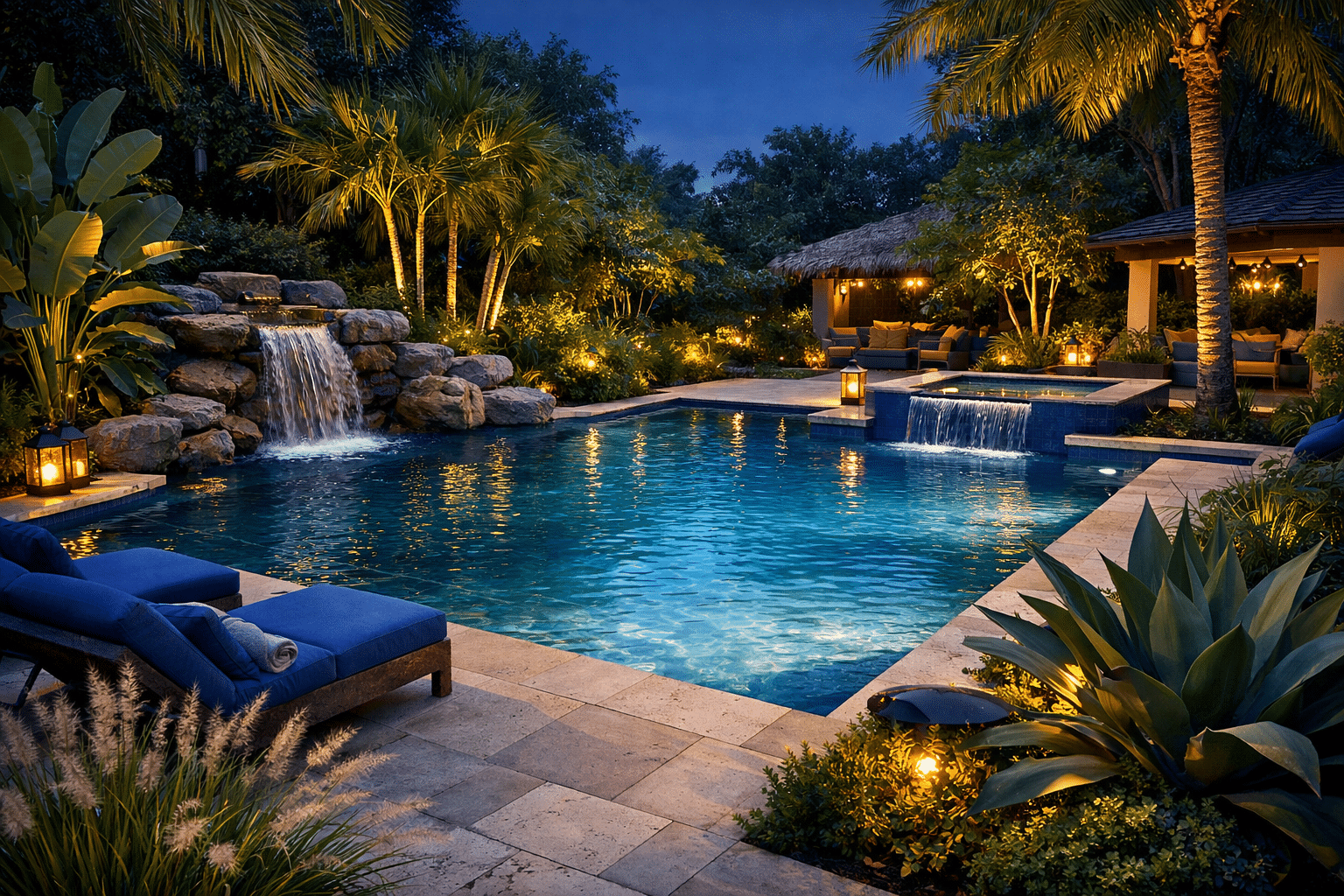
The concept of the backyard has evolved. It is no longer merely an expanse of grass but an extension of the home—a private sanctuary designed for restoration and connection.
In our climate, where the sun is a near-constant companion, a swimming pool naturally becomes the focal point of this outdoor living space.
However, its presence can feel stark, even disruptive, if not thoughtfully woven into the living tapestry of the garden. The true retreat emerges not from the water feature or the greenery alone, but from their deliberate and harmonious balance.
A successful backyard oasis is a study in coexistence. It considers root systems and evaporation, safety and aesthetics, cool stone underfoot and the dappled shade of a well-placed tree. It is a space that feels intentional, where every element serves a purpose, either for beauty, function, or, ideally, both.
The Green Frame: Selecting Foliage for Function and Form
The choice of plantings around a pool is perhaps the most critical design decision after the pool itself. The wrong species can transform a haven into a chore, with constant skimming and clogged filters. The goal is to create a lush, tropical buffer that enhances privacy and beauty while being inherently pool-friendly.
Prioritize plants with minimal leaf litter, non-invasive root systems that won’t seek out plumbing, and a tolerance for the splash of chlorinated or salt water. In our specific humidity, several species stand out for their reliability and visual appeal.
Certain palms, like the Queen Palm or European Fan Palm, offer height and drama with relatively clean habits.
Ornamental grasses, such as Muhly Grass or Fountain Grass, provide movement and soft texture at the pool’s edge without significant shedding.
For flowering color, Oleander is a hardy, drought-tolerant option that thrives in full sun, though its toxicity warrants consideration for households with very young children or pets. Bird of Paradise and Agave contribute strong architectural forms with resilient natures.
The principle is to think in layers: taller palms or Podocarpus for screening, mid-level shrubs like Ixora for bursts of color, and ground covers such as Sunshine Mimosa or Asiatic Jasmine to anchor the space and prevent erosion.
This layered approach builds depth and seclusion, making the pool area feel like a hidden grotto.
Table: Pool-Friendly Plant Selection for South Florida Climates
|
Plant Type |
Example Varieties |
Key Benefits |
Considerations |
|---|---|---|---|
|
Palms |
Queen Palm, European Fan Palm, Pygmy Date Palm |
Minimal leaf drop, architectural height, non-invasive roots. |
Some varieties may drop seeds or flowers; regular maintenance advised. |
|
Ornamental Grasses |
Muhly Grass, Fountain Grass, Lomandra |
Soft texture, movement, low litter, drought-tolerant. |
Can require division every few years to maintain vigor. |
|
Flowering Shrubs |
Oleander, Ixora, Plumbago |
Vibrant color, heat-loving, generally pest-resistant. |
Oleander is toxic; ensure plants are positioned to avoid constant chemical splash. |
|
Structural/Accent |
Bird of Paradise, Agave, Coontie Palm |
Bold foliage, sculptural interest, very low maintenance. |
Agave have sharp points; site carefully near walkways. |
The Foundation: Hardscape and the Imperative of Drainage
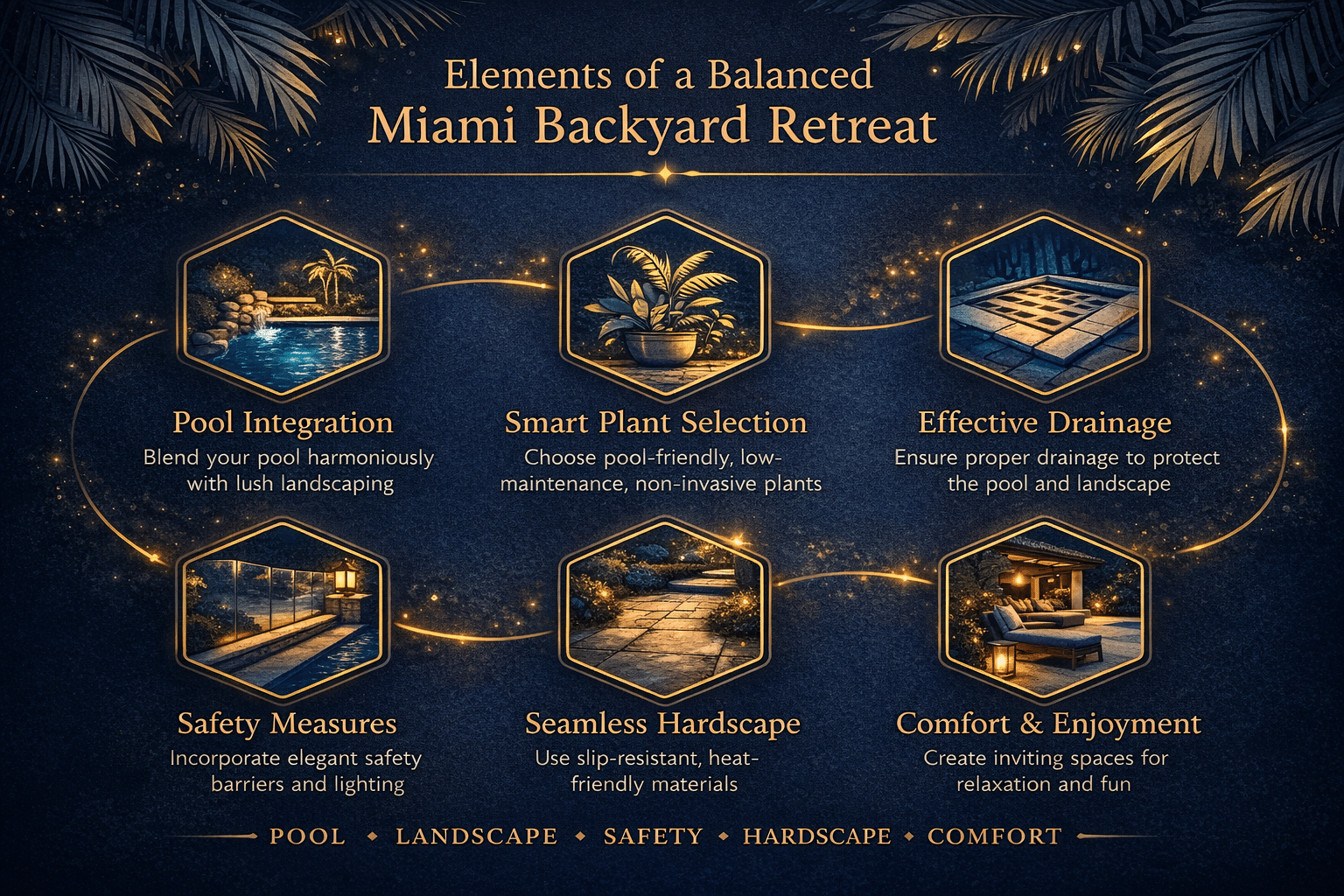
The surfaces that surround your pool—the hardscape—define its functionality and safety. The material must be chosen not only for its appearance but for its performance under the intense sun and in wet conditions.
Travertine, certain textured concretes, and composite decking are preferred for their ability to remain relatively cool to the touch and provide slip resistance, a non-negotiable feature for wet feet.
Beyond the immediate decking, consider the pathways that connect the pool to the house, garden, or an outdoor kitchen.
Consistency in material creates a cohesive flow, while a change in pattern or texture can subtly signal a transition from one “room” of the garden to another.
However, none of this beauty is sustainable without addressing a fundamental, unseen element: drainage. Proper drainage is the unsung hero of a lasting oasis.
It directs rainwater and pool splash-away from the pool shell to prevent undermining, protects planting beds from becoming waterlogged, and guides runoff away from your home’s foundation.
A landscape architect or qualified contractor can design a system—often involving French drains, channel drains, and careful grading—that protects your investment and prevents future headaches. It is a step where upfront precision saves considerable expense and effort later.
Safety as a Design Element
For families, especially with younger children, safety is the parameter within which all enjoyment exists. Modern safety solutions can be integrated with elegance.
A transparent, frameless glass barrier provides an unobstructed view while serving its vital purpose.
Alternatively, a code-compliant fence can be seamlessly disguised as a design feature when clothed with a fast-growing, dense hedge like Clusia or Simpson’s Stopper. This merges security with the lush, green aesthetic of the retreat.
Safety extends beyond barriers to the environment itself: secure storage for pool chemicals, adequate lighting for evening use, and clear, unobstructed sightlines from the home. These measures should feel inherent to the design, not an afterthought.
This thoughtful planning creates the stage for genuine relaxation. Yet, there is a dimension of safety that no fence or drain can provide. The profoundest safety, and the key to unlocking the full joy of a backyard oasis, resides in confidence and competence in the water.
A beautiful pool’s potential is only fully realized when everyone in the family possesses the skills to enjoy it safely and with assurance.
From Space to Place: The Heart of the Oasis
A pool surrounded by lush, thoughtful landscaping and built with precision is a magnificent asset. But it is the human element that gives it life. It becomes the true centerpiece of home life—the venue for play, for quiet morning swims, for gathering on a warm evening.
This transition from a beautiful space to a cherished place is rooted in comfort.
The peace of mind that comes from knowing your children are not just near the water, but at home in it, is immeasurable. It transforms supervision from a state of vigilance to one of shared participation. Investing in this competency is the final, most crucial layer in creating your retreat.
In Miami, where pool culture is intertwined with daily life, establishing a foundation of strong swimming skills is a natural part of creating a family home.
Professional instruction builds not just strokes, but water awareness and respect. Institutions like SwimRight Academy focus on this holistic approach, offering lessons for all ages that emphasize safety, skill, and confidence. Integrating this education into your family’s routine completes the vision of your backyard oasis.
It ensures the space you’ve so carefully designed is defined not by worry, but by laughter, activity, and the simple, profound pleasure of cool water on a warm day. The result is more than a landscape project; it’s a shift in how your family lives, centered around a hub of confident, enduring fun.
Consider the landscape, the hardscape, the drainage. Then, consider the most dynamic element of all: the people who will use it. Bringing all these elements into harmony is the art of creating a sanctuary that endures.