

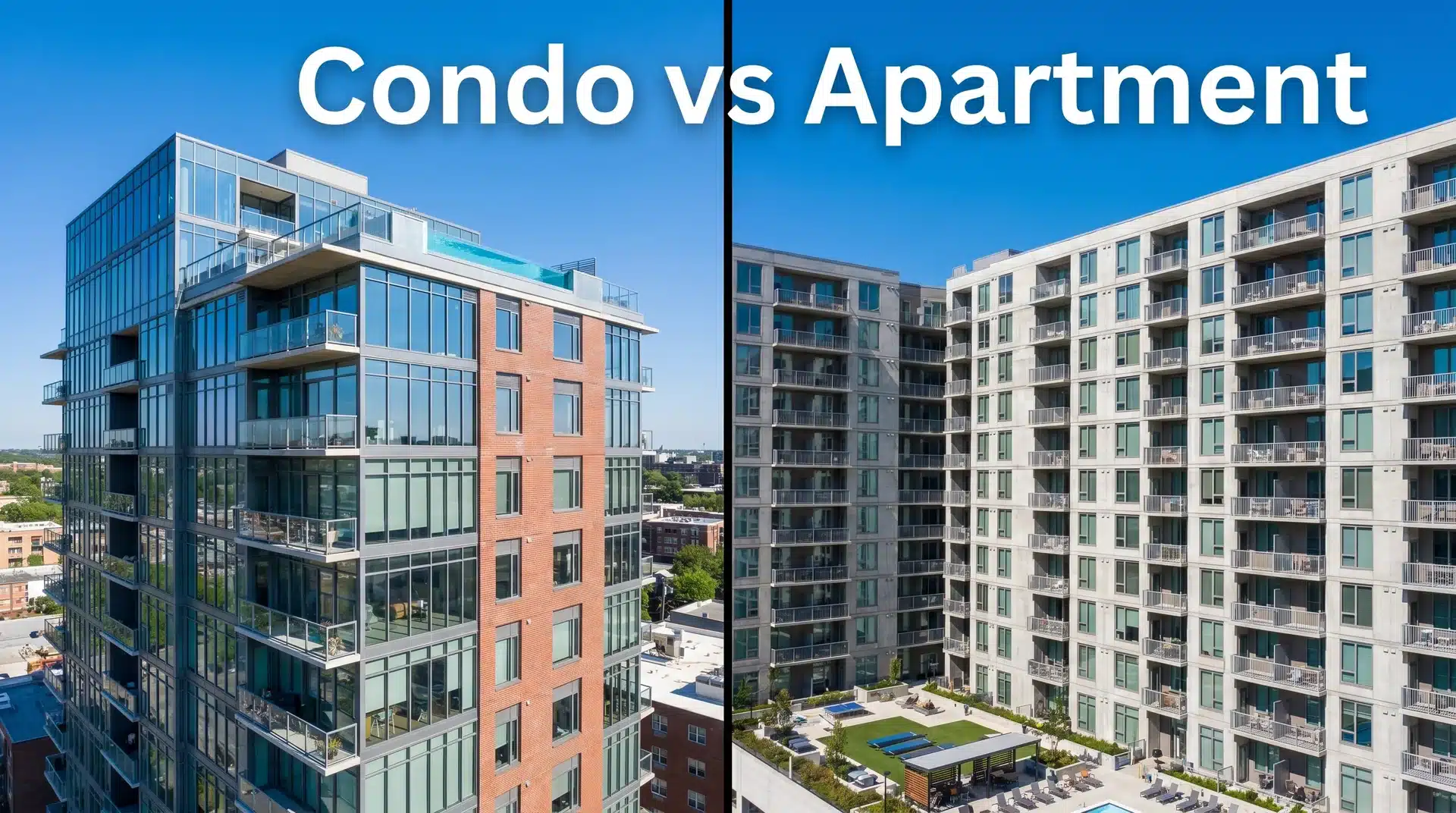
Condo or apartment? The question may sound simple, but the answer depends on whether you’re buying or renting, how long you plan to stay, the city you’re in, and your current financial situation.
The confusion isn’t a mistake on your part. The distinction is a legal and ownership one, not an architectural one. In some cases, you can rent a apartment and have no idea it is classified as a condominium.
This guide breaks it down clearly so you can make the right call for your budget, lifestyle, and timeline without second-guessing yourself later.
What Is a Condo?
A condominium, or condo, is a residential unit privately owned by an individual within a shared building or community. The owner holds legal title to the interior of the unit and shares ownership of common areas through a homeowners association (HOA).
When you buy a condo, you own your specific unit and a percentage stake in shared spaces like lobbies, gyms, pools, and hallways. The HOA manages those shared spaces using monthly fees collected from all unit owners.
Per the US Census Bureau 2024 American Community Survey, roughly 21.6 million households paid condo or HOA fees in 2024.
| Condo Quick Facts | Data |
|---|---|
| Total condos in the US | Over 7.4 million (ApartmentList) |
| Median condo sale price (early 2025) | $335,100 (National Association of Realtors) |
| Who manages common areas | HOA board, often elected unit owners |
| Governing document | CC&Rs (Covenants, Conditions, and Restrictions) |
| Most common states | New York, Florida, California, Arizona, Nevada |
| National median HOA fee (2024) | $135/month (US Census ACS 2024) |
What Is an Apartment?
An apartment is a rental unit within a building or complex owned entirely by a single landlord, investor, or property management company. Tenants lease the unit for a set term and do not own any part of the property.
You sign a lease, pay monthly rent, and have zero ownership stake. One company or landlord owns every unit in the building. All maintenance requests go to a property manager or leasing office, and the same rules apply to every resident in the building.
| Apartment Quick Facts | Data |
|---|---|
| Ownership model | Single landlord or management company owns entire building |
| Tenant equity | None |
| Maintenance responsibility | Landlord or property management company |
| Rule enforcement | On-site property manager |
| New units under construction (2023) | Over 1 million multifamily units (US housing data) |
| Geographic availability | Virtually every US city, suburb, and rural area |
| The Core Difference
A condo is owned by an individual, and an apartment is rented from a company or landlord who owns the entire building. That single fact drives every other difference. Who you write the check to, who fixes a broken pipe, what rules you follow, what it costs upfront, and what happens to your money over time. Everything traces back to ownership. |
Condo vs Apartment: 7 Key Differences
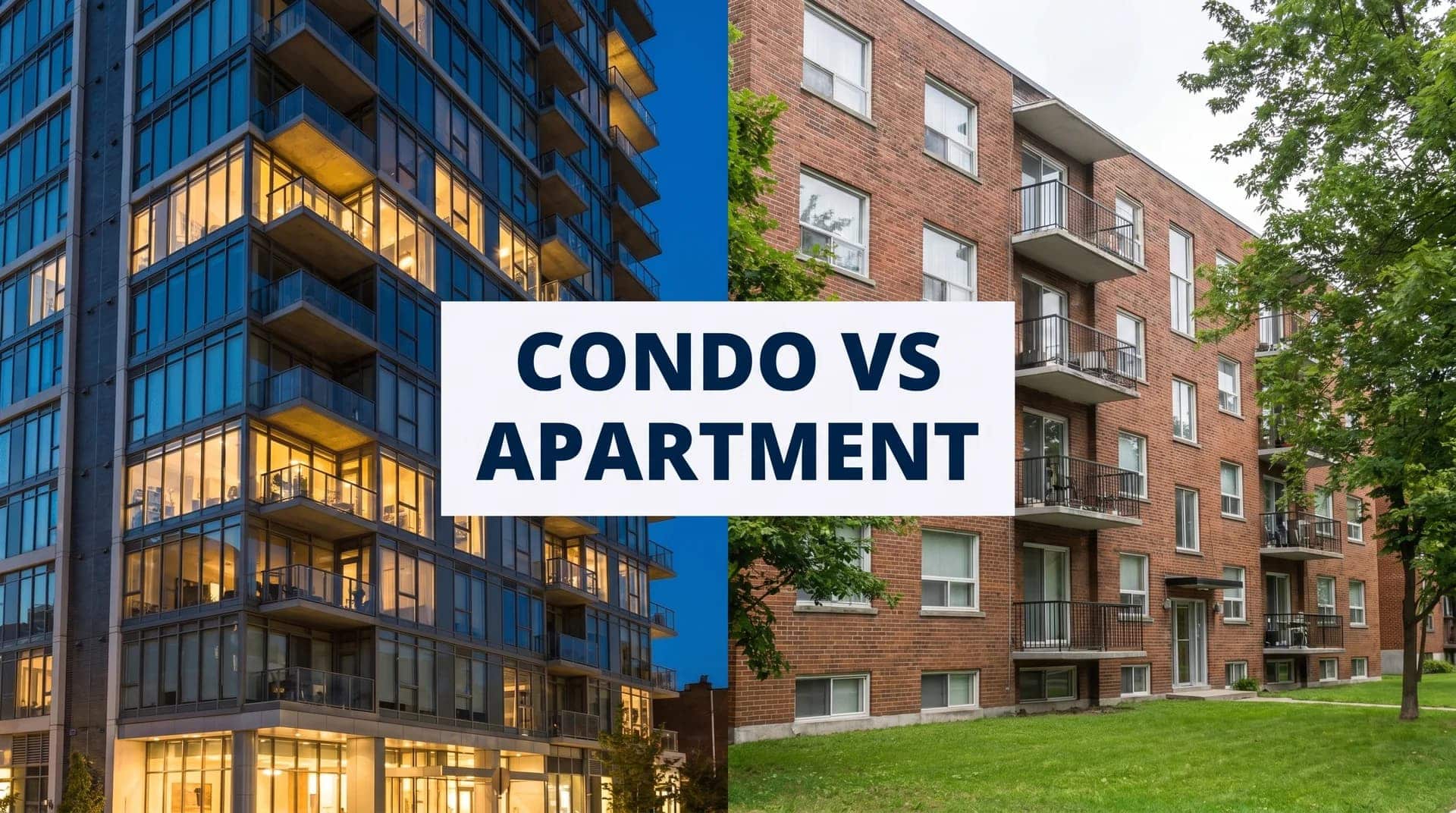
The two options look alike on the surface. Below the surface, they operate very differently across seven areas that affect your daily life and finances.
1. Ownership Structure
The legal ownership model separates condos and apartments at the foundation.
Condo: You buy the unit, hold the deed, and can sell, rent out, or live in it. You build equity with every mortgage payment.
Apartment: A company or investor owns all units in the building. You pay rent for the right to occupy the space. No deed, no equity, no ownership stake.
| Feature | Condo | Apartment |
|---|---|---|
| Who owns the unit? | Individual buyer | Landlord or management company |
| Can tenants buy the unit? | Yes | No |
| Do residents build equity? | Yes | No |
| Legal title held by? | The individual owner | The building’s owner or LLC |
2. Who You Pay and Who You Deal With
Where your rent goes and who answers your calls are very different depending on which type of housing you choose.
Condo: You deal directly with the individual condo owner. Some are responsive and personally invested. Others manage their unit as a side income source and may take longer to act on requests.
Apartment: You deal with a property management company or on-site leasing office. The experience is more corporate but typically more consistent. One point of contact handles leasing questions, maintenance, and complaints.
Say your kitchen faucet starts leaking at 10 pm. In an apartment, you submit a request through an app or portal, and a maintenance team member is typically assigned within 24 hours because the management company has vendor contracts and on-call staff.
In a condo, you call the individual owner. If they are traveling or juggling other responsibilities, your timeline becomes their timeline.
3. Cost Breakdown: Upfront, Monthly, and the Costs Nobody Mentions
The sticker price is rarely the full picture. Both options carry costs that are easy to overlook.
Condo (buying):
- Down payment (3% to 20% of purchase price)
- Closing costs (2% to 5% of the loan amount)
- Monthly mortgage payment
- HOA or condo association fees (national median: $135/month in 2024; can exceed $1,000 to $2,000/month in urban high-rises)
- Property taxes (owner’s responsibility)
- Homeowners insurance (HO-6 policy for condo interiors)
- Interior maintenance costs
Apartment (renting):
- Security deposit (typically one month’s rent)
- First month’s rent, sometimes last month’s rent as well
- Monthly rent
- Renters insurance (often required)
- Utilities (may or may not be included, varies by building)
One figure worth knowing: in some US cities in 2025, the total monthly cost of owning a condo (mortgage plus HOA plus taxes plus insurance) runs 40% to 50% higher than renting a comparable apartment. That gap varies by city, but it is real and worth calculating before committing.
4. Maintenance Responsibilities
Who fixes what when something breaks is one of the most practical differences between the two.
Condo: Interior maintenance is 100% the owner’s responsibility. If the dishwasher breaks, you call a vendor and pay the bill. Common area maintenance (roof, elevator, hallways, pool, landscaping) is the HOA’s responsibility, funded by monthly fees.
Apartment: The property management company handles maintenance for both inside and outside your unit. You submit a request, they send someone. You may not even be permitted to attempt small DIY repairs because management holds standards consistent across all units.
5. Rules, Restrictions, and HOA Governance
Both types of housing come with rules. The source and structure of those rules are quite different.
Condo: Governed by CC&Rs (Covenants, Conditions, and Restrictions), which cover noise limits, pet policies, renovation permissions, parking rules, and guest policies. These rules are set and enforced by an HOA board made up of other unit owners.
Apartment: Rules come from the property management company and apply uniformly to all residents. No board of residents, no elections, no CC&R document to review. More predictable but also less flexible.
If you rent a condo, you follow two sets of rules: the lease your landlord wrote and the HOA’s CC&Rs. Most renters never ask to see the CC&Rs. That document can restrict your pets, limit your guests, dictate when you can move furniture in and out, and more.
6. Customization and Interior Freedom
How much you can personalize your space depends on which type of housing you are in and whether you own or rent.
Condo owner: You can repaint, renovate, replace appliances, and reconfigure within your unit. Some HOA rules restrict exterior modifications or require approval for major renovations, but the interior is generally yours to work with.
Apartment renter: Most landlords restrict painting, hardware changes, or any structural modification. You return the unit to its original condition when you leave or risk losing your deposit.
Condo renter: Somewhere between the two. Some condo owners are more flexible than property management companies. Others are not. Ask specifically what is and is not allowed before you sign.
7. Amenities: What You Actually Get
Both condos and apartments can offer gyms, pools, parking, and community spaces. Amenities alone are not a reliable way to tell them apart anymore.
Condo: Amenities are maintained through HOA fees. If the HOA’s reserve fund is low, fees rise or amenities get deferred. Condo interiors tend to feel more personalized since each owner chose their own finishes. Granite countertops, hardwood floors, and updated appliances appear more often in individually owned units.
Apartment: Amenities are maintained by the management company out of operating costs. Interiors tend to be more standardized across all units since one entity furnished and finished the entire building.
What Happens When You Rent a Condo Instead of Buy It?

Condo owners can legally lease their unit to tenants if the HOA permits it, which means you can rent a condo just like you would rent an apartment.
The interior may look nearly identical, but the experience differs: you deal with an individual landlord (not a management company), you must follow both the owner’s lease terms and the HOA’s CC&Rs, maintenance response times are less predictable, and if the owner decides to sell, you may need to find a new place depending on your state’s tenant protections.
Always request a copy of the CC&Rs before signing a condo lease, confirm the pet policy with both the owner and the HOA in writing, and ask the owner directly about their long-term plans for the unit.
Condo vs Apartment: Pros and Cons at a Glance
There is no universal right answer here. The better choice depends on where you are financially, how long you plan to stay, and what you want your daily life to look like.
Pros of Buying a Condo
- You build equity over time as the property value grows and you pay down the mortgage
- You can customize and renovate your interior space
- A fixed-rate mortgage gives you a stable monthly payment
- Tax advantages include the mortgage interest deduction and potential capital gains exclusion on sale
- Long-term financial stability that renting does not provide
Cons of Buying a Condo
- High upfront costs: down payment, closing costs, and HOA fees start immediately
- Interior maintenance costs are entirely your responsibility
- HOA rules can be restrictive and fees can increase year to year
- Selling a condo takes far longer than ending a lease
- In many cities right now, the total monthly ownership cost exceeds comparable rents by a wide margin
Pros of Renting an Apartment
- Lower upfront costs compared to buying
- Maintenance is handled by the landlord or management company
- Easier to move when the lease ends
- Monthly expenses are more predictable
- No HOA governance to deal with
Cons of Renting an Apartment
- You build no equity
- Rent can increase at lease renewal
- Less freedom to personalize your space
- No tax benefits tied to housing
- Unit interiors are often more standardized and less upgraded
Financial Angle: Building Equity vs Staying Flexible
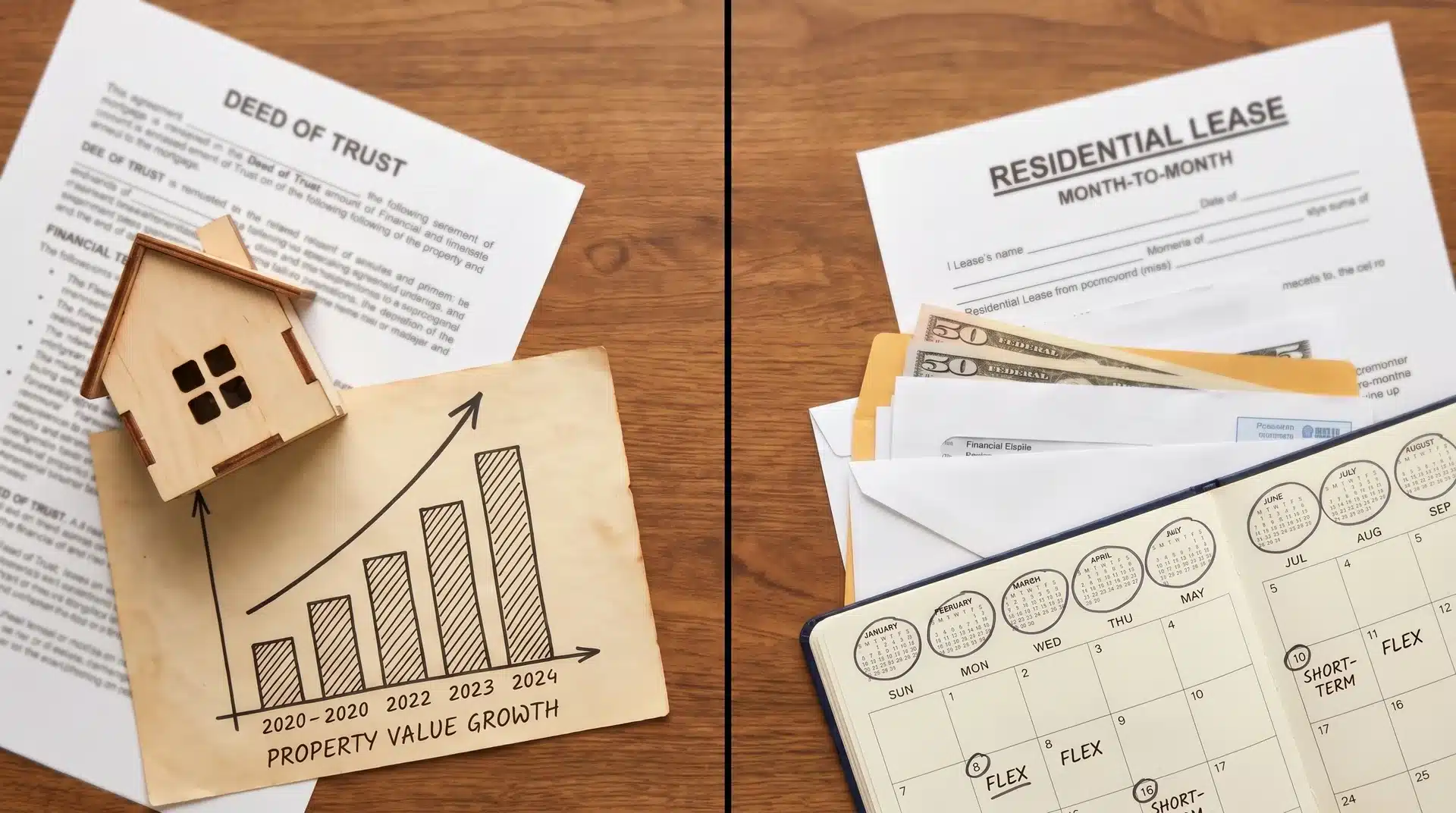
The financial picture between condos and apartments goes well beyond the monthly payment. Both carry costs that show up in different places and at different times.
| Cost Category | Condo (Buying) | Apartment (Renting) |
|---|---|---|
| Upfront cost | Down payment + closing costs (5% to 25% of purchase price) | Security deposit + first/last month’s rent |
| Monthly housing cost | Mortgage + HOA fees + property taxes + insurance | Monthly rent (utilities may or may not be included) |
| Maintenance | Owner’s responsibility for interior | Landlord’s responsibility |
| Equity | Builds over time | None |
| HOA or condo fees | Yes (median $135/month in 2024, up to $2,000/month in some cities) | No |
| HOA fee tax deductibility | Not deductible for primary residence (IRS 2025) | Not applicable |
| HOA fee deductibility (rental property) | Yes, deductible on Schedule E | Not applicable |
| Tax benefits | Mortgage interest deduction, property tax deduction (SALT cap applies) | None |
| Capital gains exclusion on sale | Yes ($250K single / $500K married if primary residence for 2 of last 5 years) | Not applicable |
Condo vs Apartment by Life Stage
Choosing between a condo and an apartment depends on where you are in life. If you’re early in your career or new to a city, an apartment offers flexibility and lower upfront costs.
If you’re settled and planning to stay long-term, a condo can make sense financially, as you build equity over time.
Condos are often a practical entry point for first-time homebuyers due to their lower median price compared to single-family homes.
1However, if you have pets, confirm the pet policy with both the owner and HOA before signing a lease, as one approval doesn’t override the other. A condo can also be a profitable asset if you plan to rent it out later.
Final Verdict
Ask yourself three questions before you commit.
How long are you staying? Under two years, go with an apartment. Five or more years and financially stable, a condo starts to make real sense.
Have you run the full monthly number? Mortgage plus HOA plus taxes plus insurance. Compare that total to what a comparable apartment rents for nearby. The gap often surprises people.
What do you want from your living situation? Ownership and stability point toward a condo. Flexibility and lower upfront costs point toward an apartment. Both are the right answer for different situations.
Frequently Asked Questions
How Is an Apartment Different from a Condo?
A condo is individually owned, while an apartment is rented from a landlord or property management company that owns the entire building.
Is It Smarter to Get a Condo or an Apartment?
It depends on your timeline. A condo builds equity over time, while an apartment offers flexibility and lower upfront costs with no ownership commitment.
Can a Condo Be Called an Apartment?
Not in real estate terms. A condo is individually owned; an apartment is a rental unit in a building owned by one entity. They can look identical, but the legal classification is different.
Can I Permanently Live in a Condo?
Yes. Condos are built for long-term, primary residence. There is no time limit as long as you follow the HOA rules and meet your mortgage obligations.