


Walk into a grocery store, rent a desk at a co-working space, or pass a warehouse on the highway, you’re looking at commercial real estate.
Yet for something this common, it’s surprisingly misunderstood.
This guide covers what commercial real estate actually is, the main property types, how it works as an investment, and what sets it apart from owning a home.
What Is Commercial Real Estate?
Commercial real estate (CRE) is property used for business purposes or to generate income.
This includes office buildings, retail stores, warehouses, hotels, and apartment buildings with five or more units.
Unlike a single-family home, a commercial property is typically leased to businesses or groups of tenants. The U.S. CRE market is worth over $20 trillion, making it one of the largest asset classes in the country.
Types of Commercial Real Estate

Commercial real estate covers a wide range of property types. Each one serves a different purpose and carries its own risk and return profile. Here’s a look at the eight main categories.
1. Office Properties
Office properties are buildings where companies run their daily operations. They range from small suburban office parks to large downtown high-rises.
Sub-types include general office space, medical offices, and co-working facilities. As of 2025, remote work trends have pushed vacancy rates higher in many U.S. office markets, which has made this category more complex for investors.
2. Retail Properties
Retail properties house businesses that sell goods or services directly to consumers. Think clothing stores, coffee shops, and grocery chains. Sub-types include strip centers, power centers, and enclosed shopping malls.
According to the National Association of Realtors (NAR), retail posted the lowest vacancy rate among commercial property types at 4.1% in Q1 2024. Investors favor retail for its long leases and steady consumer foot traffic.
3. Industrial Properties
Industrial properties are used for manufacturing, storage, and distribution. Warehouses, fulfillment centers, and flex spaces all fall here.
These properties tend to be very large, often between 50,000 and 1,000,000 square feet. The growth of e-commerce has made industrial one of the strongest-performing CRE sectors in recent years, with demand for last-mile delivery centers rising sharply.
4. Multifamily Properties
Multifamily properties are apartment buildings with five or more units. They are considered commercial real estate because of their size and the way they are financed and managed.
Sub-types include garden apartments, high-rise buildings, senior housing, and student housing. This property type tends to stay stable because people always need somewhere to live, which makes it popular with both new and experienced investors.
5. Hospitality Properties
Hospitality properties are hotels and short-term lodging. There are three main types: full-service hotels (like Marriott or Ritz-Carlton), limited-service hotels near airports or business districts, and extended-stay properties.
Revenue in this category depends heavily on tourism levels, business travel, and broader economic conditions. Hospitality carries more operational complexity than most other CRE types.
6. Special-Purpose Properties
Special-purpose properties are designed for one specific use, schools, churches, theaters, car washes, self-storage facilities. They typically cannot be repurposed easily, which adds risk.
That said, when the underlying business is strong, these properties can generate steady returns for investors who know the niche well.
7. Mixed-Use Properties
Mixed-use properties combine two or more property types in a single building or development. A common example is retail space on the ground floor with apartments above.
These are growing in popularity in urban areas as cities push for walkable, live-work-play neighborhoods. For investors, mixed-use properties offer income from more than one source within a single asset.
8. Vacant Land
Vacant land is raw, undeveloped property with no structures. Investors buy it to hold for future development or to sell when land values rise.
This category requires a solid understanding of local zoning laws and market demand. It carries more uncertainty than income-producing properties since there is no rental income while you hold the land.
Commercial Real Estate vs. Residential Real Estate
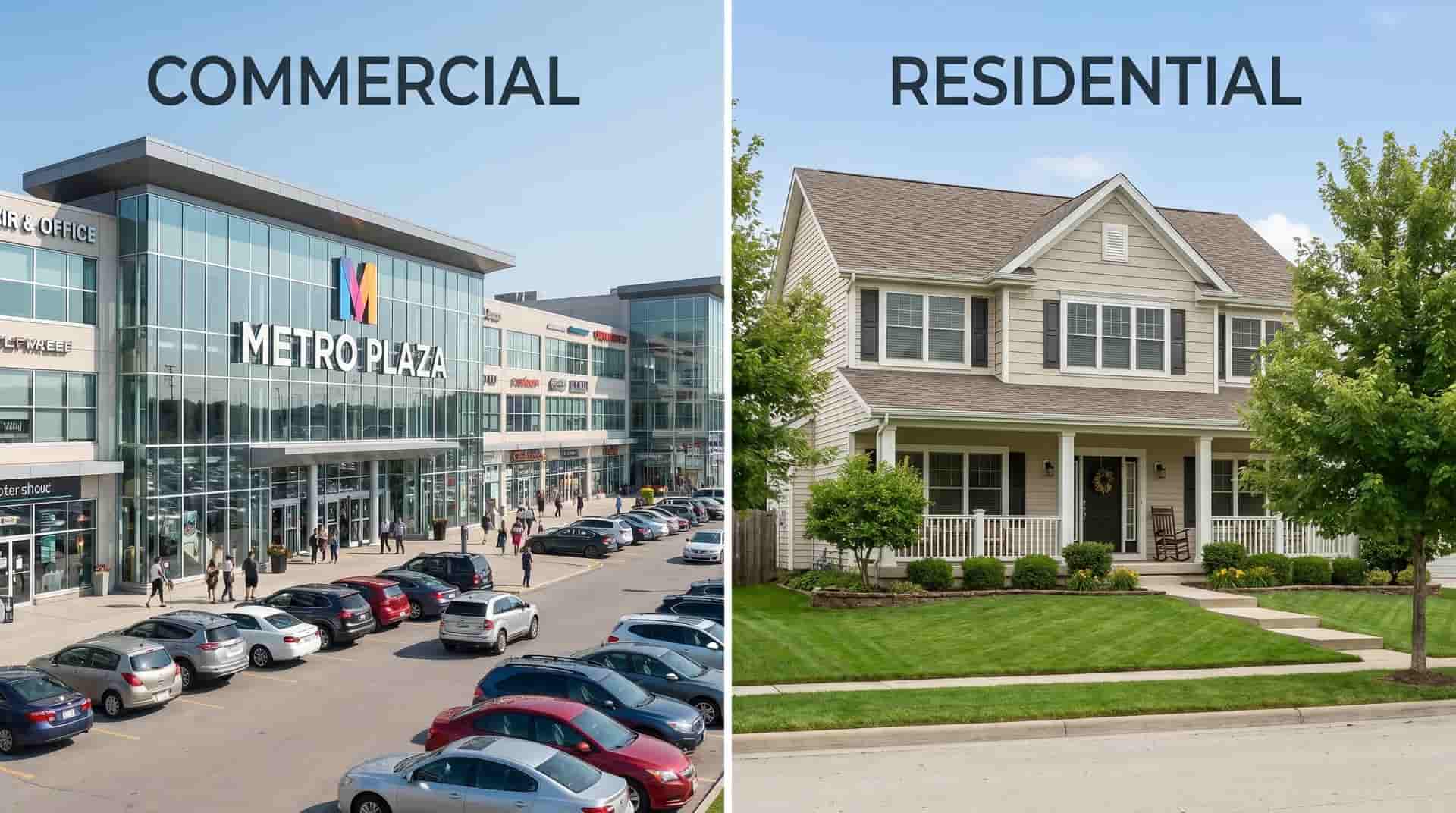
Commercial and residential real estate both involve owning property and collecting rent, but they work very differently in practice. Here’s a direct comparison.
| Feature | Commercial Real Estate | Residential Real Estate |
|---|---|---|
| Primary use | Business or income-generating | Personal living |
| Tenants | Businesses | Individuals and families |
| Lease length | 3 to 20+ years | Typically 1 year |
| Down payment | 20% or more | Can be as low as 3-5% |
| Property valuation | Based on income (cap rate, NOI) | Based on comparable sales |
| Management complexity | High | Moderate |
| Income potential | Higher | Moderate |
| Entry cost | High | Lower |
Commercial real estate values are driven by income and cap rates rather than neighborhood feel or curb appeal. This is a meaningful shift in thinking. A vacant commercial building loses value fast, while a well-leased building with strong tenants holds or grows value over time.
For beginners, residential real estate is often a lower-risk starting point, but once you understand the numbers, commercial properties offer a different level of income potential.
How Commercial Real Estate Is Classified (Class A, B, C)
Commercial properties are grouped into three classes based on their condition, location, and tenant quality. This classification affects financing options, cap rates, and the kind of tenants you can attract.
Class A properties are newer buildings in prime locations with high-end finishes and strong tenants. They command premium rents and carry the lowest risk. These are typically institutional-grade assets owned by large funds or REITs.
Class B properties are older but still functional. They are in solid locations and offer moderate rents. Many investors target Class B buildings because they can buy at a lower price, make improvements, and raise rents over time. This strategy is often called “value-add investing.”
Class C properties are the most dated. They need significant work, carry higher vacancy risk, and attract lower rents. The price is usually lower, but so is the predictability of income. These properties are best suited for experienced investors with the capital and expertise to manage renovations and tenant challenges.
How Commercial Real Estate Leases Work

One of the biggest differences between commercial and residential real estate is how leases are structured. In commercial real estate, the type of lease determines how costs are split between the landlord and the tenant. This directly affects how much money you make as an investor.
1. Gross Lease
Under a gross lease, the tenant pays a flat monthly rent. The landlord covers property taxes, insurance, and maintenance. This is simpler for tenants but offers the owner lower profit margins since all operating costs come out of the landlord’s pocket.
2. Single Net Lease (N)
The tenant pays base rent plus property taxes. The landlord still handles insurance and maintenance costs. This shifts one expense to the tenant but leaves the majority of operating responsibilities with the owner.
3. Double Net Lease (NN)
The tenant covers rent, property taxes, and building insurance. The landlord handles ongoing maintenance and repairs. This is a more balanced arrangement and is common in mid-size commercial spaces.
4. Triple Net Lease (NNN)
Under a triple net lease, the tenant pays rent, taxes, insurance, and all maintenance costs. This is the most favorable structure for property owners because the income is predictable and management demands are low.
Triple net leases are common in retail and industrial properties and are typically long-term agreements, often 10 to 20 years.
What Is a Cap Rate in Commercial Real Estate?
A cap rate, or capitalization rate, is the ratio of a property’s net operating income (NOI) to its purchase price. It tells you the annual return you can expect if you bought the property outright in cash.
The formula is straightforward: divide the NOI by the purchase price. For example, if a building has an NOI of $80,000 and costs $1,000,000, the cap rate is 8%.
According to PNC Insights, most commercial real estate investors look for cap rates in the 4% to 10% range, depending on risk tolerance and property type.
Lower cap rates indicate lower risk; higher cap rates suggest more uncertainty in the investment.
How to Invest in Commercial Real Estate

There are several ways to get into commercial real estate investing. The right choice depends on your budget, experience level, and how hands-on you want to be.
1. Direct Investment
You buy a commercial property outright from a seller. From there, you find tenants, manage lease agreements, and maintain the property or hire someone to do it.
This approach offers the most control but requires significant capital, market knowledge, and a reliable team, including a real estate broker, attorney, and accountant. It works best for experienced investors.
2. Real Estate Investment Trusts (REITs)
REITs are companies that own and manage large portfolios of commercial properties. Shares trade on the stock market, so you can buy in with relatively little capital and no hands-on management required.
This is one of the most accessible ways for beginners to get exposure to commercial real estate.
3. Real Estate Crowdfunding
Crowdfunding platforms let investors pool money online to fund commercial deals. Some platforms require accredited investor status, while others are open to all.
Minimum investments are typically lower than direct ownership, making this a reasonable option for those who want to invest in larger deals without buying a property themselves.
4. Private Equity Partnerships
In a private equity setup, investors partner with a professional real estate firm that manages the deal. Historically, minimums have been $250,000 or more.
The investor takes a passive role while the firm handles sourcing, management, and eventual sale. Returns can be strong, but these deals are less liquid than REITs and require trust in the operating partner.
Benefits and Risks of Investing in Commercial Real Estate
Before putting money into commercial real estate, it helps to see both sides of the equation.
| Benefits | Risks |
|---|---|
| Long leases (3-20+ years) provide steady cash flow | Economic downturns can hurt occupancy rates and values |
| Higher income potential compared to residential | High upfront capital needed for down payment and costs |
| Low correlation with stocks and bonds for diversification | Commercial loans have stricter criteria and shorter terms |
| Property values tend to grow over time | Losing a major tenant can sharply cut income |
| Tax benefits including depreciation and 1031 exchanges | Management is more complex and time-consuming |
| Rental income often keeps pace with inflation | Office sector faces structural challenges from remote work |
Is Commercial Real Estate Right for You?
Commercial real estate works well for investors who have higher capital to start, a longer investment horizon, and comfort with complex lease structures and financing.
Beginners are often better served starting with residential real estate or REITs before buying a commercial property directly.
A licensed commercial real estate broker or financial advisor can help you assess whether the risk and return profile of CRE fits your specific situation and goals.
Closing Remarks
Commercial real estate is property used for business or income-generating purposes. It covers everything from office buildings and retail centers to warehouses and apartment complexes.
Understanding the property types, lease structures, building classes, and how cap rates work gives you a real foundation for evaluating CRE as an investment.
For some investors, it becomes a reliable source of long-term income and tax benefits. For others, starting with a REIT or crowdfunding platform first makes more sense.
Either way, the more you understand how commercial real estate works, the better your decisions will be.
Still have questions about real estate? Check out the rest of our Real Estate guides. we cover everything from first-time buying to long-term investment.
Frequently Asked Questions
What Is the Difference Between Commercial and Residential Real Estate?
Commercial real estate is used for business or income purposes, while residential real estate is used for living.
Which One Is Better, Commercial or Residential?
Commercial real estate offers higher income potential; residential is easier to start with and requires less capital.
What Is the Minimum Deposit for a Commercial Property?
Most commercial property purchases require a down payment of at least 20% of the purchase price.
How Much Loan Do We Get for a Commercial Property?
Lenders typically finance 65% to 80% of the property’s value, depending on the deal and borrower qualifications.