

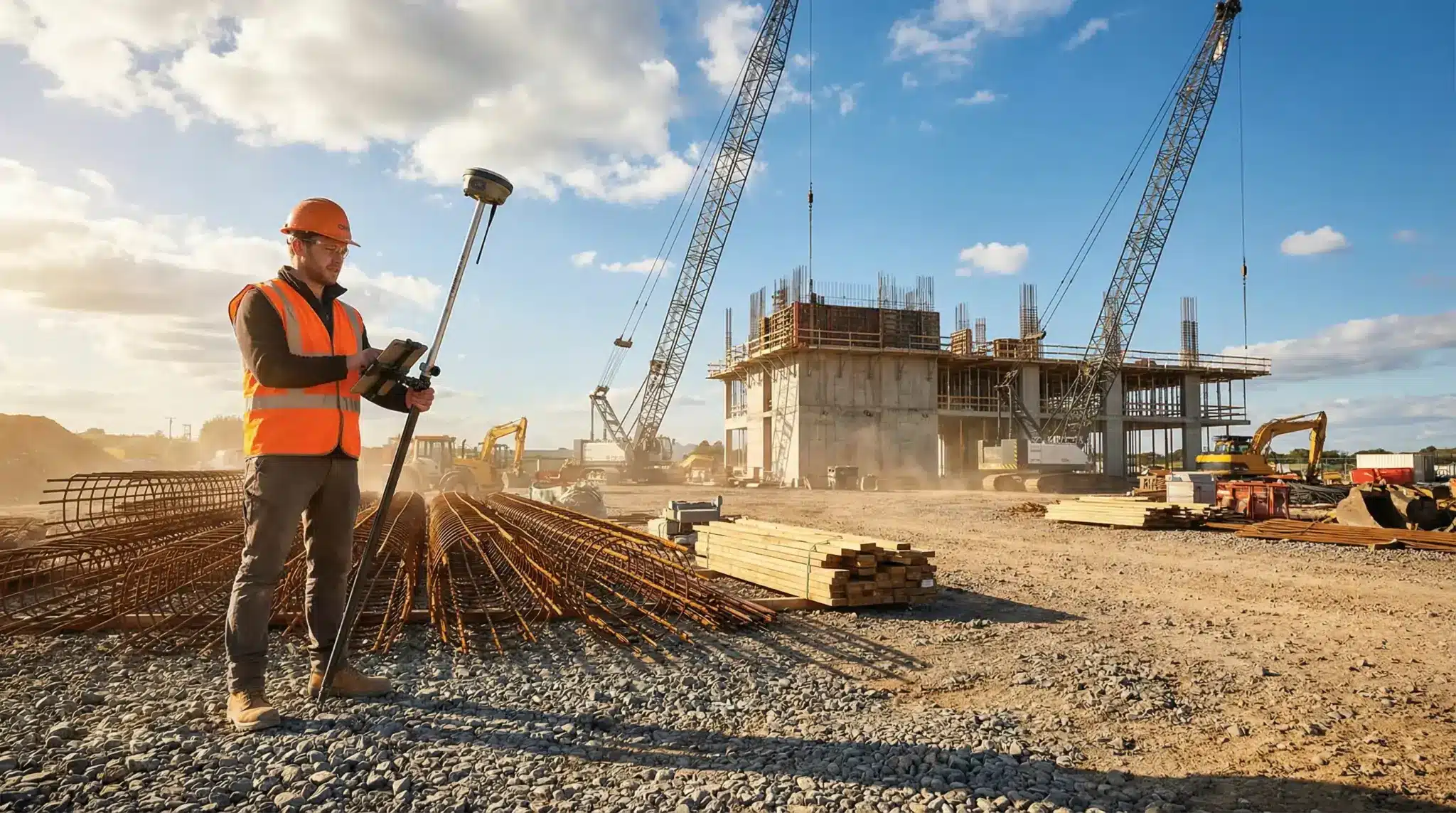
A survey point looks calm on a screen. On site, it rarely is. One moment you’re standing on crushed stone beside rebar cages, the next you’re squeezed between a concrete pump and a delivery truck, trying to keep your antenna steady while someone asks if the sleeve can be shifted «just a bit». The point is still the point. The environment has other plans.
That’s where the pairing often summarized as gnss imu earns attention. It’s not a buzzword for «more accurate». It’s a practical way to keep measurements coherent when satellite signals behave like a polite guest in open sky and a chaotic roommate near steel, glass, cranes, and tree cover.
In practice, that “motion context” often shows up as reliable tilt compensation: you can keep working when perfectly vertical pole handling is unrealistic—tight corridors, curb edges, rebar clutter—and still collect repeatable points instead of gambling on a single “good-looking” fix.
>Satellite positioning is exceptionally capable, but it depends on radio signals arriving cleanly and predictably. Construction and urban sites specialize in the opposite. The most common troublemakers are unglamorous: The result isn’t always dramatic. Often it’s worse: the solution looks plausible. Plausible is how rework is born. >An inertial unit measures rotation and acceleration. That sounds like it should give you position on its own. It doesn’t—at least not for long. Left alone, inertial navigation drifts. It will confidently walk away from the truth if you let it. So why use it? Because in field measurement you’re not trying to replace satellites with inertia. You’re trying to add missing context: Inertia is good at short-term motion truth. GNSS is good at long-term position truth. Combining them is less about wizardry and more about keeping the story consistent between chapters. “Sensor fusion” can sound abstract. Here’s the field translation: the system is constantly deciding how much to trust each stream of information. When signals are clean, GNSS anchors the position. When signals get noisy, inertial data helps prevent the position from doing things a real object couldn’t do—like sliding sideways while the pole stayed still, or “teleporting” across a curb because reflections briefly tricked the receiver. The goal is not perfection. The goal is fewer moments where you have to stop and ask: «Is this real, or is this one of those days?» In projects that move fast, reliability is often the real bottleneck. You can tolerate a small, known uncertainty better than a large, hidden one. Reliability shows up as: The quiet benefit is psychological: when the instrument behaves consistently, crews are more willing to do the boring checks that protect them later. ear reflective surfaces, GNSS can be tricked into stable-looking errors. Inertial constraints can reduce sudden leaps and keep movement realistic. That doesn’t mean «problem solved». It means the system is less eager to accept a lie that arrives with confidence. Canopy doesn’t always kill positioning, but it often makes it intermittent. In those moments, inertial bridging can keep your trajectory coherent while the satellite solution recovers. That matters when you’re collecting lots of points and can’t afford long occupations at each one. Many modern workflows are “walk and capture”: curb lines, signs, utility features, site objects that don’t justify a full setup each time. Motion-aware positioning can make those collections look like a human path rather than a series of nervous corrections. It also helps when you pause briefly at a feature: the system understands whether you actually stopped. If you’re moving on a platform—cart, vehicle, boat, or simply navigating tight spaces—knowing attitude and short-term motion can improve stability. The measurement stream becomes less sensitive to tiny bumps that would otherwise show up as positional “fidgets.” Inertial support is not a license to stop thinking. Common failure modes still exist, just with different clothes: The biggest trap is emotional: because the output looks calmer, people trust it more. Calm is not proof. You don’t need a research lab to sanity-check motion-assisted positioning. You need habits that take minutes, not hours: These checks aren’t glamorous. They’re the difference between «we measured it» and «we can defend it». If your work is mostly open sky, static points, generous tolerances, and time for careful occupations, motion support may feel like a convenience. If your work is dense sites, frequent obstructions, lots of points collected quickly, or high-consequence layout where one wrong sleeve becomes a scheduled argument, inertial context shifts from convenience to risk control. It won’t make the site simple. It can make your measurements less fragile under pressure. Field measurement is not performed in a vacuum; it’s performed in a living environment that resists clean signals and clean schedules. Pairing positioning with motion sensing doesn’t promise miracles. It offers something more useful: a steadier, more auditable way to keep the story of your data consistent when the site tries to rewrite it.
Fusion, in Plain Field Language
Reliability Is Not the Same as Accuracy
Where Motion Support Helps Most
1) Steel, Glass, and the “Mirror Site” Problem
2) Under Trees and Along Edges
3) Walking As-Built and Asset Mapping
4) Vehicle- or Pole-Mounted Work in Dynamic Conditions
What It Will Not Save You From
Field QA That Fits in a Busy Day
When Is It Worth It?
Closing Thought