

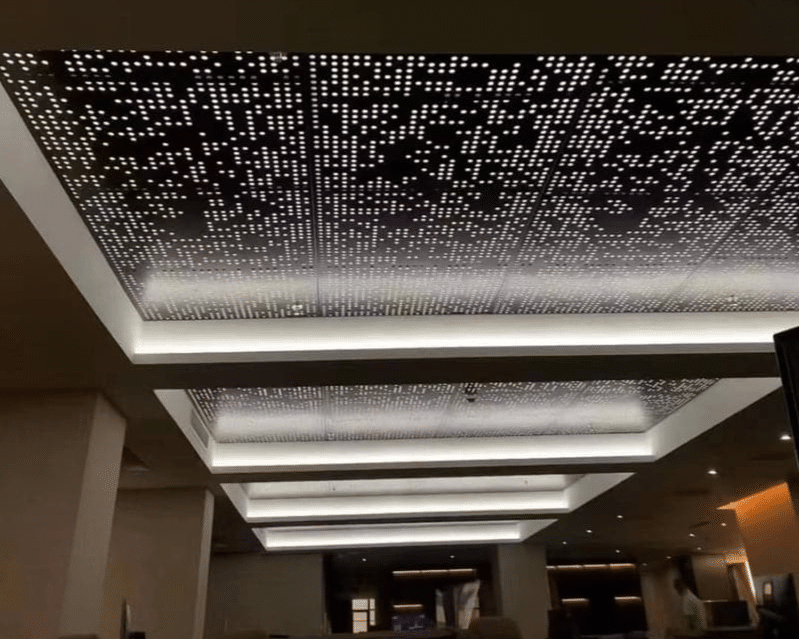
The ceiling is often an overlooked element in architectural design, yet it plays a crucial role in shaping the acoustic environment of any space. Quality ceiling design goes beyond mere aesthetics—it fundamentally transforms how sound behaves within a room, affecting everything from speech intelligibility to overall occupant comfort.
For architects striving to create spaces that perform as beautifully as they look, the ceiling represents a critical opportunity to achieve both functional excellence and visual impact.
Today’s innovative ceiling solutions offer architects unprecedented flexibility in addressing acoustic challenges while maintaining design integrity. Perforated metal panels, acoustic tiles, and custom fabricated systems provide powerful tools for controlling reverberation, reducing noise transfer, and enhancing sound clarity.
However, navigating the vast array of available options can be overwhelming, particularly when projects demand solutions that satisfy stringent acoustic requirements without compromising architectural vision.
This article serves as a practical guide for architects seeking to integrate high-performance ceiling systems into their projects.
We’ll explore how strategic ceiling design can elevate your acoustic strategy, examine the specific advantages of perforated metal ceiling panels, and provide actionable insights for selecting and implementing ceiling solutions that deliver both technical performance and distinctive style.
Understanding Perforated Metal Ceiling Panels
Perforated metal ceiling panels represent a sophisticated fusion of engineering precision and architectural expression. These panels feature carefully patterned perforations—holes punched or drilled through metal substrates—that create pathways for sound waves to pass through the surface and interact with acoustic backing materials.
The perforations transform what would otherwise be a sound-reflective metal surface into an effective acoustic absorber, allowing architects to harness the inherent strength and visual appeal of metal while achieving superior acoustic performance.
The acoustic effectiveness of perforated metal panels stems from their ability to reduce reverberation time and control sound reflection patterns.
When sound waves encounter a perforated panel backed by acoustic insulation, a portion of the sound energy penetrates through the perforations and becomes trapped within the absorptive material behind.
This process significantly reduces the amount of sound that bounces back into the space, creating environments where speech remains clear and background noise doesn’t accumulate into an overwhelming din. In conference rooms, the result is improved speech intelligibility during presentations. In open-plan offices, these panels help create acoustic zones that prevent conversations from traveling excessively across the workspace.
Beyond acoustic function, perforated metal panels deliver remarkable durability that translates into long-term value. Unlike fabric-wrapped acoustic panels that can stain, sag, or deteriorate over time, metal panels resist moisture, maintain their structural integrity under varying humidity conditions, and withstand the rigors of high-traffic environments.
The metal substrate won’t support mold growth, making these panels particularly valuable in healthcare facilities, educational institutions, and hospitality venues where hygiene standards are paramount. Maintenance requirements remain minimal—routine cleaning typically requires nothing more than occasional wiping with standard cleaning solutions.
The aesthetic versatility of perforated metal panels empowers architects to create distinctive ceiling planes that serve as design features rather than mere functional necessities.
Perforation patterns range from subtle micro-perforations that create refined, nearly seamless surfaces to bold geometric patterns that introduce visual rhythm and texture. The metal substrate accepts various finishes—powder coating in custom colors, anodizing for aluminum panels, or natural patinas that evolve over time.
This flexibility allows ceiling design to reinforce broader design narratives, whether the project calls for industrial authenticity, contemporary minimalism, or something entirely unique to the space’s identity.
Integrating Ceiling Design with Acoustic Strategy
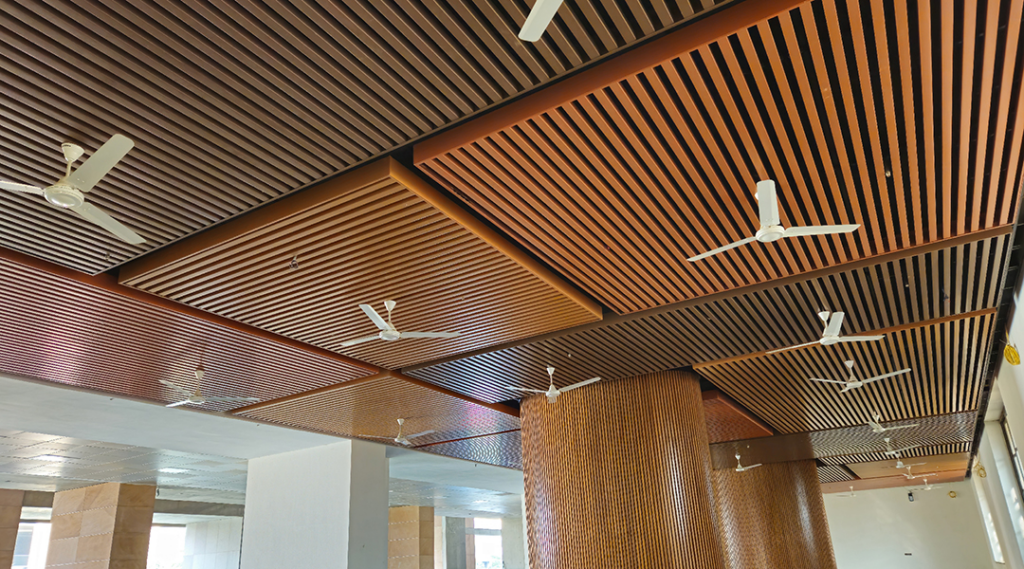
Effective acoustic design begins with understanding the specific sonic challenges each space presents. A corporate boardroom requires different acoustic treatment than a university lecture hall or a restaurant dining area.
In boardrooms, the priority centers on ensuring every participant can hear clearly without amplification, which demands ceiling systems that minimize echo while preserving speech frequencies. Concert venues need controlled reverberation that enhances musical performance without creating muddy sound.
Restaurants benefit from ceilings that reduce the cacophony of multiple conversations competing for auditory space. Tailoring ceiling design to these distinct needs starts with acoustic analysis—measuring existing reverberation times, identifying problematic reflection points, and determining target acoustic values that align with the space’s intended use.
Ceiling panels function as acoustic tools through two primary mechanisms: absorption and diffusion. Absorption occurs when sound energy enters the panel system and dissipates as heat within backing materials, preventing that energy from reflecting back into the space.
Perforated metal panels excel at absorption when paired with appropriate backing materials—typically mineral fiber or fiberglass batts positioned behind the perforated surface. The perforation percentage, hole diameter, and spacing all influence how effectively the panel absorbs different sound frequencies.
Panels with higher perforation percentages generally provide broader frequency absorption, while the depth of the plenum space behind the panel affects low-frequency performance. Diffusion, by contrast, scatters sound waves in multiple directions rather than allowing specular reflection, which helps eliminate acoustic hotspots and creates more uniform sound distribution throughout the space.
Selecting ceiling materials demands careful consideration of the acoustic requirements specific to your project. For spaces where speech intelligibility is paramount—such as classrooms, conference facilities, and healthcare environments—prioritize materials with high Noise Reduction Coefficient (NRC) ratings, typically above 0.70.
The NRC indicates the fraction of sound a material absorbs, with higher values representing greater absorption. Examine the material’s performance across the frequency spectrum, as some products excel at absorbing mid and high frequencies but offer limited low-frequency control.
For music venues or spaces where acoustic balance matters, review the material’s Sound Absorption Average (SAA) ratings and frequency-specific absorption coefficients. Consider the ceiling’s role within the broader acoustic strategy—if walls already provide substantial absorption, the ceiling might focus on diffusion or reflection control.
In spaces with significant mechanical noise from HVAC systems, evaluate the ceiling assembly’s Ceiling Attenuation Class (CAC) rating, which indicates how effectively the system blocks sound transmission between adjacent spaces through the plenum.
Collaboration between architects and acoustic consultants transforms ceiling design from guesswork into precision engineering. Engage acoustic specialists early in the design process, ideally during schematic design when fundamental spatial decisions remain flexible.
Acoustic consultants bring specialized measurement tools and modeling software that predict how sound will behave in the designed space before construction begins. They can evaluate proposed ceiling configurations, recommend adjustments to perforation patterns or backing materials, and identify potential acoustic problems that might not be apparent from drawings alone.
This partnership proves particularly valuable in complex projects—performing arts centers, recording studios, or multi-use spaces where acoustic requirements shift between different activities. The consultant provides performance specifications that guide material selection, while the architect ensures these specifications integrate seamlessly with aesthetic intentions and construction realities.
Regular coordination meetings throughout design development allow both parties to refine the ceiling system, balancing acoustic targets with budget constraints, structural coordination, and installation logistics.
Documentation from these collaborations should include acoustic performance targets, testing protocols for verifying installed performance, and maintenance guidelines that preserve acoustic function over the building’s lifespan.
Custom Fabrication: Tailored Solutions for Unique Spaces
Custom fabrication elevates ceiling design beyond standard catalog solutions, enabling architects to realize precisely the vision their projects demand. Off-the-shelf ceiling panels impose limitations—predetermined dimensions, fixed perforation patterns, and standard finishes that may not align with a space’s unique proportions or design language.
Custom fabrication removes these constraints, allowing panels to be engineered for specific ceiling geometries, whether that involves accommodating curved surfaces, creating seamless integration with architectural features, or developing perforation patterns that reinforce the project’s visual identity.
The process begins with detailed measurements and design specifications that capture every nuance of the space—ceiling heights, structural constraints, lighting integration requirements, and acoustic performance targets. These specifications guide fabricators in creating panels that fit perfectly without field modifications that compromise appearance or performance.
The aesthetic possibilities of custom fabrication transform ceilings into signature design elements that distinguish a space from generic environments. Consider a corporate headquarters where the company’s logo pattern becomes a subtle perforation motif repeated across the ceiling plane, creating brand presence without overt signage.
In a performing arts venue, custom panels might feature gradated perforation densities that create visual movement while providing variable acoustic absorption across different zones. Heritage restoration projects benefit from fabricators who can replicate historical ceiling details in durable metal while incorporating modern acoustic technology behind period-appropriate surfaces.
The fabrication process accommodates complex geometries—faceted panels for dramatic three-dimensional ceiling planes, radiused panels that follow curved architectural forms, or panels with integrated reveals that create shadow lines enhancing spatial depth.
Finish options extend beyond standard powder coating to include custom color matching, multi-tone effects, perforated patterns that create moiré effects when viewed from different angles, and even digital printing technologies that apply imagery directly to metal surfaces.
Precision in custom fabrication ensures that design intent translates flawlessly from drawings to installed reality. This precision begins with accurate field verification—laser scanning or detailed hand measurements that capture existing conditions before fabrication begins.
Digital fabrication technologies, including CNC punching and laser cutting, execute perforation patterns with tolerances measured in fractions of millimeters, ensuring consistency across hundreds of panels.
Manufacturers specializing in perforated metal products, such as AnsusMetal, utilize advanced fabrication equipment that maintains these exacting standards across large production runs. Edge details receive particular attention, as visible edges significantly impact the ceiling’s finished appearance.
Fabricators can provide hemmed edges for clean lines, returns that conceal raw metal, or custom trim profiles that integrate with adjacent construction. Coordination with other building systems proves essential—custom panels can incorporate precise cutouts for lighting fixtures, HVAC diffusers, and sprinkler heads, eliminating the awkward patches and modifications that compromise visual continuity.
Detailed shop drawings document every aspect of the fabrication, providing contractors with installation sequences, fastening details, and quality control checkpoints that ensure the installed ceiling matches the architect’s vision.
Case Studies: Real-World Applications
A corporate headquarters in Seattle demonstrates how perforated metal ceiling panels transformed a challenging open-plan environment into a productive workspace. The company occupied three floors of a converted industrial building, where exposed concrete surfaces and hard flooring created severe reverberation problems.
Employees complained that phone conversations carried across the entire floor, making concentration difficult. The architectural team specified custom aluminum panels with a 23% perforation rate, backed by two-inch mineral fiber insulation.
The panels featured a subtle linear perforation pattern that complemented the building’s industrial character while achieving an NRC rating of 0.85. Post-installation measurements showed reverberation time decreased from 2.1 seconds to 0.6 seconds, and employee surveys revealed significant improvements in perceived acoustic comfort and productivity.
A university performing arts center in Austin faced the complex challenge of creating a multi-purpose auditorium suitable for both amplified performances and acoustic concerts. The 800-seat venue required variable acoustics that could adapt to different performance types.
The design team collaborated with acoustic consultants to develop a ceiling system combining fixed perforated metal panels in the main seating area with adjustable acoustic banners in the performance zone.
The perforated panels, fabricated from steel with a bronze finish, featured varying perforation densities across different ceiling zones—denser perforations near the stage provided greater absorption for amplified events, while lighter perforation patterns toward the rear preserved beneficial reflections for acoustic performances.
The custom fabrication included precise integration points for theatrical lighting and rigging systems. The venue has successfully hosted everything from rock concerts to chamber music, with performers and audiences praising the clarity and balance of the acoustic environment.
A K-12 school renovation in Portland addressed the acoustic chaos typical of institutional cafeterias, where hundreds of students eating simultaneously created noise levels exceeding 85 decibels. The existing hard surfaces—tile floors, painted concrete block walls, and a flat drywall ceiling—offered no acoustic relief.
Budget constraints prevented comprehensive renovation, so the design focused on ceiling replacement as the most cost-effective intervention. The architect specified perforated metal panels with a micro-perforation pattern that maintained a clean, institutional appearance while providing maximum acoustic absorption.
The panels’ durability proved essential in an environment where food debris and moisture are constant concerns. Installation occurred during summer break, with panels suspended on a concealed grid system that simplified future maintenance access.
Acoustic measurements after installation showed noise levels reduced to 72 decibels during peak lunch periods, and teachers reported that students transitioned back to classrooms more calmly, with less overstimulation from the cafeteria environment.
Each project presented distinct challenges that custom perforated metal ceiling solutions successfully addressed. The corporate office required balancing acoustic performance with industrial aesthetics and budget constraints, achieved through strategic material selection and perforation engineering.
The performing arts center demanded acoustic flexibility and precise integration with complex building systems, resolved through zoned ceiling treatments and detailed coordination. The school cafeteria needed maximum acoustic improvement within tight budget parameters and an aggressive construction schedule, accomplished by focusing resources on the single most effective intervention point.
These cases demonstrate that successful acoustic ceiling design requires thorough problem analysis, close collaboration between design team members, and willingness to customize solutions rather than accepting standard approaches that may not address the space’s specific requirements.
Achieving Acoustic Excellence Through Strategic Ceiling Design

Quality ceiling design stands as a cornerstone of effective acoustic strategy, offering architects a powerful means to shape how spaces sound and feel. Throughout this article, we’ve explored how perforated metal ceiling panels deliver exceptional acoustic performance while providing the durability and aesthetic flexibility that contemporary projects demand.
These systems absorb unwanted reverberation, control sound reflection patterns, and create environments where communication flows clearly—whether in corporate offices, educational facilities, or performance venues.
The integration of ceiling design with broader acoustic goals requires thoughtful analysis of each space’s unique sonic challenges, strategic material selection based on performance data, and collaboration with acoustic specialists who bring technical expertise to the design process.
Custom fabrication extends these possibilities further, enabling architects to develop ceiling solutions that respond precisely to project-specific requirements while expressing distinctive design visions that elevate spaces beyond the ordinary.
As you plan your next project, consider how perforated metal ceiling panels might transform not just the acoustic environment but the entire spatial experience.
Explore custom fabrication options that align with your architectural intent, engage acoustic consultants early to establish clear performance targets, and recognize the ceiling as an opportunity to demonstrate how technical excellence and design innovation can coexist seamlessly. The right ceiling solution doesn’t compromise between function and beauty—it achieves both with conviction.