

Ever gotten a roofing estimate and felt confused by the term “square”? Roofers throw this word around like everyone knows what it means, but most homeowners don’t.
Understanding roofing squares is actually pretty simple, and it can save someone from getting overcharged or making costly mistakes.
This blog breaks down precisely what a roofing square is, why it matters, and how to calculate it without needing a math degree.
By the end, anyone can measure their roof like a pro and know if that contractor’s quote makes sense.
What is a Square in Roofing and its Size
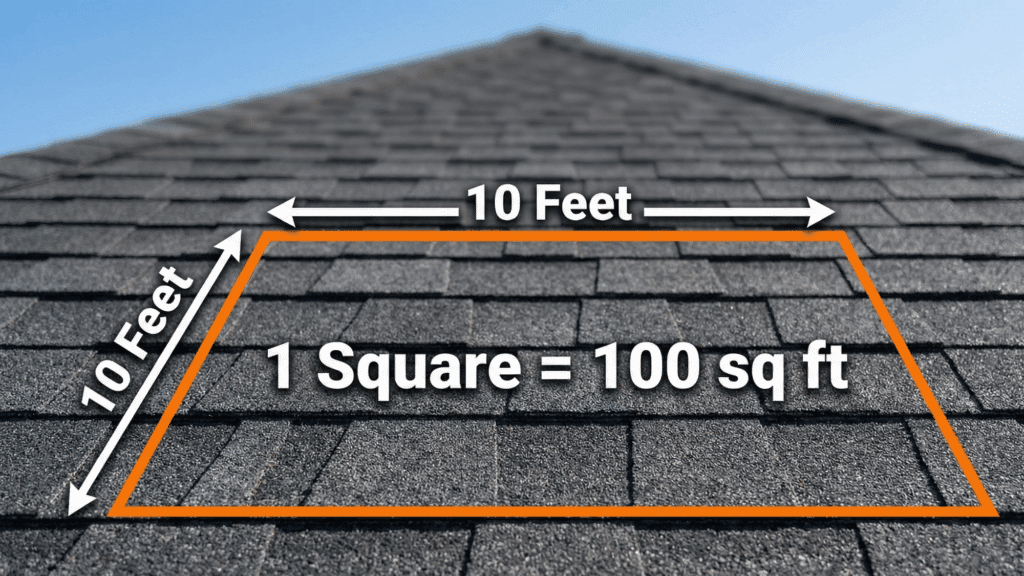
A roofing square isn’t what most people think. It’s not a shape or a tool. In roofing terms, a square is a unit of measurement that covers 100 square feet of roof area.
Think of it as the industry’s shorthand for calculating materials and labor costs.
So why 100 square feet? It makes the math easier for roofers. Instead of saying a roof needs 2,847 square feet of shingles, they just say it needs about 28 squares. Simple, right?
Here’s the key thing to remember: one square equals a 10-foot by 10-foot area. That’s it.
Whether someone’s roof is flat, sloped, or full of angles, the measurement stays the same. Roofers use squares to estimate how many bundles of shingles they’ll need and how long the job will take.
How Many Squares Cover an Average Home Roof?
Most homes need between 15 to 30 squares of roofing material. But that’s a pretty wide range, and here’s why it varies so much.
A typical single-story ranch house usually requires about 15 to 20 squares. Two-story homes bump that number up to 20 to 25 squares.
And if someone’s got a larger home with multiple peaks and valleys, they might need 30 squares or more.
The actual number depends on a few things. Roof pitch matters a lot. Steeper roofs have more surface area than flat ones, even if the house footprint is the same size.
Dormers, chimneys, and complex designs also add extra squares.
Always keep in mind that a 2,000-square-foot house doesn’t mean 20 squares of roofing. The roof area is almost always larger than the home’s footprint.
How to Calculate Roofing Squares
Calculating roofing squares isn’t rocket science, but it does require some basic math. Here’s the step-by-step process that actually works.
First, measure the length and width of each roof section.
For a simple rectangular roof, multiply length times width to get the total square footage. Let’s say the roof measures 40 feet by 60 feet. That’s 2,400 square feet.
Next, divide that number by 100. Remember, one square equals 100 square feet. So 2,400 ÷ 100 = 24 squares. Done.
The formula:
(Length × Width) ÷ 100 = Number of Squares
Example:
(40 ft × 60 ft) ÷ 100 = 2,400 ÷ 100 = 24 squares
But roofs aren’t always simple rectangles. For complex roofs, break them into sections. Measure each section separately, then add them all together.
A steep roof has more surface area than a flat one.
To account for this, multiply the square footage by a pitch multiplier. For a 4/12 pitch, multiply by 1.054. For a 6/12 pitch, use 1.118. For an 8/12 pitch, it’s 1.202.
Adjusted formula:
(Length × Width × Pitch Multiplier) ÷ 100 = Actual Squares
Example with pitch:
(40 ft × 60 ft × 1.118) ÷ 100 = 2,683.2 ÷ 100 = 26.83 squares (round up to 27 squares)
Always add 10% extra for waste and mistakes.
Roofing Square vs. Square Footage: Key Differences
People often confuse roofing squares with square footage, but they’re not the same thing. Here’s the breakdown that clears up the confusion once and for all.
| Aspect | Roofing Square | Square Footage |
|---|---|---|
| Definition | Unit of measurement used in roofing | Standard area measurement |
| Size | 100 square feet | 1 square foot |
| Usage | Estimating roofing materials and labor | Measuring any flat surface area |
| Calculation | Total square footage ÷ 100 | Length × Width |
| Industry | Roofing-specific term | Used across all industries |
| Example | A roof is 25 squares | A roof is 2,500 square feet |
| Why It Matters | Simplifies large roof measurements | Provides exact area measurements |
| On Estimates | Listed as “squares” or “sq.” | Listed as “sq ft” or “ft².” |
One roofing square always equals 100 square feet. So when a contractor says a job needs 20 squares, they’re talking about 2,000 square feet of roofing material. It’s just easier math for everyone involved.
What is the Cost Per Roofing Square
Roofing costs vary widely, but most contractors charge between $150 – $400 per square. That’s a huge range, and several factors explain why.
Material choice makes the biggest difference. Asphalt shingles run about $150 to $250 per square. Metal roofing jumps to $300 to $500 per square. And premium materials like slate or tile can hit $600 to $1,200 per square.
Labor costs also play a role. Simple, flat roofs cost less to install than steep, complex ones. Location matters too. Roofers in big cities charge more than those in rural areas.
Here’s what’s typically included in the per-square price: materials, labor, tear-off of old roofing, disposal fees, and basic warranties. But extras like new underlayment, flashing repairs, or structural fixes cost more.
Always get multiple quotes and compare them per square foot to see who’s offering the best deal.
Key Takeaway
Knowing what a roofing square is puts homeowners in control. No more nodding along when contractors throw around numbers.
Now, anyone can measure their roof, calculate the squares needed, and spot when an estimate doesn’t add up.
Armed with this knowledge, comparing quotes becomes straightforward. Someone can tell if they’re paying a fair price or getting taken for a ride.
And when that next roofing project comes up, they’ll walk into it confident, informed, and ready to make smart decisions. That’s worth more than any shingle on the roof.