


The national median for real estate agent income sits around $58,960 a year, as per the Bureau of Labor Statistics. But that number hides more than it reveals.
Most new agents earn under $25,000 in year one. Many veterans clear $100,000 or more. The median lands between those two realities and represents neither.
Income here is almost entirely commission-based. No salary, no base pay, no income between closings. What an agent keeps depends on deals closed, local home prices, broker split structure, and business expenses.
This article walks through each of those, so you know exactly what drives the number.
Real Estate Agent Income by Experience Level
The median figure tells you the middle of the distribution. It does not tell you where you will land — that depends on where you are in your career.
A McKissock Learning survey found 62% of full-time agents earn between $75,000 and $200,000. The BLS median of $58,960 covers all licensed agents, including part-timers and people in year one. Both figures are accurate. They measure different populations.
New Agents (Years 1–2)
I’ve watched this play out more times than I can count: new agents expect their license to produce income quickly. It almost never does.
About 85% of first-year agents earn under $25,000. Most close two to four transactions in year one. Volume is the problem, not commission rates.
Mid-Career Agents (Years 3–10)
Agents who build consistent referral pipelines earn between $50,000 and $75,000 annually. Repeat clients start doing work that cold prospecting used to do.
Broker split negotiations pay off most here. Moving from 50/50 to 70/30 adds thousands per transaction without one extra deal.
Veteran Agents (10+ Years)
Veterans with mature pipelines routinely earn $100,000 to $200,000 or more. Better splits, deeper referral networks, less time per deal; each one compounds on the last.
Full-Time vs. Part-Time
Full-time agents consistently earn more. What is surprising is how disproportionate the gap is.
Part-time agents do not just earn less per hour. Their pipelines reset constantly. Re-warming leads that would have stayed warm costs real income.
You cannot run a commission business at half speed and expect half the income.
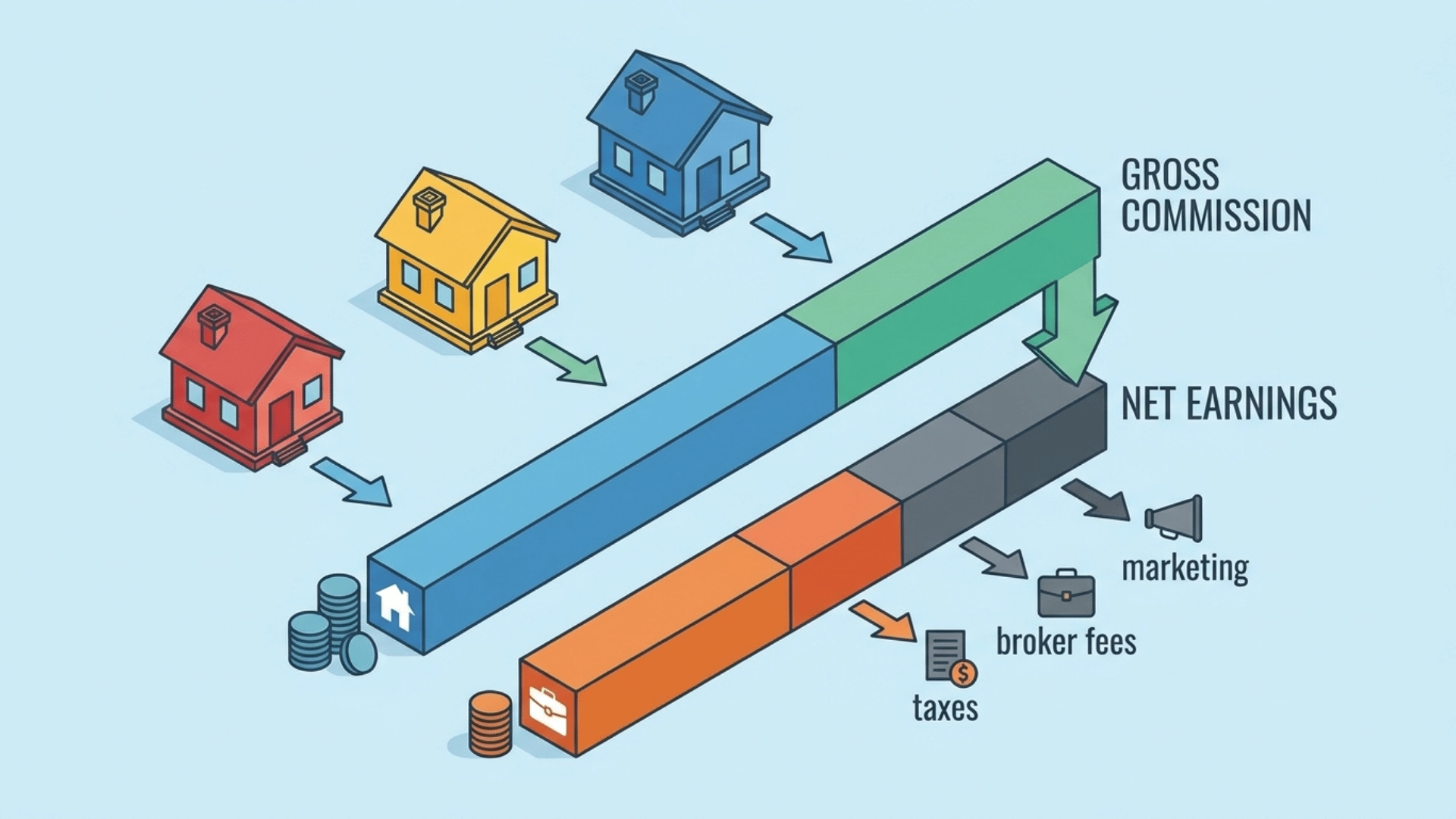
On a $400,000 sale at 2.75%, gross commission is $11,000. After a 70/30 broker split and expenses, net earnings land around $5,500 to $6,500. Year one agents closing three deals land well below the median. Income here is a volume problem.
What Percentage Do Real Estate Agents Make
The number sellers see; 5% to 6% of the home’s sale price is where the math starts. No individual agent earns that number. By the time the commission reaches an agent’s pocket, it has been cut at least twice.
Here is the sequence every agent agrees to when they get licensed:
Step 1: Agent-to-agent split. The total commission divides between the buyer’s agent and the listing agent, typically 50/50. A 6% commission on a $400,000 home becomes two $6,000 shares.
Step 2: Broker split. Each agent then shares their $6,000 with their supervising broker. At a 70/30 split, the agent keeps $4,200. At 50/50, they keep $3,000.
Step 3: Business expenses. Marketing, MLS dues, E&O insurance, licensing, these come out next. After expenses, an agent on a standard split typically nets between 1% and 1.5% of the sale price.
That gap between 5%–6% and 1%–1.5% is not the industry hiding something. It is the predictable result of a structure every agent signs up for.
Once you understand the structure, the headline rate stops being the relevant number. Volume becomes the lever that actually moves income.
If you have ever heard an agent say a deal “barely covered expenses,” this is why. On a low-priced home with a standard split, the math gets tight fast.
How the Broker Split Works and How Agents Earn Better Terms
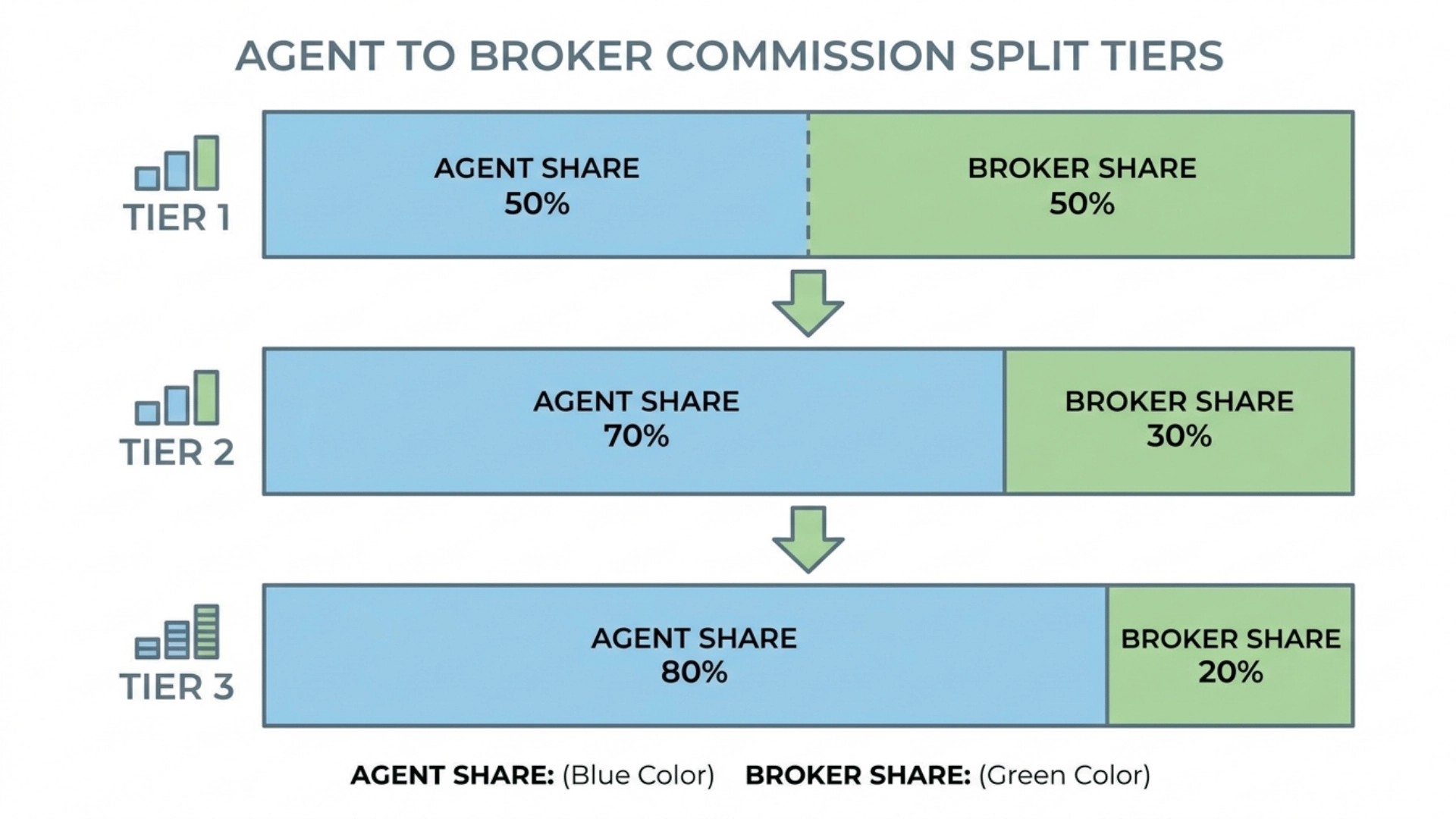
Every licensed real estate agent must work under a supervising broker. That broker takes a cut of every commission the agent earns. The size of that cut is tiered, and agents move through the tiers as they close more deals.
The Standard Tier Splits (50/50 to 80/20)
New agents almost always start at a 50/50 split. On a $400,000 sale where the listing agent’s gross commission is around $11,000, the agent takes home $5,500 before expenses.
As agents build their track record, they negotiate better terms. A 70/30 split, agent keeps 70%, broker takes 30%, is common for agents with consistent production. Experienced agents often reach 80/20.
On that same $400,000 sale, moving from 50/50 to 80/20 puts an extra $3,300 per transaction in the agent’s pocket. Multiply that across 10 or 15 sales a year and the difference is significant.
The 100% Commission / Desk-Fee Model
Some brokerages charge a flat monthly fee instead of taking a percentage. The agent pays that desk fee and keeps 100% of every commission earned.
It sounds like the obvious upgrade. It only works in your favor if you are closing enough deals to justify the fixed cost. For high-volume agents, it is a strong deal. For agents doing four or five transactions a year, the math often does not work out.
I have seen agents switch to this model too early. They end up paying more than a standard split would have cost. The break-even point is higher than most people expect.
How Agents Move to Better Splits
Better splits do not come with time. They come with volume.
Most brokerages set annual caps. Once an agent hits a closed-deal count or gross commission threshold, the split improves for the rest of the year. Some agents negotiate their split upfront, using competing offers from other brokerages as leverage.
Two agents at the same brokerage, both licensed five years, can be on very different splits depending on their production. Tenure means nothing here. Production is the only lever.
What Agents Actually Pay Before Keeping Anything

Real estate agents are independent contractors. Every business expense comes out of their own pocket before a single dollar counts as personal income. This is the cost structure most people outside the industry underestimate.
There are two types of costs worth separating. Fixed expenses exist whether you close anything or not. These typically include:
- MLS and NAR association dues
- E&O (errors and omissions) insurance
- Licensing renewal and continuing education
- Brokerage desk fees, where applicable
For new agents, the first few sales often just cover this overhead. Income has not started yet — you are still paying back the cost of being in business.
Variable expenses scale with activity. Common ones include:
- Photography and staging for listings
- Marketing and advertising
- Lead generation platforms like Zillow
Variable costs are where agents can overspend fast, especially early on when referrals have not kicked in.
Then there is the cost most new agents do not fully account for until their first tax bill: self-employment tax. As an independent contractor, you pay both sides of FICA. That is 15.3% on net earnings. A W-2 employee pays only 7.65%, their employer covers the rest. You pay the full amount alone.
Run the full numbers. The gap between gross commission and actual take-home is wider than almost anyone expects going in.
What Affects How Much a Real Estate Agent Makes?
Two agents with identical broker splits and the same expense profile can earn dramatically different amounts. Location, commitment level, and specialty area are multipliers — and they sit outside the commission structure entirely.
Location and Market Prices
Location is probably the single biggest income multiplier. It has nothing to do with how skilled an agent is.
An agent in a $900,000 average-price market earns more than double per transaction compared to a $400,000 market. Same commission rate, the only variable is home price.
Full-Time Commitment
Full-time agents treat this as a business. Consistent lead generation, active pipeline management, follow-up between transactions.
Part-time agents restart that cycle every time they step back in. The income difference is not proportional to hours. Part-time agents typically earn far less than half. Skipped pipeline work does not produce deals months later.
Specialty Area
Commercial real estate and luxury residential properties command higher per-transaction commissions because sale prices are higher. A $2 million luxury listing produces a much larger gross commission than a standard residential sale at the same rate.
The trade-off is entry. Deep relationship networks and specialized knowledge take years to build. The income upside is real, but so is the barrier.
Wrapping Up
The spread in what real estate agents make is wider than almost any other licensed profession. A part-time agent closing three deals a year and a full-time veteran closing thirty hold the same license. The title covers income that does not remotely resemble itself.
Figures that look large before splits and expenses look very different after. The median is pulled down by part-timers and agents still in year one. And volume separates the middle of the pack from the top tier.
If you understand those three things, you understand what actually drives earnings in this field.
Frequently Asked Questions
How much does a real estate agent make on a $300,000 sale?
At a 2.75% commission, the agent’s gross is $8,250. After a 70/30 broker split, about $5,775 stays with the agent before expenses. At a 50/50 split, that drops to roughly $4,125. After deducting transaction costs and self-employment tax, take-home usually lands between $3,000 and $4,500 at that price.
How much do real estate agents make per hour?
The Bureau of Labor Statistics puts the median hourly rate at approximately $28 for all agents. In practice, a single transaction can represent 40 to 80 hours of work spread across prospecting, showings, negotiations, and closing. High-volume agents earn more per hour because their systems reduce time per deal.
How much do real estate agents make in their first year?
Most new agents earn under $25,000 in year one. Building a client base takes time, and many first-year agents close only two to four transactions. Income in the first two years depends heavily on how actively an agent prospects. Agents who start with an existing referral network close their first deals faster and earn more in year one.
What is the difference between a real estate agent’s salary and commission?
Real estate agents are almost never salaried. They earn a commission on each transaction they close, with no base pay and no income between closings. A small number of agents work under salary-plus-commission arrangements at specific brokerages. These are the exception, not the rule.