


Real estate agent commission can look like one simple percentage, but the money does not go straight to one person.
A rate you hear during a home sale is usually split between brokerages and agents before anyone gets paid. That is why the final amount an agent keeps can be much smaller than sellers or buyers expect.
Commission can also change by location, home price, service level, and negotiation.
I will explain how the fee is calculated, who may pay it, how the split works, and what changed after recent buyer agent fee rules. First, let us look at what this commission actually means.
Disclaimer: This content is for general information only and is not financial, legal, tax, or real estate advice. Always consult a licensed professional before making decisions.
What is a Real Estate Agent Commission?
A real estate agent commission is a percentage of a home’s final sale price paid at closing. It is not a flat fee that goes directly to one agent.
The total commission usually covers both sides of a transaction:
- Listing side: represents the seller
- Buyer side: represents the buyer
For example, a 5.5% commission on a home sale doesn’t mean the agent receives 5.5% of the sale price.
That percentage is divided between two brokerages, then each brokerage pays its agent based on their agreement. A $400,000 home sale with a 5.5% commission creates a $22,000 total commission.
That amount is shared between the professionals involved in the transaction before any individual agent receives payment.
The exact commission rate depends on the market, property value, services included, and negotiations between the client and agent.
How is Commission Calculated and Who Pays It?
The national average real estate commission is currently 5.70% of the sale price, split roughly into 2.88% for the listing agent and 2.82% for the buyer’s agent, according to recent commission survey data.
Rates commonly range from about 4.5% to 6.2% depending on where you sell, which is why the exact figure on your closing statement can look different from what a neighbor in another state paid.
Real estate commission is calculated by multiplying the home’s final sale price by the agreed commission percentage.
For example:
$400,000 home sale × 5.5% commission = $22,000 total commission
Historically, sellers usually paid the full commission amount from their sale proceeds at closing. That total was then divided between the listing side and buyer side.
After the NAR settlement changes, buyer-agent compensation works differently.
Buyers must now discuss their agent’s fee directly and sign a written representation agreement before touring homes with an agent.
The seller can still offer to cover the buyer agent’s fee through a concession or negotiation. However, it is no longer an automatic part of every listing arrangement.
This means sellers now decide whether offering buyer-agent compensation makes sense for their situation, while buyers have a clearer understanding of the cost of working with an agent.
Does Real Estate Agent Commission Vary by State?
Yes. Real estate commission rates vary by a meaningful margin from state to state, even though the practice of splitting a percentage between two agents stays consistent everywhere.
State averages run from about 4.50% in Washington, D.C., up to 6.20% in Michigan, against a national average of 5.70%, based on a 2026 survey of active agents across all 50 states.
Here’s a snapshot of where rates run highest and lowest:
| State | Average total commission |
|---|---|
| Michigan | 6.20% |
| Tennessee | 6.05% |
| Missouri | 5.93% |
| California | 5.47% |
| Maryland | 5.41% |
| Washington, D.C. | 4.50% |
A few things drive that spread:
- Home values. States with higher median home prices, like California, tend to see lower percentage rates, since even a smaller percentage still adds up to a strong dollar commission.
- Disclosure rules. Some states require commission terms to be spelled out at specific points in the transaction, while others leave the timing more open, which affects how much negotiation happens upfront.
- Dual agency laws. States that allow one agent to represent both the buyer and seller sometimes see slightly lower combined rates, since a single agent is handling both sides of the deal.
If you want your area’s exact number, ask a local agent for their typical rate before you sign anything. It’s one of the first questions worth asking, right alongside how they price and market a home.
How Commission is Split Between Agents and Brokerages?
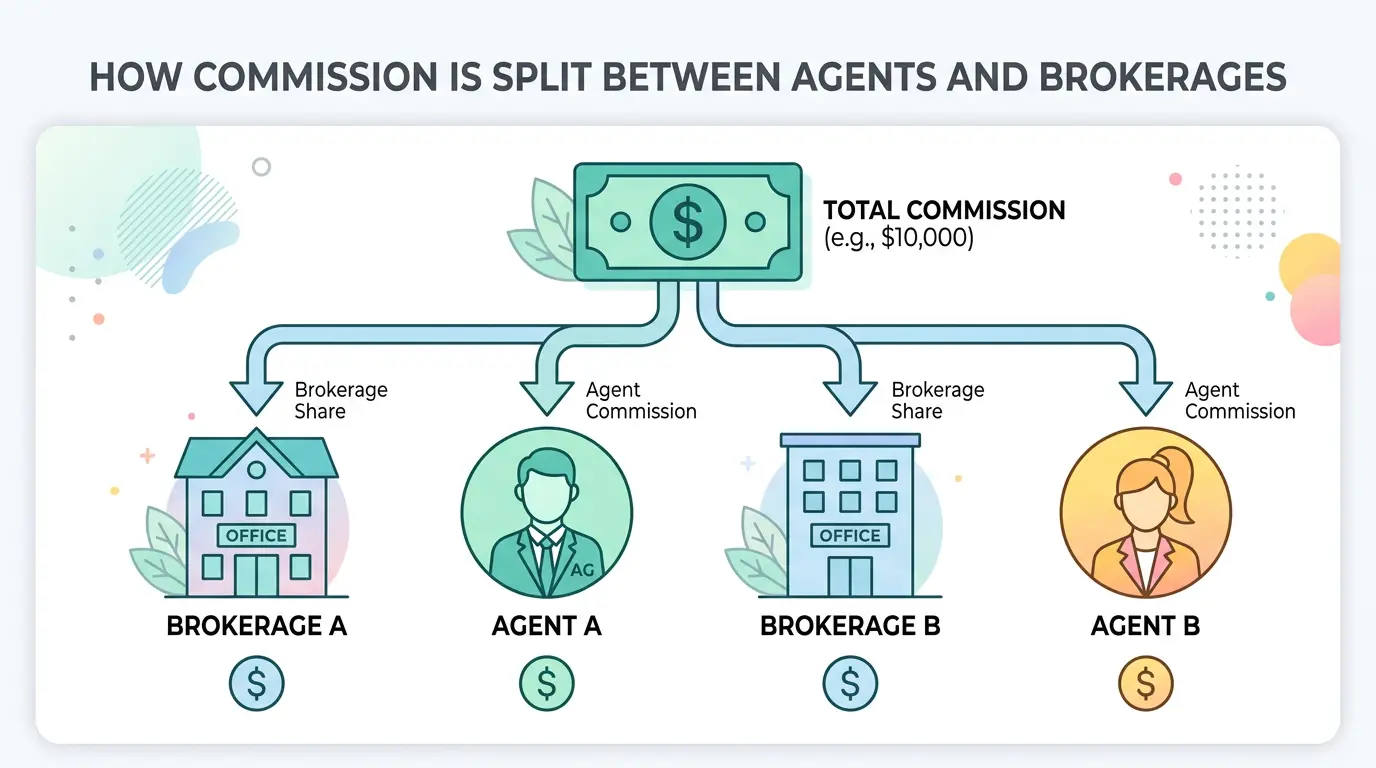
A real estate commission is divided between four parties:
- Listing brokerage
- Listing agent
- Buyer brokerage
- Buyer agent
The first split usually happens between the listing side and buyer side. For a $400,000 home with a 5.5% total commission, that $22,000 breaks down like this:
| Split | Amount |
|---|---|
| Listing side | ~$11,000 |
| Buyer side | ~$11,000 |
The brokerage then takes its agreed share before paying the agent.
A common brokerage split ranges from 30% to 50%, though experienced agents with strong production records may negotiate better terms.
Using a 50/50 brokerage split, an agent receiving $11,000 from their side would keep about $5,500 before taxes and business costs.
Agents also pay for expenses like marketing, photography, insurance, licensing fees, software, and transportation. The advertised commission rate is therefore very different from an agent’s final income.
The Listing Side Split
The listing side includes the listing broker and listing agent who work with the seller.
The listing brokerage receives the listing commission portion first. The brokerage then pays the listing agent according to their contract.
A newer agent may have a closer split with their brokerage, while experienced agents who bring in more business may negotiate higher splits such as 70/30 or 80/20.
The listing agent’s earnings depend on the commission percentage, the home’s sale price, their brokerage agreement, and the costs involved in preparing and marketing the property.
The listing agent’s earnings depend on the commission percentage, the home’s sale price, their brokerage agreement, and the costs involved in preparing and marketing the property.
The same costs are worth accounting for if you’re prepping a home to sell fast and want it to show well from the first showing.
The Buyer Side Split
The buyer side includes the buyer brokerage and buyer agent who help a buyer search for and purchase a home.
Before the NAR settlement changes, buyer-agent compensation was often handled through the listing side. Today, buyers must negotiate their agent’s fee directly through a representation agreement.
A seller can still agree to cover the buyer agent’s compensation, but the amount is now part of the offer negotiation rather than an automatic arrangement.
The buyer agent then follows the same process: the brokerage receives its share, and the agent receives payment based on their brokerage agreement.
Buyers working through the legal side of a purchase alongside these negotiations may also want to know the difference between a conveyancer and a solicitor, since that choice affects who reviews the paperwork tied to the deal.
What the NAR Settlement Changed, and What It Didn’t
Here’s a quick breakdown of what actually shifted after the settlement, and what stayed the same:
| Aspect | Before the Settlement | After the Settlement |
|---|---|---|
| MLS advertising | Buyer-agent compensation could be advertised through MLS listings | No longer allowed on MLS listings |
| Buyer’s role | Often didn’t negotiate agent compensation directly | Must discuss and sign a written representation agreement before touring homes |
| Seller’s option | Compensation was commonly handled through the listing side | Sellers can still offer compensation via concession or negotiation |
| Commission rates | Set by market and negotiation | Still not set or required to decrease by the settlement |
| Transparency | Buyer-agent cost was often invisible to the buyer | Buyer-agent cost is now clearer and separated from the listing process |
These changes trace back to a 2024 settlement in which the National Association of Realtors resolved litigation over commission practices, without admitting wrongdoing, by agreeing to the MLS and disclosure changes above.
The main takeaway: buyer-agent compensation is now its own conversation, not an automatic part of the listing.
Can You Negotiate Commission, and How Does It Actually Work Now?
Yes, real estate commission rates are negotiable. That applies to both sellers and buyers now.
- For sellers: negotiation usually covers the listing agent’s rate, services included, and marketing strategy
- For buyers: the big shift is negotiating your agent’s fee directly, before signing a representation agreement
Agents tend to be more flexible when:
- The home is higher-priced, where a lower percentage still adds up to a strong dollar amount
- The client brings repeat business or multiple transactions
- The market is competitive, with agents actively competing for business
That flexibility isn’t guaranteed everywhere. Agents in lower-priced markets or areas with fewer transactions usually have less room to budge.
If lowering the rate is your main goal, a few alternatives exist outside standard negotiation:
- Flat-fee brokerages: charge a set amount instead of a percentage
- Discount brokerages: offer reduced rates, often with fewer services or limited support
- FSBO (For Sale By Owner): removes the listing agent fee, but not buyer-agent costs if the buyer brings their own representation
A lower commission doesn’t always mean better value. Services, experience, negotiation skills, and support matter just as much as the rate itself.
Factors That Affect Real Estate Agent Commission
Commission depends on more than the percentage alone. Property price, location, market conditions, agent experience, and service level all shape the final structure.
Several things can change how much a real estate agent commission comes to in the final sale.
- Property value: Higher-priced properties usually create a larger commission payout, even when the commission percentage stays the same.
- Type of property: Commercial and luxury properties may involve more marketing, longer timelines, and tougher negotiations.
- Location: Commission rates can vary by area, market demand, and how competitive the local real estate market is.
- Current market conditions: Agents may adjust fees depending on whether homes are selling quickly or taking longer to close.
- Agent experience: Experienced agents may charge more because of their network, negotiation skills, and past results.
- Scope of services: Full service agents may charge more when they handle marketing, staging advice, photography, paperwork, and post-sale support.
Conclusion
Real estate agent commission is not just one percentage taken from a sale. It can be split among brokerages, listing agents, and buyer agents before anyone is paid.
The final cost also depends on the home price, local market, services included, and what each side agrees to.
The biggest takeaway is simple: commission should be discussed clearly before you sign anything.
Ask what is included, how the fee is split, and whether buyer agent compensation is part of the deal. A lower rate can help, but only if the service still fits your needs.
What commission question would you ask first? Tell us, share with us in comments below.
Frequently Asked Questions
How much commission do you pay on a $300,000 house?
At a 5.7% national average, total commission would be about $17,100. At a negotiated 5% rate, it’s $15,000. Sellers typically pay this, though buyer-agent compensation is now a separate negotiation.
What percentage do most realtors charge?
The national average is around 5.7%, split between listing and buyer sides. Rates vary by location, home price, and services provided. Expensive markets may see lower percentages with still-significant dollar amounts.
Do realtors still charge 6%?
Some still do, but it’s no longer a fixed standard. Competition, market conditions, and NAR settlement changes have made rates more flexible, with options like discount and flat-fee brokerages available.
Is 3% a good commission for a realtor?
That usually refers to one side, not the total. On a $350,000 home, 3% equals $10,500. After a 50/50 split, the agent keeps about $5,250 before taxes and expenses.