

A kitchen can look flawless in a rendering and still become frustrating once the doors begin to sag, the finish chips, or a missing panel delays installation for weeks. Comparing OPPEIN and cabinet manufacturers therefore requires more than choosing an attractive door style or accepting the lowest quotation.
The real decision involves materials, engineering, hardware, measurements, manufacturing consistency, logistics, installation, warranties, and after-sales support. Whether you are renovating one home, furnishing apartments, or sourcing cabinetry for a hotel, these details determine what arrives, how well it fits, and how the finished space performs over time.
Understanding OPPEIN and Cabinet Manufacturers
OPPEIN is a Guangzhou-based whole-house customization company founded in 1994. Its official website says it operates five production bases, produces more than nine million cabinets annually, and serves customers across 146 countries and regions. The company supplies kitchens, wardrobes, bathroom cabinets, interior doors, and other fitted furniture for individual homes and commercial projects.
Those figures place OPPEINin the large industrial-manufacturer category rather than the small joinery-workshop category. Scale can support repeatability, broad finish selections, project capacity, and coordinated whole-house packages. It does not, by itself, prove that every order will be perfectly designed, measured, delivered, or installed. Buyers still need to assess the exact product specification and the local team responsible for their project.
Four Common Manufacturing Models
Cabinet suppliers usually fall into four broad groups:
- Stock manufacturers produce standard sizes and limited finishes for fast purchasing.
- Ready-to-assemble manufacturers ship flat-packed components for local assembly.
- Semi-custom manufacturers use standardized systems but allow selected changes in size, finish, or internal storage.
- Custom manufacturers produce cabinetry from project-specific measurements, drawings, materials, and details.
A large manufacturer may operate in more than one category. OPPEIN promotes custom kitchens, whole-house solutions, RTA options, and large project services, so the appropriate comparison depends on the exact product line and contract rather than the company name alone.
Start With the Cabinet Specification, Not the Brand Name
A brand can indicate manufacturing capability, but the specification tells you what you are actually buying. Two kitchens from the same company may use different core panels, finishes, hinges, countertops, drawer systems, and accessories. Their price and durability can therefore be very different.
Ask every supplier to issue a room-by-room specification tied to the final drawings. It should identify cabinet dimensions, panel materials and thicknesses, door finish, visible side panels, edge treatment, back-panel construction, shelves, hinges, drawer slides, handles, toe kicks, fillers, lighting, countertops, sinks, appliances, and installation responsibilities.
Cabinet-Box Materials
The cabinet box carries shelves, drawers, doors, countertops, and daily loads. Common options include plywood, particleboard, and medium-density fiberboard. OPPEIN’s published material information lists seven-layer plywood, particleboard, and MDF among its base materials, while its FAQ also identifies these as common substrates for kitchen products.
Each material can perform well when correctly specified and manufactured:
- Plywood is valued for layered construction, screw holding, and resistance to ordinary handling damage, although veneer quality, core voids, adhesive, and thickness vary.
- Particleboard offers a flat, stable, cost-efficient substrate and is widely used in modern modular cabinetry. Its vulnerable edges require effective sealing and protection from prolonged moisture.
- MDF has a smooth, uniform surface that suits painted, lacquered, routed, and wrapped doors. It is dense and machinable but can be heavy and sensitive to water if the finish or edges are damaged.
Do not accept a quotation that simply says “wood,” “engineered wood,” or “premium board.” Require the substrate type, thickness, emission classification, surface finish, and manufacturer or grade where relevant.
Door Materials and Finishes
Doors create most of the visible character of a kitchen. OPPEIN lists solid wood, wood veneer, metal foil, lacquer, PVC, acrylic, laminate, and melamine among its door-panel options. This breadth is useful, but the buyer should compare the specific sample and construction proposed for the project.
Painted or lacquered surfaces can provide a smooth contemporary appearance, but quality depends on preparation, coating thickness, curing, and edge coverage. Laminates and melamine can be practical and consistent, while acrylic can produce a high-gloss or super-matte effect. Veneer offers natural variation, and solid wood responds to humidity differently from engineered panels.
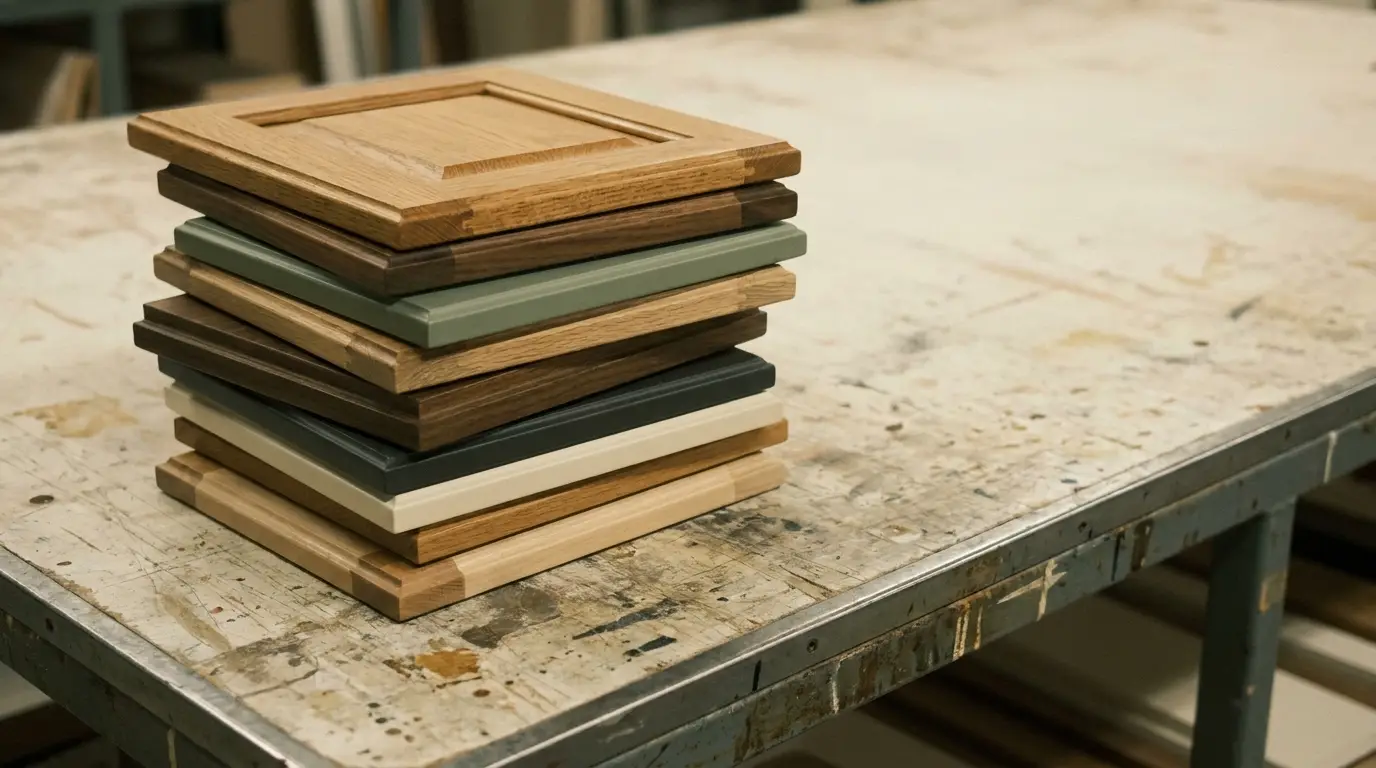
Request a labeled sample before approving production. View it vertically and horizontally under daylight and artificial light. Check color, sheen, texture, edge transitions, fingerprints, scratch visibility, and how easily the surface can be cleaned.
Hardware and Moving Parts
Hinges and drawer slides are small compared with a cabinet box, but they shape the daily experience of the kitchen. OPPEIN states that it works with hardware suppliers such as Blum and Hettich. Buyers should still confirm the exact brand, series, load rating, finish, and soft-close mechanism included in their quotation because broad supplier relationships do not mean every package uses the same components.
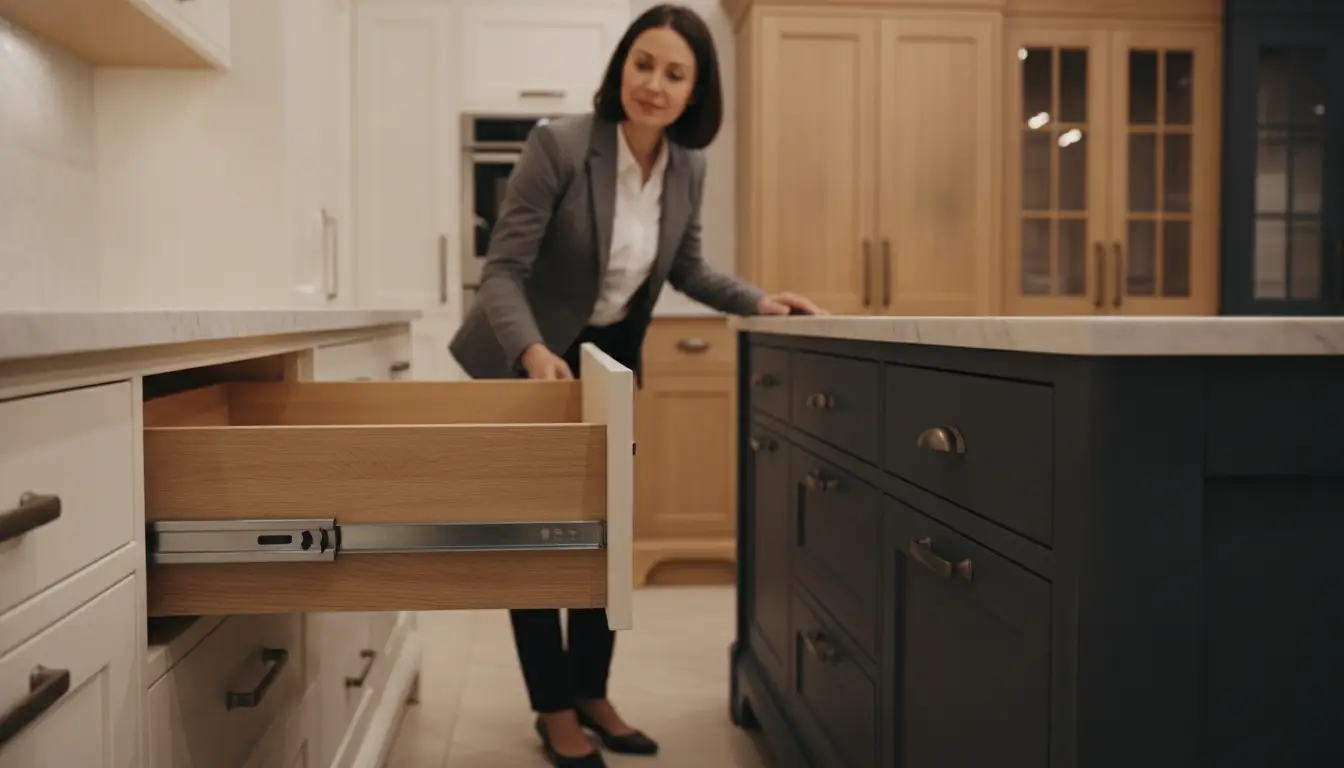
Open and close the sample doors and drawers repeatedly. A quality drawer should run smoothly, remain aligned, and feel stable when extended. Hinges should offer adjustment after installation. For wide drawers, waste bins, pull-out pantries, and corner systems, confirm the rated load and internal dimensions rather than relying on a showroom demonstration alone.
How to Compare Construction Quality
When evaluating OPPEIN and cabinet manufacturers, inspect how the components are joined and protected. Look beyond the front elevation and examine the inside corners, shelf holes, backs, drawer bottoms, edge bands, connector fittings, and exposed cutouts.
Important construction questions include:
- How are cabinet sides joined to tops and bottoms?
- Are backs full height, recessed, stapled, screwed, or fitted into grooves?
- What thicknesses are used for sides, shelves, backs, and drawer bottoms?
- Are exposed and hidden edges sealed?
- How are wall cabinets fixed to the building?
- Are shelves adjustable, and what loads are they designed to carry?
- How are tall units anchored?
- Are sink cabinets protected against leaks?
- Are oven and appliance clearances shown in approved drawings?
Precision matters, but so does design for the actual site. A perfectly machined cabinet can still fail if the wall is uneven, the service points are wrong, the filler is too narrow, or the installer lacks suitable fixing details.
Why Independent Performance Standards Matter
For buyers in North America, the Kitchen Cabinet Manufacturers Association’s A161.1 program is one useful reference point. KCMA says its quality certification evaluates cabinet structure, door and drawer operation, and finishes through more than a dozen laboratory tests; its materials describe 14 tests that simulate long-term use and abuse. Certification applies to listed cabinet lines, so buyers should verify the actual product rather than assuming an entire company is covered.
A manufacturer without a particular regional seal is not automatically poor quality, especially when products are made for another market. However, the supplier should provide equivalent test reports, product certificates, or documented internal quality procedures that match the project’s destination and specification.
Manufacturing Scale Versus Delivered Quality
Large production capacity can be valuable for apartment towers, hotels, multi-unit housing, or franchise networks. OPPEIN reports five intelligent production sites covering more than three million square meters, with daily capacity exceeding 25,000 customized cabinets. These are company-reported capabilities and should be evaluated alongside project references, sample approvals, production schedules, and contractual remedies.
For a homeowner, factory size matters less than whether the designer understands the room and the installer can resolve site conditions. For a developer, factory capacity matters more, but only when combined with batch consistency, packaging accuracy, container planning, replacement-part response, and coordinated installation.
Samples, Mock-Ups, and First-Article Approval
Before authorizing a large order, request a physical sample, sample door, or full mock-up. For commercial work, a first-article unit can expose problems with dimensions, hinges, service access, color, labeling, installation sequence, and packaging before hundreds of units are produced.
Approve samples in writing and record:
- Material codes and suppliers
- Color and gloss level
- Grain direction
- Edge-band color and thickness
- Hardware series
- Handle drilling
- Interior finish
- Lighting temperature
- Countertop edge profile
- Acceptable tolerances
Photographs help, but retain a signed physical control sample whenever possible. It gives the buyer, manufacturer, and installer the same reference if a later shipment looks different.
Design, Measurement, and Shop Drawings
Custom cabinetry begins with accurate information. A manufacturer can produce only from the dimensions, appliance specifications, and service details it receives. Errors introduced during measurement may be reproduced very accurately in the factory.
OPPEIN presents its service as a process extending from inspiration and design to production, installation, and after-sales support. Its overseas installation page says local installation partners may be used where available, or a team may be arranged from headquarters for an additional charge. The availability and scope of that service should be confirmed for the project location before signing.
What Final Drawings Should Show
Do not release production from attractive 3D renderings alone. Final shop drawings should show:
- Verified wall-to-wall and floor-to-ceiling dimensions
- Door, window, column, beam, and bulkhead positions
- Plumbing, gas, ventilation, and electrical points
- Appliance model numbers and ventilation clearances
- Cabinet widths, heights, depths, and opening directions
- Fillers, scribes, end panels, toe kicks, and shadow gaps
- Countertop joints, overhangs, cutouts, and supports
- Internal accessories and drawer divisions
- Lighting channels, drivers, switches, and cable routes
- Fixing methods and installation tolerances
The person responsible for site measurement should be named in the contract. The buyer should also know who absorbs the cost if verified dimensions differ from the approved drawings.
Indoor Air Quality and Environmental Claims
Composite wood products may contain adhesives that emit formaldehyde. In the United States, EPA’s TSCA Title VI rules cover hardwood plywood, MDF, particleboard, and finished goods containing those materials. Products sold or imported into the United States are subject to labeling and compliance requirements.
OPPEIN states that its panels comply with European E1 requirements and promotes additional low-emission materials for some project offerings. Treat environmental statements as product-specific claims: request the test report for the exact board, production period, and destination standard rather than relying only on a general webpage or logo.
When comparing OPPEIN and cabinet manufacturers, ask for:
- The applicable emission standard
- Product-specific laboratory reports
- The panel producer and board code
- Chain-of-custody or sourcing documents when required
- Coating and adhesive information
- Country-specific import compliance
- Instructions for ventilation after installation
“Sustainable,” “green,” and “eco-friendly” are too broad to evaluate without supporting documents and a defined scope.
Pricing: Compare the Landed and Installed Cost
Cabinet quotations are difficult to compare because companies bundle products and services differently. One price may include countertops, shipping, handles, accessories, and installation, while another covers only cabinet panels at the factory.
Build a comparison sheet that separates:
- Design and measurement
- Cabinet boxes and doors
- Decorative panels and fillers
- Hardware and accessories
- Countertops and cutouts
- Appliances, sinks, and taps
- Lighting and electrical components
- Packaging
- Inland transport
- Export documents and port charges
- Ocean or air freight
- Insurance
- Customs duties and taxes
- Delivery from port to site
- Assembly and installation
- Site modifications
- Replacement parts
- Warranty service
OPPEIN’s shipping guidance shows a multi-stage route from factory and export transport through port handling, ocean shipping, destination procedures, and final delivery. This illustrates why a factory quotation should not be mistaken for the total installed price.
Beware of Vague Allowances
A quotation may appear complete while using allowances for hardware, stone, lighting, or accessories. If the final selection exceeds the allowance, the project price rises.
Require quantities and product codes. Confirm whether taxes, duties, port storage, demurrage, crane access, floor distribution, waste removal, and making good are included. Currency movements and freight changes should also have a defined treatment in the contract.
Overseas Ordering and Logistics
Buying directly from an overseas manufacturer can expand design choice and support large-volume projects. It also introduces longer communication lines and more responsibility for documentation, shipping, customs, local compliance, and installation.
OPPEIN says it can assist with export and shipment where buyers do not manage those tasks themselves. Its packaging information describes individual panel protection using foam and bubble materials after production and inspection. Buyers should still require shipment-specific packing lists, package labels, moisture protection, damage procedures, and spare-part planning.
Plan for Missing or Damaged Pieces
Even a well-managed shipment can contain damage, shortages, or site changes. Decide in advance:
- How shortages will be reported
- What evidence is required
- Who pays for replacement production and freight
- Whether urgent pieces can travel by air
- How long the supplier has to respond
- Which spare panels and hardware are included
- Where replacement items will be stored
- Whether local repairs are acceptable
For large developments, a small percentage of spare hinges, slides, handles, shelves, toe kicks, and common panels can prevent minor defects from delaying handover.
Warranty and After-Sales Support
Warranty language should identify the covered products, duration, exclusions, claim process, labor responsibility, shipping responsibility, and available remedy. OPPEIN’s general warranty page says coverage starts from delivery and advises buyers to confirm exact warranty time with customer service. Some product pages state five years for wood products and one year for electrical appliances, making written project-specific confirmation essential.
A long warranty is useful only when the responsible company can be reached and the claim covers the actual failure. Ask whether the local dealer, installer, distributor, or overseas factory handles the claim. Confirm whether labor, removal, reinstallation, travel, and replacement freight are covered or excluded.
Serviceability Matters
Choose standard hinges, slides, lighting drivers, and accessories that can be identified and replaced. Proprietary parts can be elegant, but they may create difficulty if a distributor closes or a model is discontinued.
Keep the approved drawings, order numbers, finish codes, hardware codes, manuals, and spare components after installation. This documentation makes future repair far easier.
Choosing for a Home Renovation
Homeowners comparing OPPEIN and cabinet manufacturers should prioritize the complete local experience. A strong factory product can still become a poor kitchen when measurements, project management, installation, or after-sales service are weak.
Visit a showroom where possible. Open doors, load drawers, inspect corners, and look beneath the sink display. Ask to see an installed project that has been in use for at least a year, not only a newly completed showroom.
The most important homeowner questions are practical:
- Who measures the room?
- Who checks plumbing and appliance requirements?
- Who signs off the drawings?
- Who receives and inspects the shipment?
- Who installs the cabinetry and countertops?
- Who corrects damage or manufacturing errors?
- How long do replacements normally take?
- Who remains responsible after final payment?
Choosing for Developers and Commercial Projects
Developers, contractors, designers, and hospitality buyers need a deeper technical and commercial review. The manufacturer must translate design intent into repeatable units while managing revisions, approvals, batch production, logistics, and handover documentation.
OPPEIN reports more than 18,000 completed global projects and advertises support from budget and design through production, installation, and after-sales service. These claims make the company relevant to large-project shortlists, but the buyer should request references that resemble the proposed project in location, scale, product type, and contract structure.
Commercial due diligence should cover:
- Audited factory and financial information
- Production-slot commitment
- Project organization chart
- Design coordination procedures
- Sample-room process
- Quality-control checkpoints
- Inspection rights
- Batch and color consistency
- Packaging and room-by-room labeling
- Replacement turnaround
- Delay and damages provisions
- Local code compliance
- Installation supervision
- Operations and maintenance manuals
A pilot room or apartment is particularly valuable. It tests the entire chain from drawings and production through shipping, installation, snagging, and user experience.
Common Buying Mistakes
The first mistake is choosing from images alone. Renderings do not reveal panel density, edge quality, drawer stability, coating durability, or installation skill.
The second is comparing prices without aligning scope. A quotation that excludes fillers, end panels, countertop supports, internal accessories, freight, or installation is not directly comparable with a turnkey proposal.
The third is approving production before appliances and site services are finalized. Even small changes to an oven, refrigerator, hood, sink, or electrical point can affect several cabinets.
The fourth is relying on verbal promises. Every important commitment should appear in the approved specification, drawings, schedule, and contract.
The fifth is paying too much before inspection. Where commercially possible, use milestone payments tied to design approval, material approval, production progress, pre-shipment inspection, delivery, installation, and snag completion.
Questions to Ask Any Cabinet Manufacturer
Before choosing OPPEIN and cabinet manufacturers for a project, ask the same questions of every shortlisted supplier:
- Which exact factory will make the order?
- Is the product stock, RTA, semi-custom, or fully custom?
- What are the panel types, grades, thicknesses, and emission standards?
- Which hardware brand and series are included?
- Can you provide labeled physical samples?
- Who measures the site and accepts measurement liability?
- What drawings must be approved before production?
- What is the confirmed production and shipping schedule?
- What does the price exclude?
- Which certifications apply to this exact product line?
- Can we inspect production or appoint a third-party inspector?
- How are packages labeled by room and unit?
- What happens when an item is missing, damaged, or incorrect?
- Who performs installation and carries local insurance?
- What are the written warranty and claim procedures?
A supplier that answers these questions clearly is easier to manage than one that relies mainly on brand recognition or attractive promotional language.
Frequently Asked Questions
Is OPPEIN a Cabinet Manufacturer?
Yes. OPPEIN manufactures custom kitchens and other fitted-furniture products, including wardrobes, bathroom cabinets, and interior doors. The company was founded in 1994 and reports five production bases in China.
Is OPPEIN Suitable for Individual Homes?
It markets products for individual homes as well as commercial projects. Suitability depends on the available local design, measurement, installation, and after-sales support in the buyer’s area.
What Materials Does OPPEIN Use?
Its published information lists plywood, particleboard, and MDF as base materials, with finishes including lacquer, PVC, acrylic, laminate, melamine, veneer, metal foil, and solid wood. The exact combination depends on the selected product.
Does OPPEIN Use Branded Hardware?
OPPEIN states that it works with hardware suppliers including Blum and Hettich. Buyers should confirm the exact brand and series in the written quotation because different packages can have different specifications.
Are Imported Cabinets Cheaper Than Locally Made Cabinets?
They can have a lower factory price, particularly for large orders, but the buyer must add design, freight, insurance, duties, taxes, local delivery, installation, site adjustments, and replacement risk. The installed cost is the meaningful comparison.
How Do I Compare OPPEIN and Cabinet Manufacturers Fairly?
Issue the same drawings, specification, quantities, delivery terms, and installation scope to each bidder. Then compare compliant quotations line by line rather than comparing only the final totals.
What Certifications Should Cabinets Have?
Requirements depend on the destination and project. In the United States, composite wood compliance under TSCA Title VI is important, while KCMA certification can provide evidence of cabinet performance for certified product lines. Other countries and contracts may require different emission, fire, sustainability, or structural documentation.
Should I Order Cabinets Before Selecting Appliances?
No. Final appliance models and technical sheets should be coordinated before cabinet production. Dimensions, ventilation gaps, electrical loads, plumbing, door clearances, and service access can affect the design.
Is a Five-Year Warranty Enough?
Duration is only one factor. Review what is covered, who handles the claim, whether labor and freight are included, and how replacement parts are supplied. Obtain the warranty for the exact order in writing.
Conclusion
Choosing between OPPEIN and cabinet manufacturers is not a simple contest between a large international brand and smaller suppliers. The best choice is the company that can deliver the required design, documented materials, reliable construction, compliant products, accurate drawings, safe logistics, skilled installation, and responsive service at a transparent total cost.
OPPEIN’s scale, product range, and whole-house capabilities make it a relevant option for many residential and commercial projects. The same discipline should still apply as with any supplier: verify the precise specification, approve physical samples, confirm responsibilities, test the full process, and put every important promise in writing. Cabinets become part of a building for years, so the quality of the decision should extend far beyond the showroom image.