

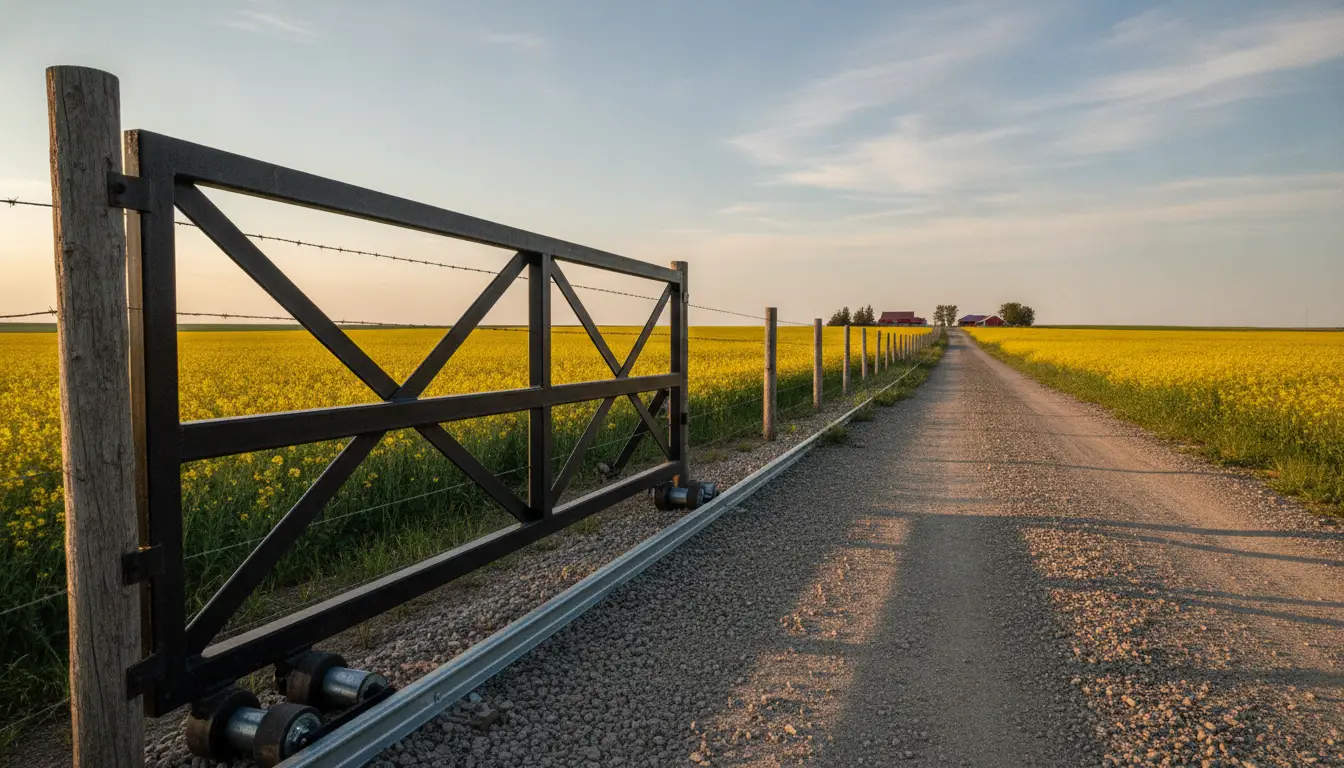
The Canadian Driveway Problem, and One Summer to Solve It
Across the Prairies and rural British Columbia, an acreage entrance is rarely a flat, generous rectangle. Driveways run long and narrow, shoulder into ditches, climb a slight grade toward the house, and sit under a metre of snow for months. Summer is the window when the ground is dry and firm enough to trench a footing and pour a rail base, which is why so many landowners plan their entrance now.
When space at the roadside is scarce, the geometry of a sliding gate changes what is possible.
A swinging gate demands a clear arc, often three or four metres of level ground, to open into. On a sloped or short driveway there is simply nowhere for that arc to go, and in winter the leading edge grinds into packed snow and stops. This is where the mechanism, not the material, decides everything.
Classifying Driveway Gates by How They Move
Every driveway gate belongs to one of three motion families, and the family determines where it can be installed.
- Swing: hinged panels; needs a clear opening arc.
- Track-sliding: rolls sideways on a ground rail; parks along the fence.
- Cantilever-sliding: hangs from a beam; no ground track at all.
A track-guided sliding gate rolls sideways along an in-ground rail instead of pivoting on hinges. Picture a barn door on its runner rather than a room door on its jamb: the whole panel travels parallel to the fence line and tucks alongside it, so the entrance needs no swing clearance whatsoever. That single difference is why this family suits sloped, short, and snow-prone Canadian driveways where a swing design jams.
Why Rolling Beats Lifting: the Physics of the Opener
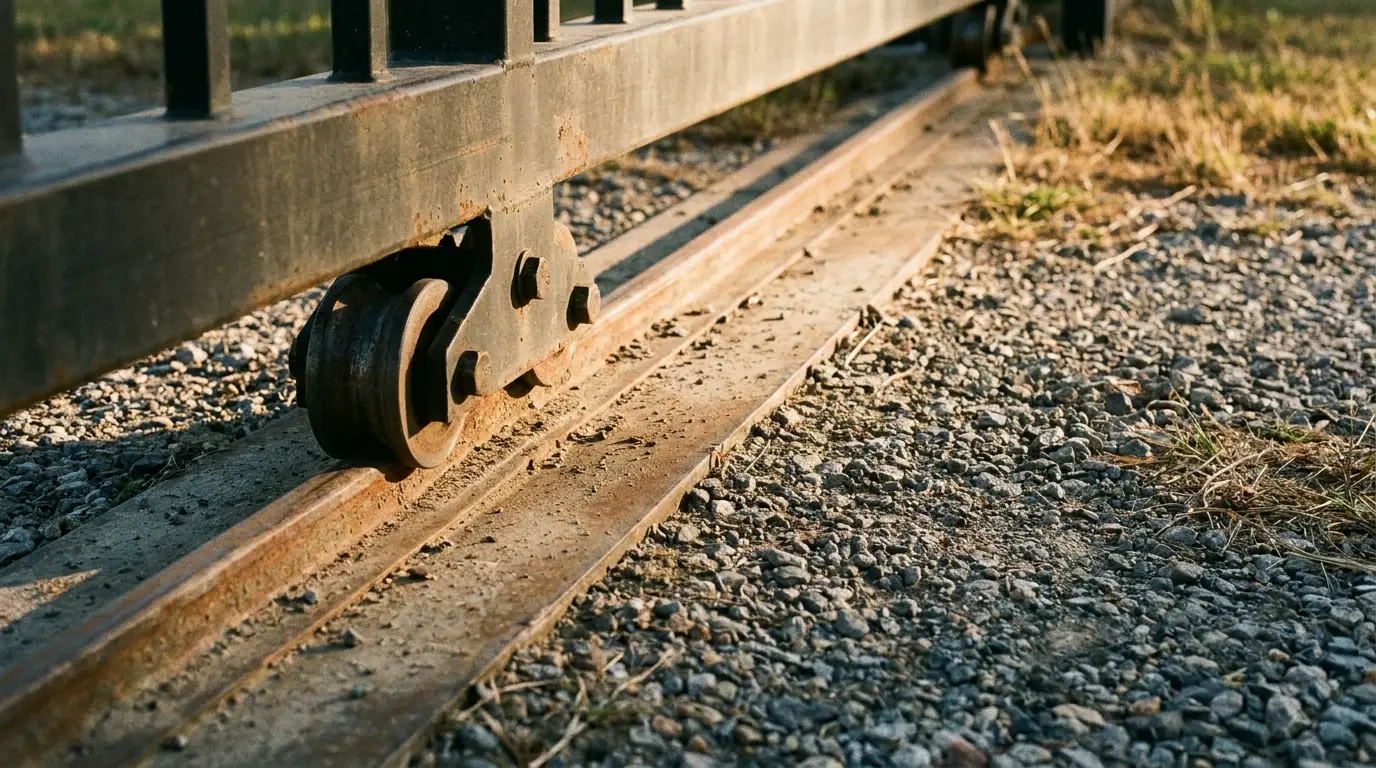
The reason a heavy welded panel opens on a modest motor comes down to what the opener actually fights. The gate’s full weight rides on rollers seated in the rail, so the panel is supported from below at all times. The motor never lifts the mass; it only overcomes rolling friction, which is a small fraction of the load.
Because the track carries the weight, a longer and heavier sliding gate does not punish the drive system. A twenty-five-foot span can be fully welded, rigid, and dense enough to block sightlines while still gliding open smoothly, since the footing and rail absorb the load the opener would otherwise carry.
Two Layers Against Canadian Rust
An entrance barrier lives outdoors through freeze-thaw cycles, road salt spray, and summer humidity, so corrosion defence is structural, not cosmetic. The strongest approach is layered. Hot-dip galvanizing bonds zinc to the steel and sacrifices itself before the iron beneath can rust, giving protection even where the surface is later scratched.
- Strengths: no swing clearance; smooth on grade; snow-tolerant.
- Trade-offs: needs a level rail footing; wider side run required.
A Working Example From an Alberta Acreage
Consider a landowner near Red Deer with a driveway that rises gently from a gravel road and offers no flat apron for a hinged panel. A trenched footing and a poured in-ground rail let the sliding gate park cleanly against the perimeter fence, clearing snowbanks in January and heavy machinery in July without fouling the opening. The welded panels give privacy at the road while the galvanized-and-coated finish shrugs off salt carried in on tires.
For entrances constrained by slope, snow, or scarce frontage, a track-guided sliding gate turns an awkward opening into a dependable, low-effort barrier that earns its place season after season.