

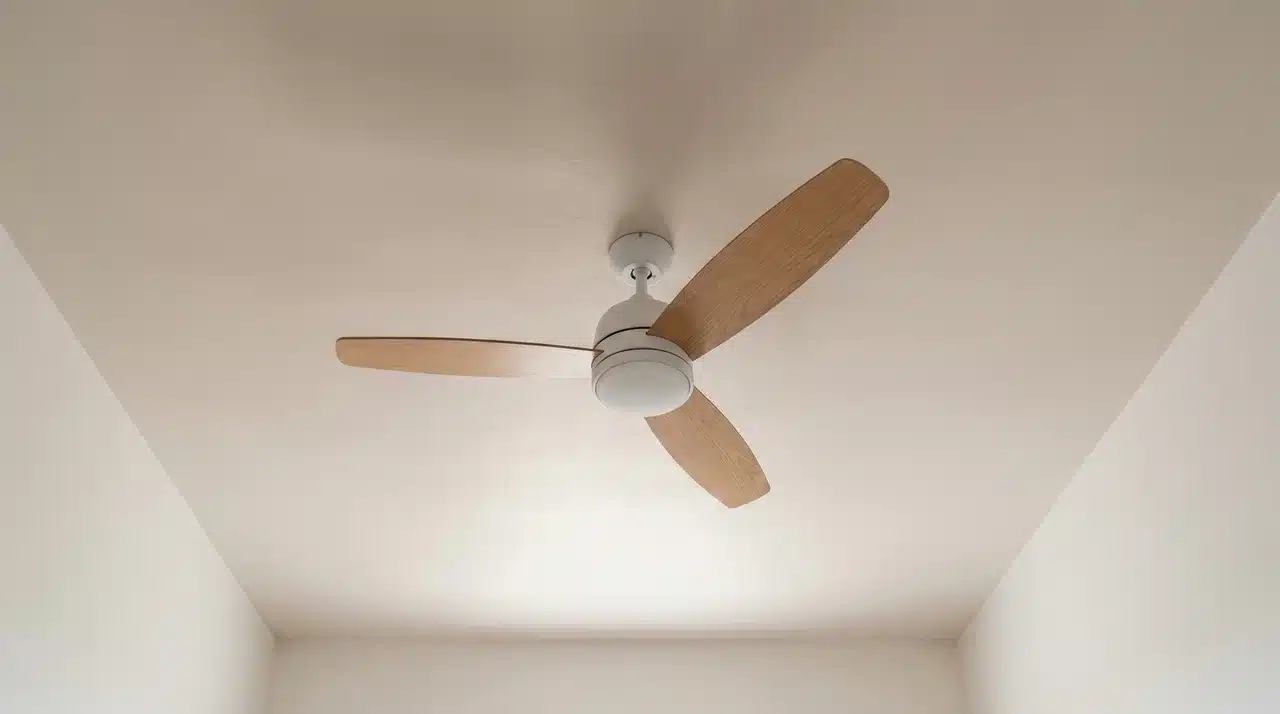
Getting the right ceiling fan size for a bedroom starts with one thing: room size. Once you know the square footage, the rest gets a lot easier.
Most people get this wrong in two ways. They either pick a fan that’s too big for a small room, making the air feel harsh, or too small for a large room, where the air doesn’t reach the bed.
If you’re trying to figure out what size ceiling fan for a bedroom works best, this is the starting point you can’t skip. After that, things like height, motor strength, and controls just help fine-tune the choice.
And once the size is sorted, choosing a ceiling fan becomes way less confusing because most of the hard part is already done.
Bedroom Fan Size by Square Footage
Blade diameter for a bedroom usually runs from 36 to 52 inches or more, depending on room size.
If you’re figuring out what size ceiling fan for bedroom use, start by measuring the length and width of the room, then multiply them to get square footage. That number helps guide the right blade size.
| Bedroom Size | Square Footage | Recommended Blade Diameter |
|---|---|---|
| Small | Up to 100 sq. ft. | 36 to 42 inches |
| Medium | 100 to 150 sq. ft. | 42 to 48 inches |
| Large | 150 to 225 sq. ft. | 48 to 52 inches |
| Extra Large / Master | 225+ sq. ft. | 52 inches or larger |
If Your Fan is Too Large
A fan that’s too large causes real problems. The blades end up too close to the walls, which breaks the airflow and creates turbulence.
It sounds powerful, but the room never feels right, and it usually runs louder than a fan that fits properly.
If It’s Too Small
A fan that’s too small has the opposite issue. It moves air over one part of the bed and misses the rest. You can run it on high all night and still feel like nothing’s happening.
I’ve seen the 52-inch-in-a-small-room mistake more than any other.
A 12×12 bedroom is 144 square feet that’s medium, not large. The right fan for that room is 42 to 48 inches. A 52-inch fan is oversized, and you’ll notice it every time it runs.
If your room lands right on the border between two size ranges, go by your longest wall. A room that’s 10 feet on one side and 14 feet on the other is closer to medium than small size up.
How Ceiling Height Affects Which Fan You Need
Depending on different ceiling types and their heights, the number that governs everything here is 7 feet.
Fan blades have to sit at least 7 feet off the floor that’s the minimum for safety and for the airflow to actually reach you. Every ceiling height decision follows from that.
For ceilings at or under 8 feet, you want a flush-mount or low-profile fan.
These mount straight to the ceiling box with no rod. That keeps the blades within the 7-foot clearance without dropping into anyone’s head.
For ceilings 9 feet and above, you need a downrod.
The downrod hangs the fan below the ceiling mount and brings the blades down into the zone where they move air toward you.
| Ceiling Height | Downrod Length |
|---|---|
| 8 feet | Flush mount (no rod) |
| 9 feet | 6 inches |
| 10 feet | 12 inches |
| 12 feet | 24 inches |
Why Height Matters More than Speed
Here’s what catches people off guard: mounting a fan flush to a high ceiling doesn’t help if you just run it faster. Distance matters more than speed.
A ceiling fan pushes air straight down in a column. The further that column has to travel before it reaches you, the more it spreads out and loses force. A fan sitting 14 feet up is basically decorative.
Use the downrod table as a starting point, but the real goal is getting the blades between 8 and 9 feet from the floor. Work backward from that height; don’t just measure down from the ceiling and call it done.
Motor Type and Airflow: What the Specs Actually Mean
Two specs matter when you’re comparing fans: CFM and motor type. Most buyers look at blade size and move on. That’s the wrong place to stop.
CFM Explained and Why It Matters for Cooling Performance
CFM stands for Cubic Feet per Minute. It measures how much air the fan moves every minute at a given speed. It’s the number that tells you whether a fan will actually cool your room, not just spin in it.
You can have two fans with the same blade diameter and very different CFM ratings. The one with lower CFM will feel noticeably weaker in the same space. Check the CFM on the product page before you buy it; it’s almost always listed.
AC Motor vs. DC Motor
Motor type is the other big factor. This is where choosing a ceiling fan really starts to make sense, because the motor decides how smooth, quiet, and strong the airflow feels.
| Feature | AC Motor | DC Motor |
|---|---|---|
| Power draw | Typically 70 to 80 watts | Typically 28 to 35 watts |
| Noise | Louder at low speeds | Significantly quieter |
| Upfront cost | Lower | Higher |
| Control options | Basic speed regulators | Compatible with remote and smart controls |
| Best use | Living rooms, common areas | Bedrooms, spaces needing quiet operation |
AC motors are solid. For a living room or hallway, they’re fine. But a bedroom is different; the fan runs all night, and noise at low speed is felt more than heard.
In my experience, the noise gap at low speeds is the thing that actually changes how well you sleep. An AC motor on speed 1 hums. A DC motor on speed 1 barely makes a sound. That difference matters at 2 AM.
Blade Pitch and Blade Count
If there’s one spec on the fan sheet most buyers ignore, it’s blade pitch. And it matters more than blade count by a lot.
Blade pitch is the angle of the blades compared to a flat horizontal. That angle controls how much air the fan pushes down with each spin.
A pitch between 12 and 15 degrees moves the most air. Drop 10 degrees below, and the fan is mostly turning without pushing.
Impact on Airflow and Motor Load
This is where a lot of people get it wrong. A five-blade fan with low pitch can move less air than a three-blade fan with a steeper pitch.
More blades don’t automatically mean better airflow. Pitch matters more.
Also, higher pitch puts more pressure on the motor. So if you pair a steep pitch with a weak motor, the fan can get noisy or wear out faster over time. When pitch goes up, motor quality needs to keep up too.
If you’re still figuring out what size ceiling fan for bedroom works best, this is the part that comes after size. Size gets you in the right range. These specs decide how well it actually performs once it’s running.
How to Choose a Ceiling Fan: Features Worth Paying For
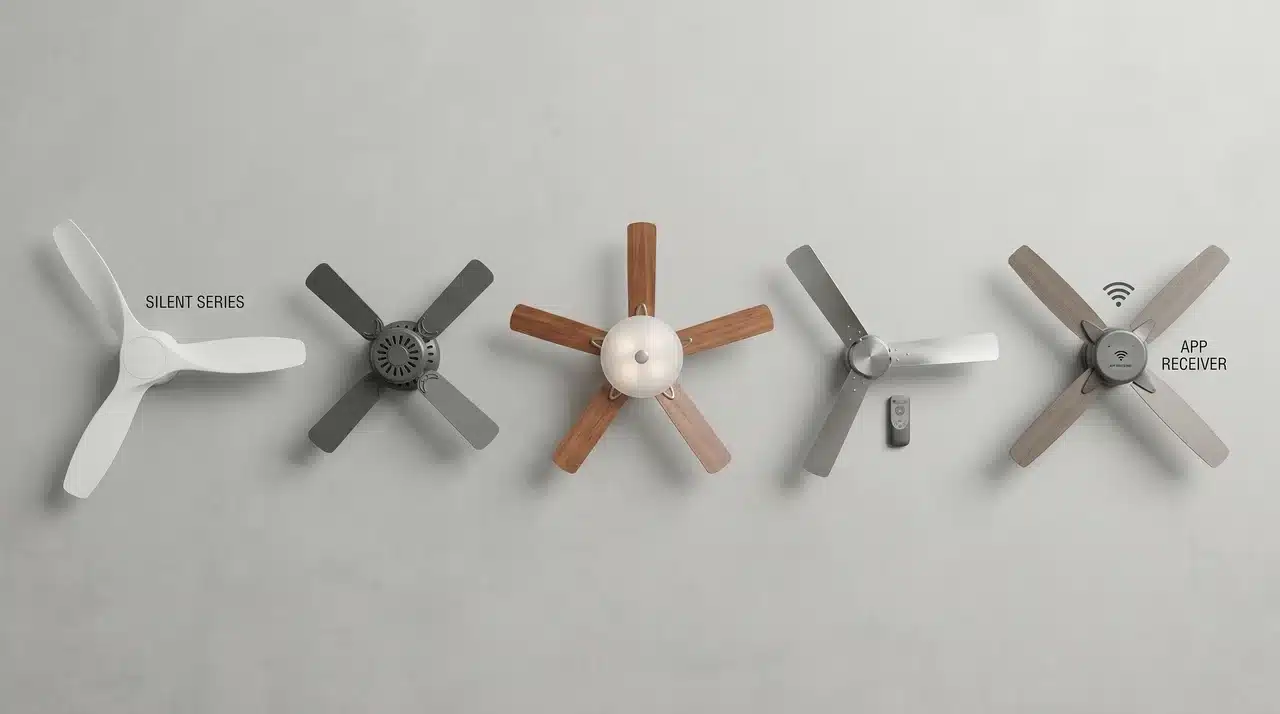
A bedroom fan lives a harder life than a fan in any other room. It runs longer, at lower speeds, in a space where every little sound matters.
The features worth paying for aren’t the flashy ones they’re the ones that serve those specific conditions night after night.
Remote Control Convenience And Night Use
The single most useful feature in a bedroom fan is remote control. If you can’t adjust the fan without getting out of bed, you’ll stop adjusting it.
That means you’ll spend the night warmer or cooler than you need to be, because getting up at midnight isn’t worth it. A remote removes that friction completely.
Lighting Temperature And Bedroom Comfort
For built-in lighting, the spec that matters is color temperature, not brightness. A fan locked to cool white is fine for an office.
In a bedroom at night, it works against you. Look for warm white or dual-tone with dimmer support. That way, the same fixture handles reading light and wind-down light without you touching a wall switch.
Tip: Skip large decorative fans made for high ceilings. They focus on looks, not airflow, and usually fail to deliver steady, focused cooling in a bedroom.
Remote and Smart Controls
- Remote control: The right baseline for any bedroom. You handle speed, power, and light from wherever you are. One remote can often run multiple fans, which is handy if you have a connected sitting area or an attached space.
- Smart control: Links to a smartphone app and works with home automation. You can set schedules, connect the fan to a thermostat, and use voice commands if your setup supports it. Worth it if your home already runs on a smart system; extra hassle if it doesn’t.
- Wall regulator: It works, but you have to get up every time you want to change the speed. Fine for a guest room. For your own bedroom, the remote is worth the extra cost.
Pull chains are worth a quick mention just to say skip them. They’re the oldest control method, genuinely awkward in a bedroom, and rare on modern fans. If a fan only ships with pull chains and no remote option, that’s your cue to keep looking.
Where to Put the Fan in a Bedroom
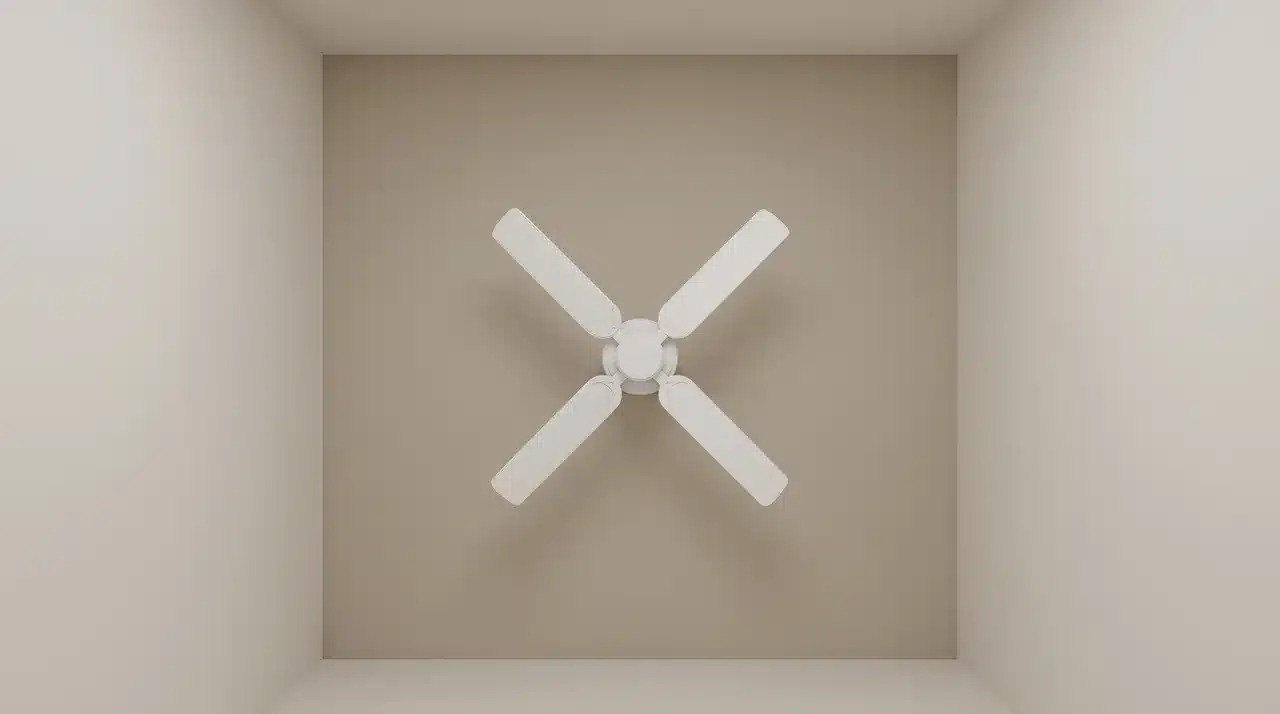
Dead center of the room, every time. An off-center fan pushes air unevenly; one side of the bed gets a breeze, the other gets nothing.
I’ve seen this blamed on the fan when the real issue was a ceiling point six inches off-center. Placement matters as much as size.
Before you install, check two clearances:
- Blade-to-wall clearance: At least 18 inches between the blade tips and the nearest wall. This is the Energy Star standard. Get closer than that, and the fan creates turbulence instead of smooth airflow.
- Blade-to-furniture clearance: A tall wardrobe or bookshelf near the fan does the same thing a wall does. It breaks the airflow and can make the fan louder at higher speeds.
A correctly sized fan installed off-center against a wall will still perform poorly. Clearance is what turns the right blade diameter into actual comfort in the room.
If dead center isn’t possible with your ceiling point, get as close as you can. A slight offset is always better than placing the fan directly over one side of the bed.
Conclusion
Two measurements settle the right bedroom fan: square footage and ceiling height. Get those right, and the rest falls into place. Motor type, controls, and lighting all follow from there.
If you’re trying to figure out what size ceiling fan for bedroom actually works, this is the starting point.
Start with your room dimensions. Multiply length by width, match the number to the size chart, and you have your blade diameter. If the ceiling is 9 feet or higher, use the downrod table to get the blades between 8 and 9 feet from the floor.
Once those two are locked, a DC motor with remote control covers the rest of what a good bedroom ceiling fan needs: quiet at low speeds, efficient overnight, and adjustable without leaving the bed.
Frequently Asked Questions
Is a 52-inch fan too big for a 12×12 bedroom?
A 12×12 room is 144 square feet that’s medium range, not large. The right fan for that size is 42 to 48 inches. A 52-inch fan is too big: the blades sit too close to the walls, which creates turbulence instead of clean airflow. A 44 to 48-inch fan is the better call for that room.
How do I know what size ceiling fan I need for my bedroom?
Measure the length and width of your room and multiply them to get square footage. Up to 100 sq. ft. needs a 36 to 42-inch fan. Between 100 and 150 sq. ft. needs 42 to 48 inches. Between 150 and 225 sq. ft. needs 48 to 52 inches. Master bedrooms over 225 sq. ft. need 52 inches or more.
What happens if your ceiling fan is too big for the room?
An oversized fan pushes air too hard for the space. The blades sit too close to the walls, which breaks the airflow pattern and creates turbulence. You get a fan that sounds like it’s working but doesn’t cool the room evenly, and it usually runs louder than a correctly sized one would.
How high off the floor should a ceiling fan be in a bedroom?
Blades need to sit at least 7 feet from the floor. Below that is a safety issue. Above 9 feet, the airflow drops off; the blades are too far from the living zone to push air toward you. If your ceiling is higher than 9 feet, a downrod brings the fan down into the range where it works.