


Most closet clean-outs fall apart in the middle. You pull everything out, the pile looks enormous, and suddenly you’re holding a shirt from four years ago, trying to decide if it still counts.
A closet clean-out works when you have a system before you start, not just good intentions.
This guide walks you through every step: what to set up, how to sort each item, how to put things back, and what to do with everything that leaves. Follow the order, it matters more than you’d think.
What You Need Before You Touch a Single Item
A closet clean-out is simple in theory: take everything out, decide what stays, put back only what earns its place. The outcome is a closet where everything in it is something you actually wear.
Where it goes wrong is the setup or the lack of one.
Before you open the closet door, clear a full workspace. Your bed or the floor works, as long as there’s enough room to lay out everything at once. Block off two to three hours with no interruptions.
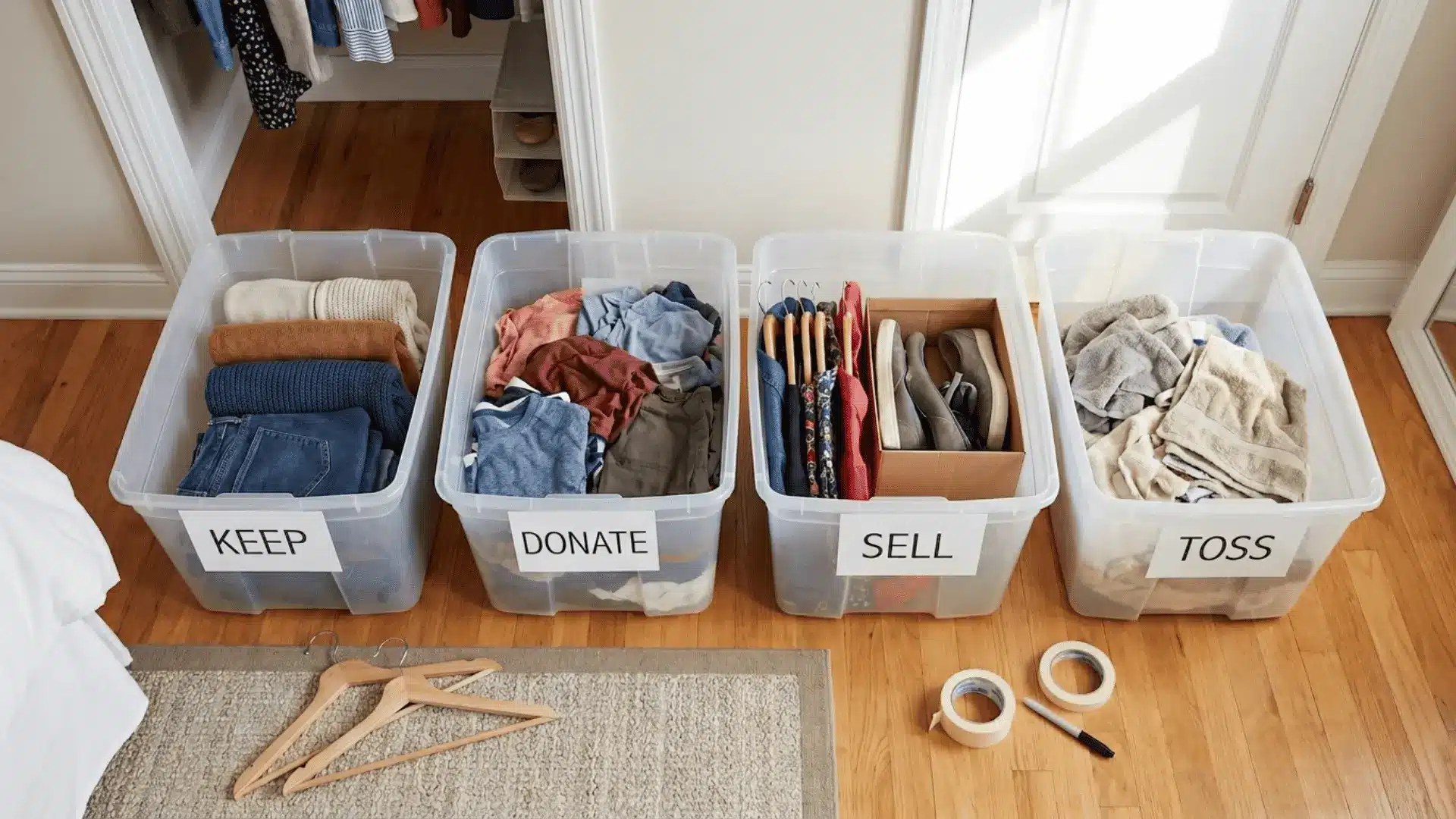
Get four bins or bags and label them: Keep, Donate, Sell, and Toss.
Without those bins in place, items pile up with no destination. You end up making the same call three times on the same piece, only to put it back.
I’ve watched people try to sort directly from a packed closet, pulling out one thing at a time. It always ends the same way: half a decision made, a chair covered in maybes, and the closet still full. Do the setup first. It’s not a detail; it’s what makes finishing possible.
How to Declutter Your Wardrobe Step-by-Step
Every item needs to move through the same sequence: empty first, sort second, try on what you’re unsure about third, and handle sentimental or seasonal pieces last.
Do it in that order. Jumping ahead, especially to sentimental items early, is the fastest way to lose an afternoon and finish nothing.
Step 1: Empty Everything Out
Take every piece of clothing out of your closet, shoes, accessories, all of it, and lay it where you can see it at once.
This is the step that surprises people. If you’ve ever thought “I don’t have that much,” you’ll change your mind fast. Seeing the full volume in one place is what makes the decision feel real, not optional.
Step 2: Sort with a Decision System
Every item goes into one of four piles: Keep, Donate, Sell, or Toss. Three rules tell you where each one lands, and having all three matters because different items need different tests.
Time Rule
- Haven’t worn a seasonal item in the past year; it goes.
- Haven’t worn a staple in six months, same decision.
- Formalwear is the exception, but only if it will actually be worn in the next few months, not at some vague future point.
Fit and Lifestyle Test
- Does it fit right now, today?
- Does it match what daily life looks like now, not what it used to be or what might happen later?
Rule of 3
- Can it be styled in at least three different outfits?
- If three combinations do not come to mind quickly, it is not doing enough work in the wardrobe.
- If it only works with one or two other items, it is not earning its place.
This is where the process breaks down for most people: guilt. Keeping something because it was expensive, a gift, or “might fit someday” is not the same as keeping it because you wear it.
My friend once spent 20 minutes on a single dress she’d never worn, building a case for it. The time rule exists so you don’t need a case; the item just hasn’t been used, and that’s the whole answer.
Your closet should reflect your real life, not an aspirational version of it.
Step 3: Try It On
Once you’ve sorted the easy keeps and obvious no’s, try on the pieces you’re unsure about. Don’t trust how they look just hanging there.
A lot of the time, a shirt looks fine on the hanger but feels totally off once it’s on your body. It might pull at the shoulders, sit weird at the waist, or just not feel right when you move.
If you put something on and you can’t quickly picture where you’d actually wear it or what you’d pair it with, that’s usually your answer. It’s not worth keeping. Put it in the donate or sell pile and move on.
Step 4: Handle Sentimental and Seasonal Items Last
Set these aside during the main closet clean-out. Come back to them later once everything else is done. One box of old concert shirts dealt with too early, and suddenly an hour disappears into nostalgia.
For seasonal items, keep it simple. Use labeled bins or vacuum bags and store them outside your main closet. For sentimental pieces, decide the limit before you even start.
One shelf, one box, one fixed space. If it doesn’t fit there, it doesn’t stay in your everyday setup. That’s a big part of decluttering your wardrobe without getting overwhelmed.
Think of it like this. Keeping something doesn’t mean it has to take up daily space in your closet. Storage is fine. The only thing that matters is setting the limit early.
How to Put Back What You’re Keeping

How you put things back decides if a closet clean-out actually sticks or if it just looks neat for a week. The order matters more than people think. Start with the category first, then sort by color inside each group.
Group by Category
all shirts together, all pants together, dresses, outerwear. This is how you reach for clothes in the morning. You think “I need a shirt,” not “I need something blue.”
Within each category, go light to dark. Color becomes a quick scanning layer once you’re already in the right section.
Store Items by Visibility and Frequency of Use
For drawers and shelves, fold sweaters, jeans, and workout gear vertically instead of stacking them. Vertical folding lets you see every item without moving anything else.
Stacking buries the bottom half of the drawer those clothes stop getting worn because you stop seeing them.
Daily shoes go at eye level. Less-used pairs go higher or in labeled bins. Anything stored behind other things disappears within a week.
What to Do with Everything That’s Leaving
Everything leaving the wardrobe goes one of three ways: donation, resale, or textile recycling. Deciding which path each piece takes before you finish sorting is what stops bags from sitting in your hallway for months.
| Route | Best For | How |
|---|---|---|
| Donation | Good-condition pieces you’re done with | Local thrift stores, shelters, or drop bins. Schedule a pickup before you finish, “I’ll drop it off eventually” is how bags become permanent fixtures. |
| Resale — Online | Items worth the extra effort | Poshmark, thredUP, Depop. More time to list and photograph, but higher return per piece. |
| Resale — Consignment | Quality or brand-name pieces, limited time | Drop off and split the sale. Lower effort, lower return. Right choice when time is short. |
| Textile Recycling | Stained, torn, or too worn to wear | Mail-in programs or drop-off bins. Don’t donate damaged items; most centers throw them away anyway. |
How to Keep It from Filling Back Up
- One-in-one-out rule: Every time something new enters the wardrobe, something leaves. Catches accumulate at the source before it quietly builds up again.
- Seasonal mini-review: Spend 20 minutes each spring and fall pulling anything unworn last season and deciding whether it earns another rotation.
- Pre-purchase filter: Before buying, ask whether it replaces an existing item or fills a gap the clean-out revealed. If neither, pause.
- Annual reset: One full clean-out a year keeps the baseline honest. It won’t hold the line alone, but it catches what daily habits miss.
- Clean wardrobe, clear criteria: Knowing what you actually own makes every future decision faster. You’re not guessing, you’re working from a real picture.
- Small habits, big difference: Two minutes of discipline at the point of purchase beats two hours of sorting later. The pile never reaches overwhelm again.
Conclusion
A closet clean-out done properly is something you only do at full scale once. After that, it’s just maintenance. The hardest part is the middle, when everything is out, and the pile looks bigger than you expected. That feeling means the process is working, not that something went wrong.
Every call you made holds. What fits, what you wear, what your life actually needs right now- those were the right questions. The closet left behind is one you can use.
Frequently Asked Questions
What is the fastest way to clean out a closet?
Empty everything first so you can see what you’re working with. Then sort into Keep, Donate, Sell, and Toss without trying anything on during the first pass; save that for the pieces you’re genuinely unsure about. Set a timer. Limiting deliberation to uncertain items cuts the time roughly in half compared to deciding on every single piece from scratch.
What is the Rule of 3 for a closet clean-out?
The Rule of 3 means keeping only items you can picture in at least three different outfits. If you can’t quickly come up with three combinations, the item isn’t earning its space. It’s a practical filter for pieces that fit well but don’t actually work with much else. You own being in good condition isn’t the same as being useful.
How often should you clean out your closet?
Twice a year, lines up with seasonal shifts, spring and fall, and keeps gradual buildup from becoming a full-scale project. Use the one-in-one-out rule between clean-outs, and each session gets shorter. The first clean-out is always the biggest. Everyone after that is easier because the pile never gets as large.
What should you not keep during a closet clean-out?
Skip anything that doesn’t fit now, hasn’t been worn in over a year, or is only staying out of guilt, a gift you never liked, or something expensive that turned out to be wrong for you. Keeping clothes for what they cost rather than what they do for your wardrobe is the most common reason a clean out leaves the closet still feeling cluttered.