


People think commercial real estate investing locks them out until they have serious capital or industry connections. That’s not quite right. The real barrier is understanding how value works in this asset class because it functions nothing like residential property.
In CRE, income drives value. Get that foundation right, and everything else, which property type fits your goals, which strategy matches your experience, and how lenders think about your deal starts to connect.
Whether you want to own a building directly or invest passively through a platform, this guide covers valuation logic, asset types, investment strategies, financing mechanics, and the team you need before you close.
How Is Commercial Real Estate Value Actually Calculated?
Commercial real estate value comes from one thing: the income the property generates. Not what a similar building sold for down the street. Not square footage. Income.
That’s the sharpest difference between CRE and residential investing, and it trips up more first-time buyers than anything else in this process.
| Concept | Definition | Key Insight |
|---|---|---|
| Net Operating Income (NOI) | What’s left from rental income after operating expenses like property management, insurance, and maintenance. Debt payments are not included. | NOI represents the raw earning power of the asset. |
| Capitalization Rate (Cap Rate) | A market-set rate reflecting risk for a property type and location. | Value is driven by how the market prices risk. |
| Valuation Formula | Property value is calculated by dividing NOI by Cap Rate. | Price and NOI are directly linked through the market Cap Rate. |
| Market Reality | A vacant building and a fully leased one are different assets in practice. | Lower NOI reduces value even if the property itself does not change. |
| Investment Focus | Experienced investors underwrite tenants as carefully as the building. | Tenant quality directly impacts NOI and therefore valuation. |
One exception worth knowing: SBA loans for owner-occupied properties.
When the business operating inside is the borrower, lenders shift focus from property income to the owner’s creditworthiness. The NOI logic still applies, but it’s not the only thing driving the deal.
What Types of Commercial Properties Can You Invest In?
Commercial real estate covers five distinct property types. Each carries a different risk profile, a different tenant structure, and a different financing path.
Knowing the difference matters before you pick a strategy; the type you choose shapes every decision that follows.
1. Office
Buildings range from downtown high-rises to suburban campuses. Leases are long, but the sector has faced real headwinds as hybrid and remote work patterns have shifted demand. Office isn’t off the table, but it takes more market-specific research than it used to.
2. Retail
Covers everything from strip malls to single-tenant net-lease properties.
Single-tenant retail with a strong national brand on a Triple-Net (NNN) lease, where the tenant covers property taxes, insurance, and maintenance on top of base rent, can be very stable.
Multi-tenant retail is a different animal. Vacancy in one unit affects the whole property’s valuation and financing.
3. Industrial and warehouse
Space has been one of the stronger CRE sectors in recent years. Demand from e-commerce and logistics keeps occupancy high and lease terms predictable.
Management demands are lower than retail or office, which makes it worth more consideration than it typically gets from first-time buyers.
4. Multifamily
Properties with five or more units are classified as commercial real estate and valued on income, just like office or industrial.
This catches residential investors off guard. If you’ve owned a duplex or fourplex, multifamily CRE follows different rules. A five-unit building is a commercial asset financed, appraised, and underwritten on NOI.
5. Specialty Assets
Hotels, self-storage, medical offices, and others each follow their own demand drivers and lease structures. They can perform well, but they’re not where you build CRE foundations. Learn the core types first.
What Investment Strategies Exist in Commercial Real Estate?

Strategy in CRE isn’t a preference. It’s a match between what you have in capital, time, and operational capacity and what the deal requires.
Choosing the wrong strategy for your situation costs more than choosing the wrong property.
1. Core and Core-Plus
Core properties are fully leased, well-located, and stable. They generate predictable cash flow with a lower return ceiling and fewer surprises.
Core-Plus properties look similar but carry a small improvement opportunity below-market rents, light renovation potential that adds modest upside without heavy operational work.
Both types suit investors who want steady income without manufacturing returns. They’re designed for investors who want the property to largely run itself.
2. Value-Add
Value-Add is the strategy most new investors target first. Buy an underperforming property, improve it, raise rents, increase value. The concept is simple. The execution is not.
What kills Value-Add deals isn’t the renovation it’s attempting one without the infrastructure to run it. You need a reliable property manager, a trusted contractor, and enough reserves to absorb delays. Build the team before you find the deal, not after.
3. Opportunistic
Opportunistic deals, ground-up development, and major repositioning projects offer the highest potential returns and the highest complexity.
Permit delays, construction cost overruns, and shifting market conditions can all compress or eliminate returns that looked strong on paper.
This strategy requires deep capital reserves, a proven team, and real experience managing multiple moving parts simultaneously. It’s not a starting point. It’s where you go after you’ve learned the asset class on simpler deals.
4. Passive and Indirect Investing
You don’t have to own a building to invest in commercial real estate. Passive vehicles give you real CRE exposure with significantly less capital and none of the management burden, and for many investors, this is the right place to start.
5. REITs
(Real Estate Investment Trusts) are publicly traded and highly liquid. You can buy and sell shares the same way you trade stocks. The trade-off is that you have no control over which properties are held or how they’re managed.
Crowdfunding platforms like CrowdStreet and Fundrise let you invest in specific deals or portfolios for a fraction of whole-building ownership.
Liquidity is lower than REITs; your capital is typically locked up for the deal’s hold period, but you get more visibility into what you’re investing in.
6. Syndications
They pool capital from multiple investors to acquire a single asset. A sponsor manages the deal; limited partners contribute capital and share in returns.
Syndications let you access deals that would otherwise require far more capital than most individuals have.
Starting passive is a legitimate path into CRE. It lets you learn how commercial assets behave before you commit to the complexity of direct ownership.
How Does Commercial Real Estate Financing Work?
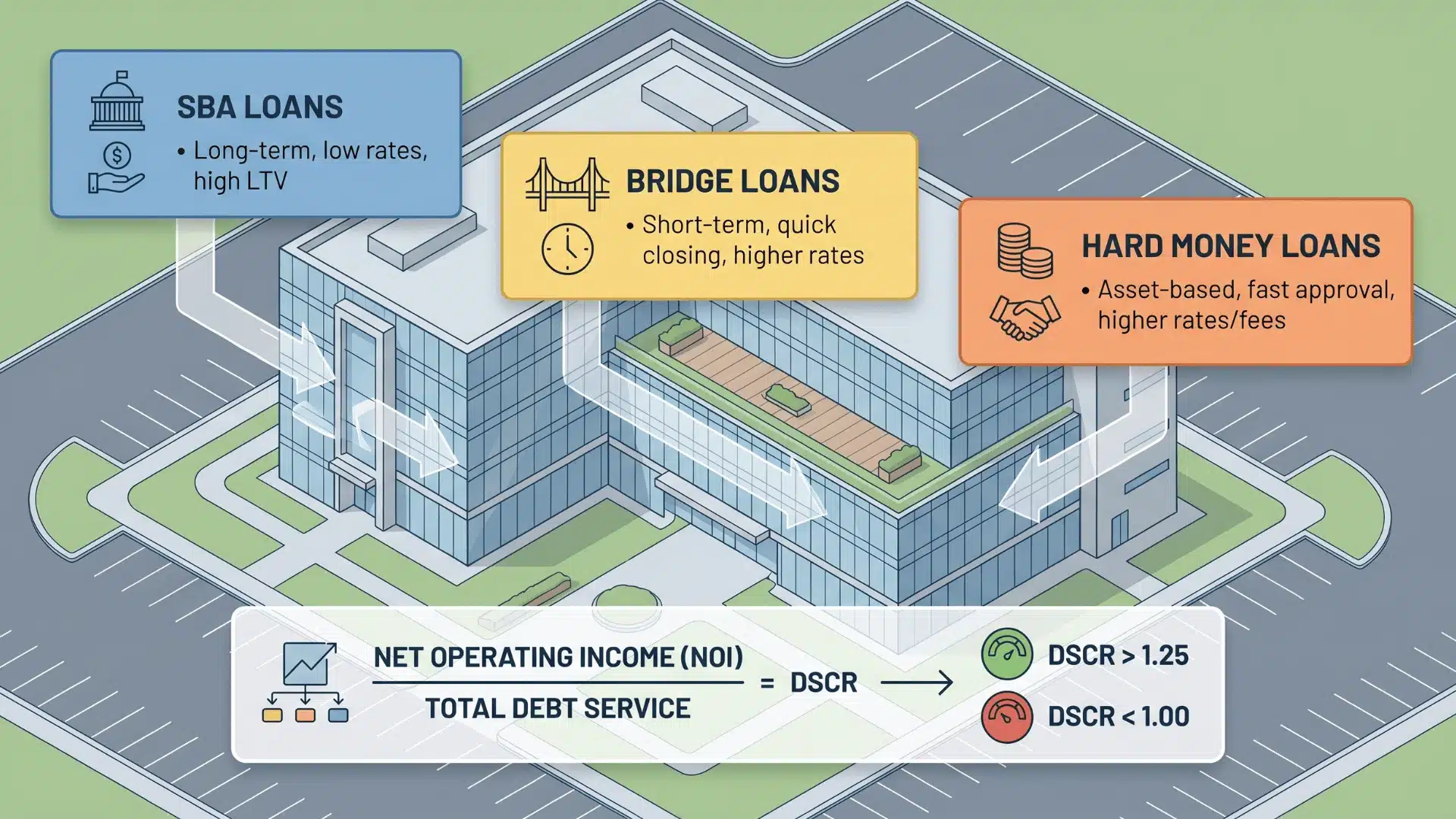
Commercial loans don’t work like residential mortgages. The property’s income is the primary thing lenders look at, not your personal salary, not your credit score alone.
That catches a lot of first-time commercial buyers off guard, usually right when it’s too late to adjust.
Debt Service Coverage Ratio (DSCR)
The number lenders care most about is DSCR (Debt Service Coverage Ratio). It’s NOI divided by the annual debt payment. Most conventional lenders require a:
- DSCR of 1.25 or higher
- property must earn 25% more than it costs to service the loan.
Drop below 1.25, and the deal is unbankable under conventional terms. Strong personal finances don’t change that.
Even partial vacancies can push DSCR under the threshold; a deal underwritten at full occupancy can fall apart at the financing stage when a lender runs a stress test.
DSCR isn’t just a lender’s metric. It’s your early warning system. If a property can’t clear 1.25 at your target purchase price, the price is wrong, the income is wrong, or both.
Loan Types and When Each Applies
Three loan types come up in most commercial acquisitions. Each serves a different situation, and picking the wrong one costs you time, money, or leverage.
- SBA loans work for owner-occupied properties where the business inside is the borrower. The lender focuses heavily on your personal creditworthiness, not just the property’s income.
- Bridge loans cover the gap between purchase and stabilization, useful for Value-Add deals where the property isn’t fully leased yet. They’re short-term and expensive, so you need a clear exit before you take one. Refinancing into a permanent loan once the property is stabilized is the typical path out.
- Hard money loans move fast and ask fewer questions. The interest rate reflects that. Use them as a last resort, not a default option.
Before you sign anything, understand one more thing: recourse vs. non-recourse.
A recourse loan lets the lender come after your personal assets if the property can’t cover the debt.
Non-recourse loans limit their recovery to the property itself. Most conventional commercial loans are recourse. Read the terms before you assume otherwise.
Who Do You Need on Your Team Before Closing?
A commercial real estate transaction is not something you navigate alone. The deals are bigger, the leases are longer, the financing is more complex, and the mistakes are harder to unwind.
Building your team before you find a deal, not after, is the right order for commercial real estate investors.
Deal Sourcing Channels and Relationship Building
Deals come from a few reliable channels. Commercial brokers are the most direct path; they know the market, they see listings early, and the best ones surface off-market opportunities that never appear on LoopNet or CREXi.
Networking at industry events and building relationships with investors who’ve already closed deals in your target market open doors that platform searches don’t. The broker relationship is worth building before you’re actively looking.
Core Professionals You Need Before Closing
Once you’re in a deal, four professionals protect your position. Here’s what each one actually does and why the generalist version of each role usually isn’t enough.
- A commercial broker reads market dynamics, spots off-market opportunities, and catches lease terms that quietly reduce a property’s value. Residential brokers rarely have the same depth on cap rate analysis or commercial lease structures.
- A real estate attorney reviews multi-year leases, tenant default provisions, and environmental liability clauses. These details carry real financial consequences over a 10-year lease term. A deal that looks clean on the surface can carry serious exposure that only shows up in the fine print.
- A CRE accountant improves after-tax cash flow through cost segregation and accelerated depreciation. These are strategies a generalist accountant often doesn’t know to apply. The difference in tax treatment over the life of a property can be substantial.
- A mortgage broker who works commercial deals regularly knows which lenders are active in your asset class and deal size, and can access terms you often won’t find approaching banks directly.
First-time deals go wrong most often when investors treat professional fees as costs to cut. A cheap legal review on a 10-year lease is not a saving. It’s a liability waiting to surface.
Conclusion
The through-line in commercial real estate investing is income. Every decision you make, from which property type to target to how you structure financing, flows from how well you protect what the asset earns.
Active ownership gives you control and equity. Passive vehicles give you exposure and simplicity. Neither path is wrong. The right one depends on where you’re starting from and how much complexity you’re ready to manage.
What separates a good first deal from an expensive lesson isn’t capital. It’s preparation: understanding the valuation logic, knowing which strategy fits your situation, and having the right people in your corner before you commit.
Frequently Asked Questions
Is commercial real estate worth it for individual investors?
It depends on your starting point. Passive vehicles like REITs and crowdfunding offer CRE exposure with minimal capital and no management burden. Direct ownership delivers stronger returns and real tax advantages, but requires significantly more capital, expertise, and operational involvement. For most individuals, starting passive and building toward direct ownership is the more durable path.
How much capital do I need to start investing in commercial real estate?
Passive entry through REITs or crowdfunding platforms like CrowdStreet or Fundrise requires very little, sometimes a few hundred dollars. Direct property ownership typically requires a 20–35% down payment plus reserves. On a $1 million property, that means at least $200,000–$350,000 before closing costs, carrying costs, or renovation budget.
What is the 2% rule in commercial real estate?
The 2% rule says monthly rent should be at least 2% of the purchase price for a property to cash flow. In practice, CRE investors use cap rate and DSCR instead. The 2% rule is a rough residential heuristic that rarely applies in commercial markets, where income quality, lease structure, and tenant creditworthiness carry far more weight.
What property types are best for first-time commercial real estate investors?
Industrial and multifamily properties are the most accessible starting points. Industrial, including self-storage, typically has lower management demands and strong tenant retention. Multifamily with five or more units provides multiple income streams that buffer against single-vacancy risk. Office and retail carry more cyclical exposure and suit experienced investors better.