

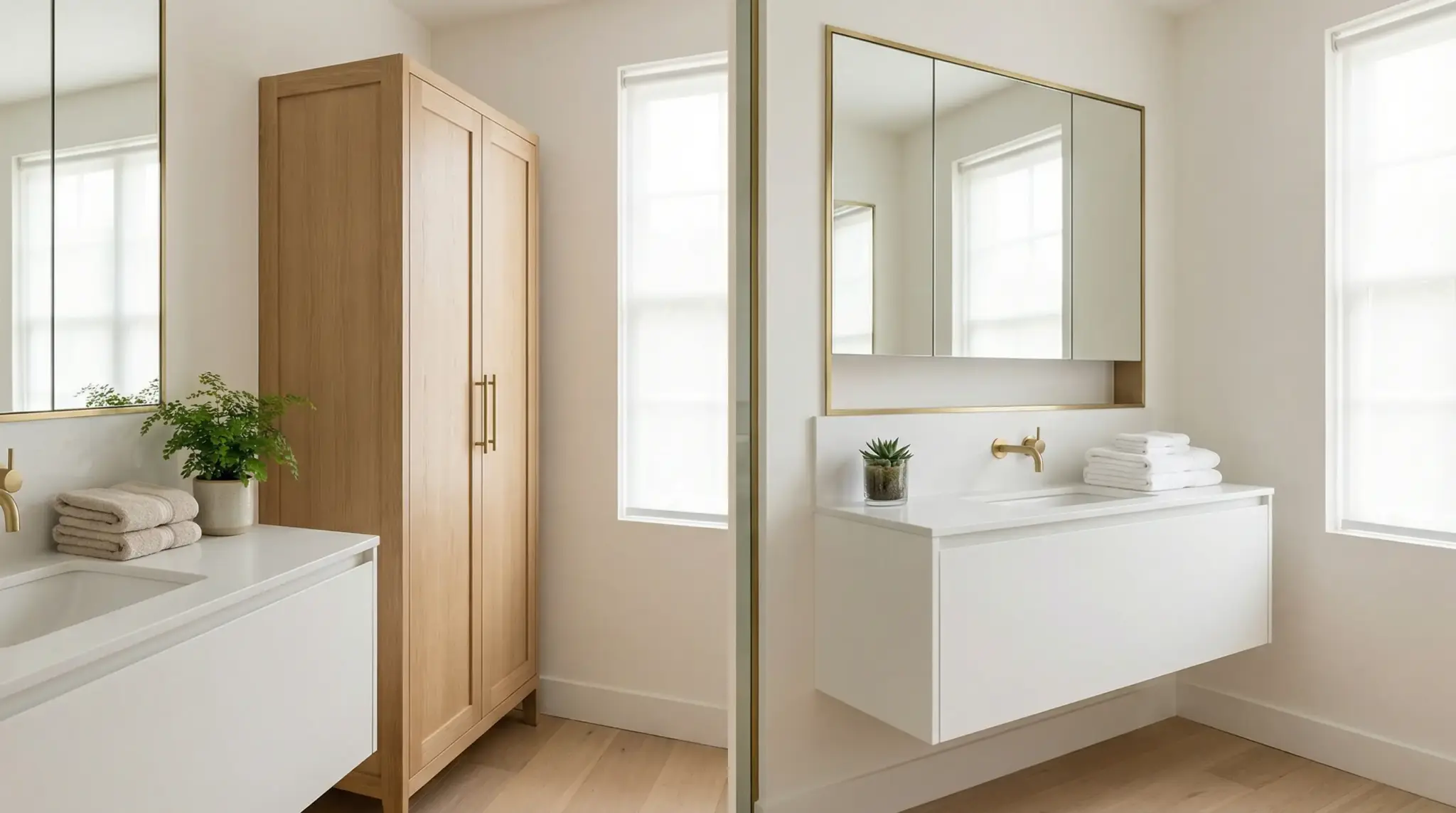
When you walk into a bathroom that works well, you probably do not notice the storage. Everything has a place. The counter is clear. Towels are within reach. Toiletries are tucked away but easy to grab. When a bathroom does not work well, the problem is almost always a lack of good storage. The counter gets cluttered, and you waste time hunting for things.
Two types of storage come up most often in bathroom remodels. One is a bathroom cabinet, which is usually a larger piece of furniture or a wall-mounted unit. The other is a medicine cabinet, which combines a mirror with hidden storage behind it. Both solve the same problem, but they do it in different ways. Choosing between them depends on your space, your storage needs, and how you use the bathroom every day.
What Each One Does Best
Before you can decide which type of storage makes sense for your bathroom, it helps to understand what each one is built to do.
A bathroom cabinet is designed for volume. It gives you shelves, drawers, or both, and it is meant to hold larger items like towels, extra toilet paper, cleaning supplies, and backup toiletries. Some bathroom cabinets are freestanding pieces that sit on the floor. Others mount to the wall. Either way, the goal is to handle the things you need to store but do not need to access every single time you are in the bathroom.
A medicine cabinet is designed for small items you reach for daily. It is mounted directly to the wall, usually above the sink, and it serves two purposes. The front is a mirror that you use for getting ready. Behind that mirror is a shallow cabinet with shelves for things like toothpaste, medication, razors, and skincare products. The idea is to keep those small, frequently used items off the counter but still within arm’s reach.
Space and Layout Considerations
The biggest factor in choosing between these two storage options is the amount of space you have and where it is located.
When a Medicine Cabinet Makes Sense
A medicine cabinet is the right choice when floor space is tight. Because it mounts to the wall and sits flush or recessed, it does not take up any floor space at all. In a small bathroom or a powder room where every inch counts, a medicine cabinet gives you storage without making the room feel cramped.
If you can recess the cabinet between the wall studs, it sits nearly flush with the wall. That is the most space-efficient option. The mirror looks like a standard wall mirror, but you get a few inches of storage depth behind it. For bathrooms with a pedestal sink or a small vanity that lacks drawers, a medicine cabinet is often the only way to add storage without a full renovation.
When a Bathroom Cabinet Makes Sense
A bathroom cabinet works better when you have more space and when you need to store larger items. If you have a family with multiple people using the same bathroom, a wall-mounted or freestanding cabinet gives you the capacity to store towels, washcloths, and backup supplies.
A tall, narrow cabinet can fit into a corner or beside the vanity without taking up much floor space. A wider cabinet mounted above the toilet uses vertical space that is otherwise wasted. The key is matching the cabinet size to the room. In a larger master bathroom, you might have room for both a medicine cabinet over the sink and a separate linen cabinet for towels and supplies.
Storage Capacity and Organization
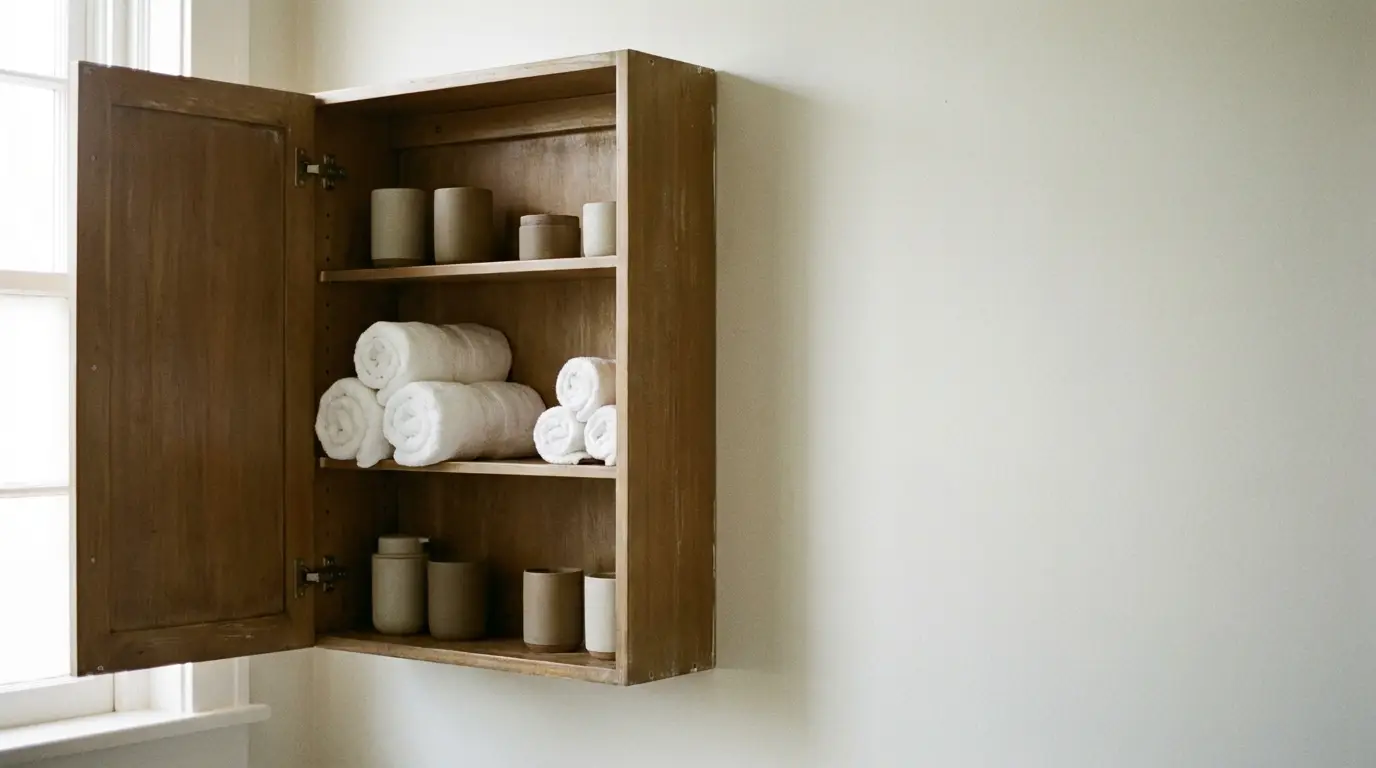
The way you store things matters just as much as how much you can store. Different items need different kinds of spaces.
Medicine Cabinet Storage
A medicine cabinet is shallow. Most are four to six inches deep. That is perfect for small, flat items but not for bulky things. You can store toothpaste, floss, a razor, contact lens solution, and daily medications. You can also store a few small bottles of skincare products if the shelves are adjustable.
What you cannot store in a medicine cabinet are towels, extra toilet paper rolls, cleaning supplies, or anything tall. The shallow depth limits you to items that fit within that few inches of space. For a household with minimal daily toiletries, a medicine cabinet may be enough. For a family with more stuff, you will need additional storage elsewhere.
Bathroom Cabinet Storage
A bathroom cabinet gives you much more flexibility. With shelves that are six to twelve inches deep or more, you can store towels, bath sheets, and extra supplies. If the cabinet has drawers, you can organize smaller items in a way that keeps them visible and accessible.
Drawers are useful for items you reach for regularly. Shelves work better for items you grab less often or that are larger. A good bathroom cabinet gives you a mix of both. You can put daily toiletries in a top drawer, extra soap and shampoo on a middle shelf, and backup supplies on a lower shelf.
The other advantage of a bathroom cabinet is that you can see everything at once when you open the door. With a medicine cabinet, you often have to move items around to reach what is in the back. With deeper shelves, you can organize in a way that keeps frequently used items in front.
Installation and Placement
How these cabinets install affects both the cost of your project and where you can put them.
Installing a Medicine Cabinet
A medicine cabinet can be surface-mounted or recessed. Surface-mounted is simpler. You attach the cabinet to the wall, and it sticks out several inches. This works in bathrooms where the wall cannot be cut open or where you want the option to change it later.
Recessed installation requires cutting into the drywall and fitting the cabinet between the wall studs. This gives you a cleaner look because the cabinet sits nearly flush with the wall. It also gives you more perceived space because the cabinet does not protrude into the room. The downside is that it is a more involved installation. You need to be sure there are no electrical wires or plumbing in the way before you cut.
Installing a Bathroom Cabinet
A wall-mounted bathroom cabinet attaches to the wall with brackets or screws into studs. The installation is straightforward, but you need to make sure the cabinet is securely anchored. A cabinet full of towels can be heavy, and drywall anchors are not strong enough to hold it long-term.
A freestanding bathroom cabinet sits on the floor. It is the easiest to install because you just place it where you want it. The trade-off is that it takes up floor space. In a small bathroom, a freestanding cabinet might make the room feel crowded. In a larger bathroom, it can serve as a design feature.
Materials and Durability
Bathrooms are humid environments. The materials you choose need to hold up over time.
What to Look For
For both types of cabinets, solid wood or plywood construction is better than particleboard or MDF. Particleboard can swell and warp when exposed to moisture. Plywood and solid wood handle humidity much better. If you choose a painted cabinet, look for a finish that is sealed to resist moisture.
The hardware matters too. Drawer slides and door hinges should be sturdy enough to handle daily use. Soft-close hinges are worth the extra cost. They prevent doors from slamming and reduce wear over time.
Medicine Cabinet Specifics
For a medicine cabinet, the mirror quality matters. Look for a mirror with clear, distortion-free glass. The backing should be moisture-resistant to prevent dark spots from forming around the edges. A sealed edge also helps keep moisture from seeping in behind the mirror.
If you choose a cabinet with a mirrored front, consider how the mirror is attached. A full-faced mirror with minimal seams looks cleaner than a cabinet with multiple small mirrors on each door.
Bathroom Cabinet Specifics
For a bathroom cabinet, consider whether you need adjustable shelves. Adjustable shelves give you flexibility to change the interior layout as your storage needs change. Fixed shelves are less flexible but can be sturdier.
If the cabinet has doors, think about whether you want glass fronts or solid doors. Glass fronts let you see what is inside, which can be helpful for finding things quickly. Solid doors hide clutter, which is useful if the cabinet is in a visible part of the room.
Lighting and Mirror Considerations
If you choose a medicine cabinet, it replaces your bathroom mirror. That means you need to think about lighting placement.
Lighting Placement
A medicine cabinet with a mirror front takes up the wall space where you might otherwise put a mirror. If you want sconces on either side of the mirror, you need to make sure the cabinet is narrow enough to leave room for them. A cabinet that spans the full width of the vanity may not leave space for side lighting.
If you prefer a light bar above the mirror, a surface-mounted medicine cabinet can work well. The light bar mounts to the wall above the cabinet. Just make sure the cabinet door does not hit the light fixture when it opens.
No Lighting Conflicts
A bathroom cabinet does not interfere with mirror placement. You can hang a mirror separately, which gives you more flexibility with lighting. You can put sconces on either side of the mirror or a light bar above it without worrying about cabinet doors hitting anything.
This separation also means you are not limited to the size of the cabinet for your mirror. You can choose a large mirror that spans most of the wall, which makes a small bathroom feel bigger.
Making the Choice for Your Bathroom
Every bathroom is different. The right storage solution depends on your space and how you use the room.
In a small powder room or guest bathroom, a medicine cabinet is often the best choice. It gives you storage for guest toiletries without taking up floor space. The mirror serves its primary function, and the shallow cabinet holds everything you need.
In a master bathroom shared by two adults, you may want both. A medicine cabinet over each sink gives each person their own space for daily items. A separate bathroom cabinet provides storage for towels, backup supplies, and larger items.
In a family bathroom with kids, a bathroom cabinet with drawers and shelves is usually the better choice. You need the capacity to store multiple towels, bath toys, and extra supplies. A medicine cabinet alone would not be enough space.
Storage is one of those things you do not think about until you do not have enough of it. A bathroom that works well has a place for everything, and the counter stays clear because there is somewhere to put things. Whether you choose a medicine cabinet for its space-saving design or a bathroom cabinet for its larger capacity, the goal is the same. You want a bathroom where you can find what you need without digging through clutter.