

Walk into any busy warehouse, distribution center, or construction site and one thing becomes immediately clear: not all forklifts are created equal.
The machine humming through tight indoor aisles is built very differently from the rugged beast hauling lumber across a gravel lot. Yet many businesses buy a forklift the same way they buy office chairs — by price alone. That’s a mistake that compounds over years of use.
This guide breaks down the most common forklift types, what each one is built for, and the key questions you should answer before making a purchase decision.
Start With Your Environment
Before you think about lifting capacity or brand, think about where the forklift will actually live and work. The single biggest fork in the road is indoors versus outdoors.
Indoor environments demand tighter turning radii, lower emissions, and surfaces that won’t destroy cushion tires.
Outdoor and mixed-terrain environments need pneumatic tires, weather resistance, and often diesel or LP gas power.
Getting this wrong means either tearing up your warehouse floor or getting a machine that bogs down the moment it hits a patch of gravel.
The Main Types of Forklifts — and Who They’re For
Counterbalance Forklifts
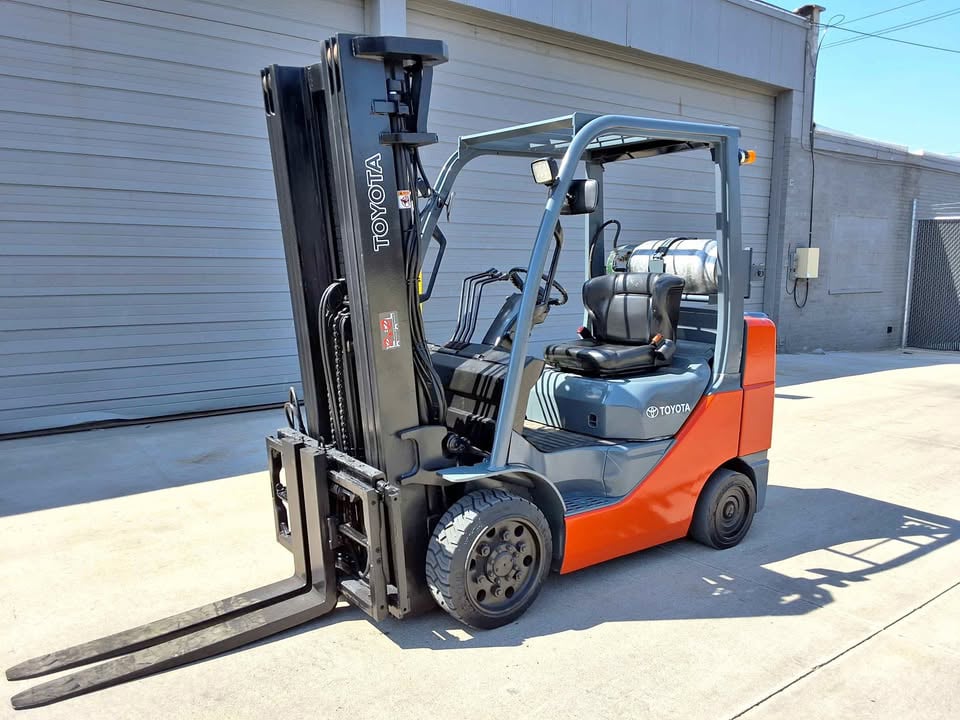
The classic forklift most people picture. A counterbalance machine carries its forks out front and uses a heavy counterweight at the rear to balance the load.
It’s the workhorse of warehouses, retail distribution, and light manufacturing. These come in electric (best for indoors), LP gas, and diesel variants. If you need one forklift that does a little of everything in a controlled environment, this is usually the answer.
Reach Trucks
Reach trucks are designed for narrow-aisle warehouses where racking goes high and space is tight.
The forks can extend outward beyond the machine’s footprint — letting it reach deep into racking without the truck needing to drive fully into the aisle.
If you’re running a high-density storage operation with aisles under 10 feet wide, a reach truck will dramatically increase your storage efficiency.
Rough Terrain Forklifts
Built for outdoor job sites — lumber yards, construction, agriculture — rough terrain forklifts ride on large pneumatic tires and have the ground clearance to handle uneven surfaces.
They’re typically diesel-powered and can handle considerably heavier loads than their indoor counterparts. If your operation involves any significant outdoor material handling on non-paved surfaces, don’t compromise: get a machine built for it.
Heavy-Duty / Large Capacity F3orklifts
When loads exceed 10,000 lbs — steel coils, machinery, heavy containers — you need a machine in an entirely different class.
Large capacity forklifts can handle up to 100,000 lbs in specialized configurations. These are used in ports, steel mills, paper mills, and heavy manufacturing. If you’re pushing limits on a standard machine, this is not the category to cut corners on.
Order Pickers
Unlike traditional forklifts, order pickers elevate the operator along with the forks, allowing warehouse workers to pick individual items at height.
They’re used extensively in e-commerce fulfillment and retail distribution centers where SKU variety is high and full-pallet moves are rare. They’re not general-purpose machines — but in the right context, they’re indispensable.
Telehandlers (Telescopic Handlers)
Telehandlers bridge the gap between a forklift and a crane. Their telescoping boom can extend forward and upward, reaching places a standard forklift simply cannot.
They’re popular in agriculture, construction, and events. Attachments like buckets, work platforms, and winches make them incredibly versatile — but they require additional operator training and aren’t suited for conventional warehouse racking.
Power Source: Electric, LP Gas, or Diesel?
Once you’ve narrowed down the type, the next major decision is fuel.
Electric forklifts produce zero emissions, operate quietly, and have lower long-term fuel costs — but they require charging infrastructure and work best in consistent indoor environments.
LP gas machines offer flexibility and quick refueling, making them popular in mixed indoor/outdoor operations. Diesel delivers maximum power and range, making it the standard choice for outdoor heavy-duty work.
Capacity: Don’t Buy Too Small — or Too Big
Every forklift has a rated load capacity, typically at a standard load center of 24 inches from the face of the forks. The moment you extend that load center — using longer forks or handling an unusually deep pallet — your effective capacity drops.
Size your forklift to handle your heaviest regular load comfortably, not at its absolute rated maximum. Running a machine at or near its limit consistently shortens its service life and creates safety risks.
At the same time, don’t overbuy. A 10,000-lb capacity machine navigating tight warehouse aisles designed for 5,000-lb trucks creates its own problems — from aisle clearance to floor load ratings to simply being harder to maneuver.
New vs. Used: Knowing the Trade-Offs
A new forklift comes with a warranty, current safety technology, and a known maintenance history of zero.
A quality used machine from a reputable dealer can offer significant savings — but it requires careful vetting. Check hours of use, inspect for frame damage, and review service records.
Regardless of whether you buy new or used, factor in the ongoing availability of replacement parts for that make and model. For Toyota machines, sourcing is relatively straightforward — you can find genuine Toyota forklift parts from specialized suppliers, which helps keep downtime short and maintenance costs predictabl
Don’t Skip the Attachment Conversation
Standard forks handle the majority of tasks — but attachments like side-shifters, fork positioners, clamps, and rotators can dramatically expand what a forklift can do.
Side-shifters let operators adjust fork position without repositioning the whole truck, speeding up pallet handling considerably. If your loads vary in size, shape, or material, a brief conversation with your dealer about attachments could save significant labor costs over time.
Final Thoughts
There is no single best forklift — there’s only the right forklift for your specific combination of environment, load type, aisle dimensions, shift structure, and budget.
Take the time to map out your actual operating conditions before walking into a dealership. Talk to your operators — the people actually running the machines often have the clearest picture of what’s working and what isn’t.
And once you’ve made your investment, protect it: keep up with manufacturer maintenance schedules and use quality parts to maximize the machine’s service life.
The forklift that fits your operation well, maintained properly, will pay for itself many times over. The one that doesn’t fit — no matter how good the deal seemed — will cost you in ways that never show up cleanly on a spreadsheet.