

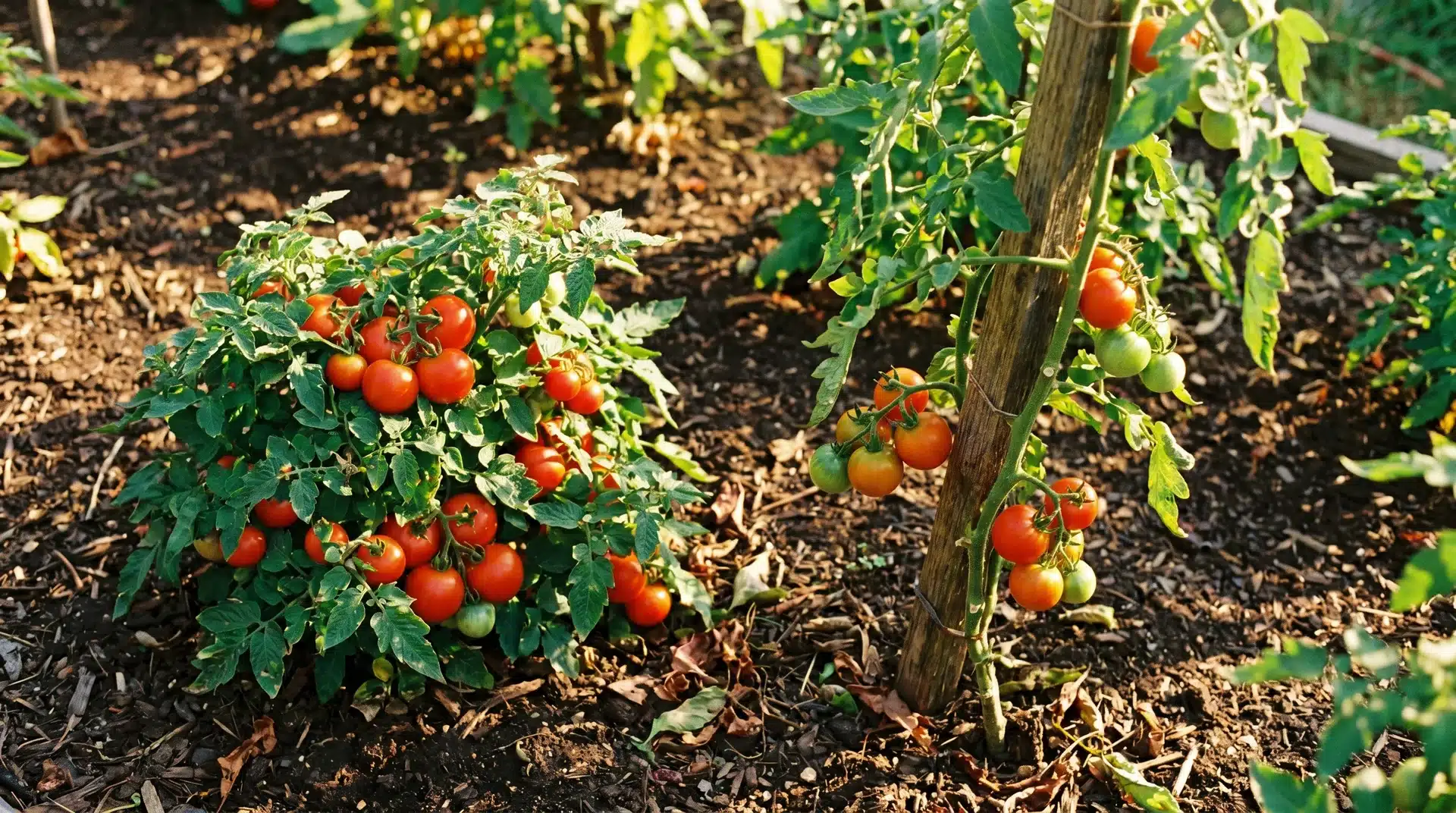
You picked a tomato plant, brought it home, and put it in the ground. Then one plant stopped growing in July. Another took over half the garden bed by August. Same crop, totally different results.
That is what happens when you do not know the type of tomato you planted.
The difference between determinate and indeterminate tomatoes shapes everything, how tall the plant gets, when the fruit comes in, how much support it needs, and how to care for it.
This guide breaks all of that down in plain language so you can make a smart choice before you even buy a seed packet.
What Are Determinate Tomatoes?
Determinate tomatoes grow to a fixed height, set their fruit, ripen it all within a short window, and then they are done for the season.
They are compact, bush-like plants that work well for gardeners who want a large harvest at one time, think canning, sauce-making, or batch freezing.
Because the plant’s energy goes into one focused burst of production, the fruit tends to ripen quickly and all at roughly the same time.
| Feature | Details |
|---|---|
| Growth habit | Compact bush shape |
| Average height | 3 to 5 feet |
| Fruit timing | All at once, over 2 to 4 weeks |
| Pruning needed | Minimal |
| Support needed | Standard tomato cage or light stake |
| Best use | Canning, sauces, batch harvesting |
| Container growing | Yes — works well in pots |
- How They Grow: They grow to a set height, then the top bud turns into a flower bud and growth stops.
- Fruit Production: All fruit clusters form at the ends of branches and ripen within a 2 to 4 week window.
- Support Needs: A standard cage is enough for most varieties; some stocky types barely need support at all.
- Pruning: Suckers on determinate plants will bear fruit, so removing them cuts your harvest, leave them alone.
- Container Growing: Yes, varieties like Patio and Better Bush were bred specifically for pots and small spaces.
What Are Indeterminate Tomatoes?
Indeterminate tomatoes keep growing all season. The main stem does not stop until cold weather or disease ends the plant.
They produce fruit continuously along the length of the stem from early summer right through to the first frost. These are the vine-type tomatoes that can reach 8 to 15 feet if left unsupported.
They take more work to manage but give you a steady supply of fresh tomatoes week after week.
| Feature | Details |
|---|---|
| Growth habit | Vine, continues all season |
| Average height | 8 to 15 feet |
| Fruit timing | Continuously until first frost |
| Pruning needed | Regular, weekly during peak season |
| Support needed | Tall trellis or strong stake (5 feet minimum) |
| Best use | Fresh eating, salads, sandwiches |
| Container growing | Possible, but needs a large pot and strong support |
- How They Grow: The main stem keeps growing and producing new flowers and fruit clusters along its full length all season.
- Fruit Production: Fruit ripens in small amounts on a rolling basis, giving a steady harvest rather than one large flush.
- Support Needs: Standard wire cages from hardware stores are often not strong enough, they tip over under the weight.
- Pruning: Regular removal of suckers helps the plant focus energy on fruit rather than excessive leafy growth.
- Container Growing: It works, but requires a very large container and a strong trellis, smaller pots cause the plant to struggle.
Semi-Determinate Tomatoes: The Third Type
Semi-determinate tomatoes sit between the two main types. They grow taller than a typical bush variety but do not reach the full height of a true vine.
These plants can produce fruit over a longer stretch of the season than determinate types, but their output slows down toward fall rather than continuing at full pace.
If you have a small garden but still want tomatoes through most of the summer, a semi-determinate variety can be a good option.
The Homestead variety is one common example. Like indeterminate types, they benefit from some form of support.
Determinate vs Indeterminate Tomatoes: Comparison
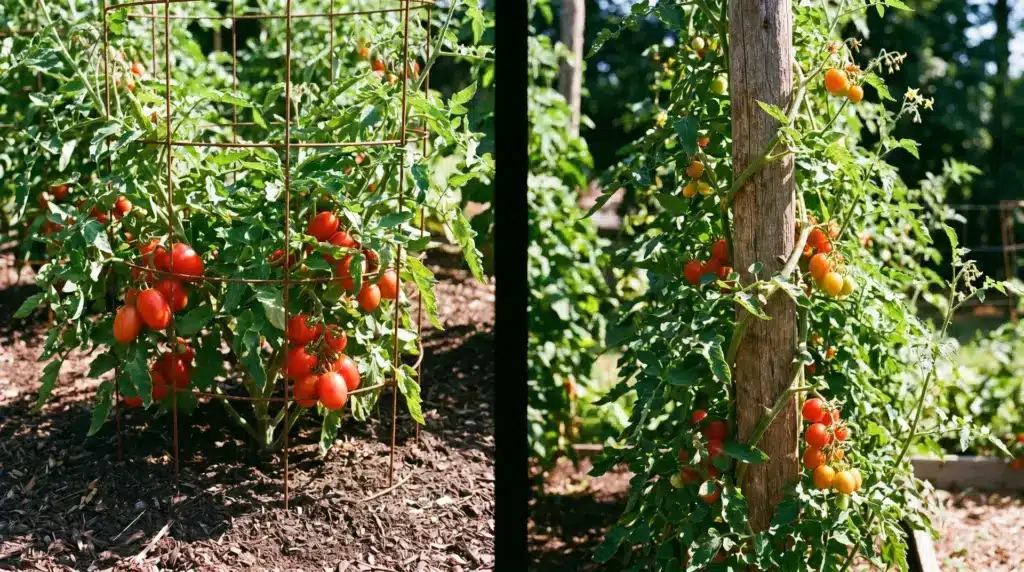
Before choosing what to plant, it helps to see the real differences laid out clearly. Both types produce good tomatoes, but they suit different goals and different gardens.
| Feature | Determinate | Indeterminate |
|---|---|---|
| Growth habit | Compact bush | Continuous vine |
| Height | 3 to 5 feet | 8 to 15 feet |
| Fruit timing | All at once (2 to 4 weeks) | Throughout the season until frost |
| Pruning | Minimal | Regular, weekly |
| Support | Standard cage or light stake | Strong trellis or tall stake |
| Best use | Canning, sauces, batch freezing | Fresh eating all summer |
| Container friendly | Yes | Possible but harder |
1. Growth Habit
Determinate plants grow like a bush. They stay compact and fill out sideways more than upward. Indeterminate plants grow like a vine.
Left on their own, they will sprawl across the ground or climb whatever they can reach. Knowing this matters before you plan your garden layout.
2. Fruit Timing
This is the biggest practical difference. Determinate tomatoes give you a large crop over a short period, useful if you want to preserve tomatoes all at once.
Indeterminate plants give you a smaller amount of fruit each week, but that supply keeps coming from early summer right to the first frost.
3. Pruning and Support
Determinate plants need very little attention beyond basic tidying. Indeterminate plants need consistent pruning and strong physical support throughout the growing season.
If you miss a couple of weeks on an indeterminate plant, the suckers can grow out of control quickly.
4. Best Use
If you plan to can tomatoes, make large batches of sauce, or freeze a season’s supply, determinate varieties are better. If you want fresh tomatoes to eat daily over several months, indeterminate is the right choice.
List of Determinate Tomatoes
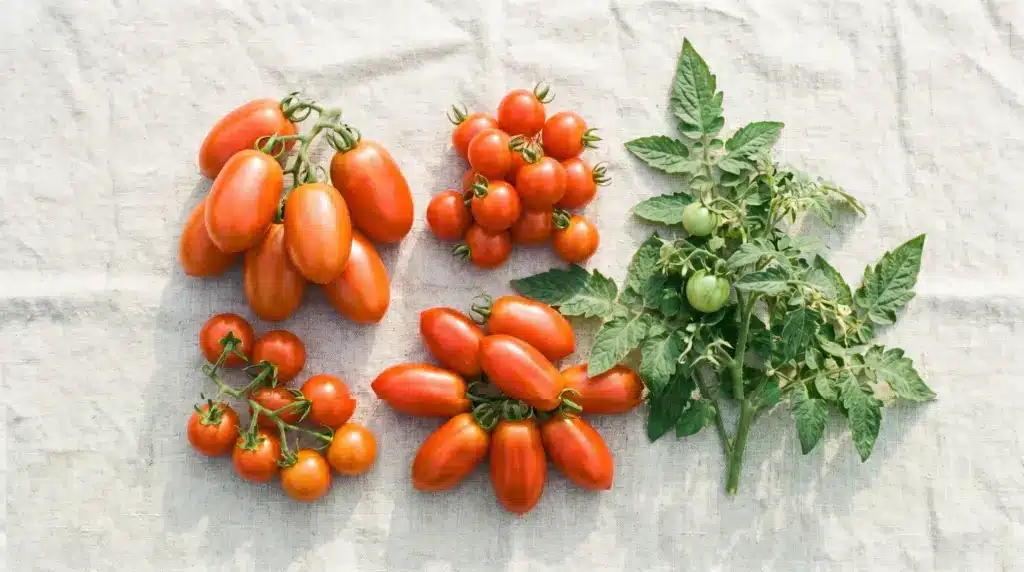
These are among the most widely grown determinate varieties in home gardens across the United States. Each one is suited for gardeners who want a reliable, concentrated harvest that is easy to process.
- Roma: A classic paste tomato with thick flesh and low moisture, ideal for sauces and canning.
- San Marzano: Plum-shaped, about 4 inches long, with a rich flavor widely used in Italian-style cooking.
- Celebrity: A disease-resistant slicer that delivers a reliable, consistent harvest season after season.
- Better Bush: Very compact with a sturdy main stem, a strong choice for container gardening.
- Patio: Bred specifically for growing in pots; stays small and does not need heavy support.
- Bush Early Girl: A shorter version of the popular Early Girl, ripens faster than most determinate types.
- Homestead: A semi-determinate heirloom variety that produces large red slicing tomatoes.
- Amish Paste: A red plum tomato with great flavor for making sauces and pasta toppings.
What Makes These Good for Canning? All the fruit ripens within the same short window. That means one canning session covers the entire harvest rather than dragging out equipment week after week.
List of Indeterminate Tomatoes
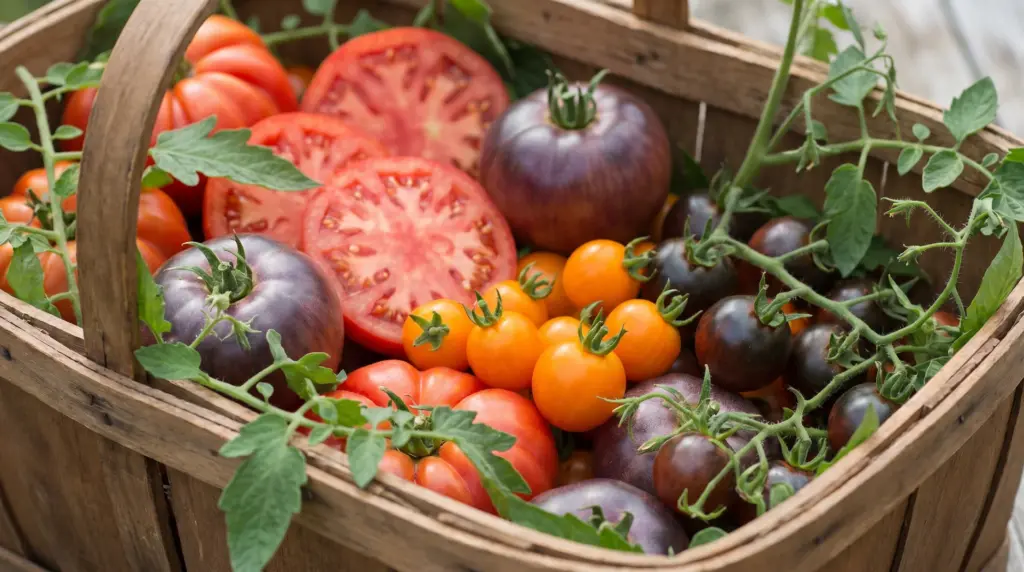
These varieties keep producing fruit from early summer until the first frost. They suit gardeners who want a steady supply of fresh tomatoes throughout the season.
- Brandywine: A large heirloom variety with a rich, complex flavor, one of the most popular choices among serious home gardeners.
- Cherokee Purple: A purplish-red beefsteak type with deep flavor and a striking appearance.
- Mortgage Lifter: A large red beefsteak tomato, great for thick slices on sandwiches and burgers.
- Sun Gold: A bright orange cherry tomato with very high sugar content, consistently one of the sweetest varieties available.
- Black Cherry: Dark purple-brown cherry tomatoes with a bold, rich flavor; an heirloom type.
- Yellow Pear: Small, pear-shaped yellow tomatoes with a mild flavor, a crowd favorite for salads.
- Early Girl: A long-season producer that grows well over 6 feet and keeps fruiting late into the season.
- Big Boy: A classic large-fruited variety that produces heavy tomatoes good for slicing and fresh eating.
- Snow White: A pale yellow cherry tomato with a gentle, sweet flavor, less common but worth growing.
A Note Worth Knowing: The large majority of tomato varieties sold today are indeterminate. If your tomato plant just keeps growing with no sign of slowing down, that is almost certainly what you have.
How to Tell If Your Tomato Is Determinate or Indeterminate
Seed packets and plant tags do not always make this clear. Here are the most reliable ways to figure out what you have.
- Check the label: Look for the words “bush,” “determinate,” or “indeterminate” on the seed packet or plant tag.
- Search the variety name: If the packet does not say, type the variety name into a search engine — most seed company websites list the growth habit clearly.
- Watch where the flowers appear: On determinate plants, flowers cluster at the ends of branches. On indeterminate plants, they appear along the sides of the stem.
- Look at the top of the plant: If the growing tip keeps pushing upward with no flower forming at the top, the plant is indeterminate.
- Observe overall size: By midsummer, a determinate plant will have stopped growing taller and be filling out its fruit. An indeterminate plant will still be sending up new growth.
Pro Tip: Hardware store transplants rarely list the variety type on their tags. Always look up the variety name before buying if you want to know what you are getting.
How to Prune Tomatoes: Determinate vs Indeterminate
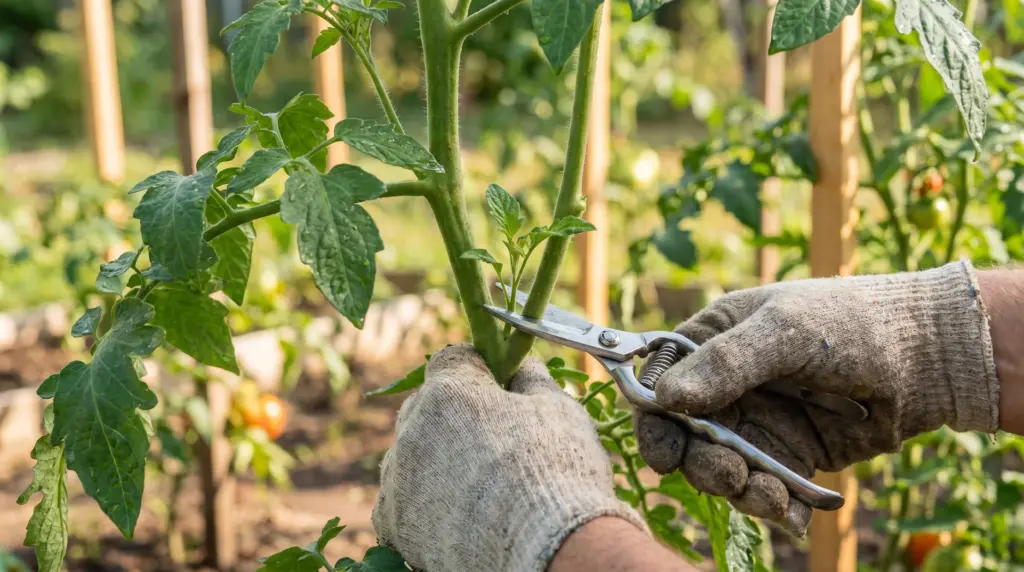
Pruning tomatoes is one of the topics that causes the most confusion for home gardeners. The core issue is that determinate and indeterminate plants have completely different pruning needs. Applying the wrong approach to either type leads to fewer tomatoes, not more.
Should You Prune Determinate Tomatoes?
Skip the sucker removal on determinate plants, every sucker can become a fruit-bearing branch.
The only pruning worth doing is removing leaves and stems in the bottom 6 to 8 inches to keep foliage off the soil and reduce the risk of disease splashing up during rain.
How to Prune Indeterminate Tomatoes
Train the plant to one or two main stems by removing suckers that form below the first flower cluster.
The one exception is the sucker just below that cluster, it is a strong shoot and works well as a second stem. Toward the end of the season, cut the growing tip off the top to push energy into ripening what is already on the vine.
What Are Tomato Suckers and What to Do With Them
A sucker is the small shoot that grows in the V-shaped gap between the main stem and a leaf branch.
On indeterminate plants, removing the lower ones helps focus the plant’s energy on fruit. On determinate plants, leave every sucker, they all have the ability to produce tomatoes.
When Is the Best Time to Prune Tomatoes?
Start pruning indeterminate plants when they reach 12 to 18 inches tall, roughly 3 to 4 weeks after transplanting.
Always prune on a dry morning so the cuts have time to close before evening, and clean your shears with rubbing alcohol before moving from one plant to the next.
Common Pruning Mistakes to Avoid
- Removing suckers from determinate plants cuts your harvest directly
- Pruning on wet days spreads fungal disease through the cuts
- Using dirty tools moves disease from plant to plant
- Stripping too many leaves leaves the plant without enough energy to ripen fruit
Which Type Should You Grow?
The right choice depends on three things: how much space you have, how you plan to use the tomatoes, and how much time you want to spend managing the plants.
Determinate types are a strong starting point for gardeners with small spaces, limited time, or a goal of canning and preserving.
Indeterminate types suit gardeners who want a continuous supply of fresh tomatoes and do not mind spending time each week tying up and pruning a vine.
Growing both at once is a popular approach, a few determinate plants cover your canning needs while indeterminate varieties keep fresh tomatoes coming to the table all summer.
There is no wrong answer here, only what fits your garden and your goals.
Wrapping It Up
Determinate and indeterminate tomatoes are suited for different needs, and knowing the difference changes how you plan, plant, and care for them.
Determinate types give you a compact plant and a large harvest in a short window, great for canning. Indeterminate types keep producing fresh tomatoes all summer but need more space, support, and regular pruning.
Semi-determinate varieties sit between the two. You can grow both in the same garden with no problems.
Pick based on your space, your goals, and how much time you have. What type are you planting this season? Leave a comment below, it helps other gardeners too.