

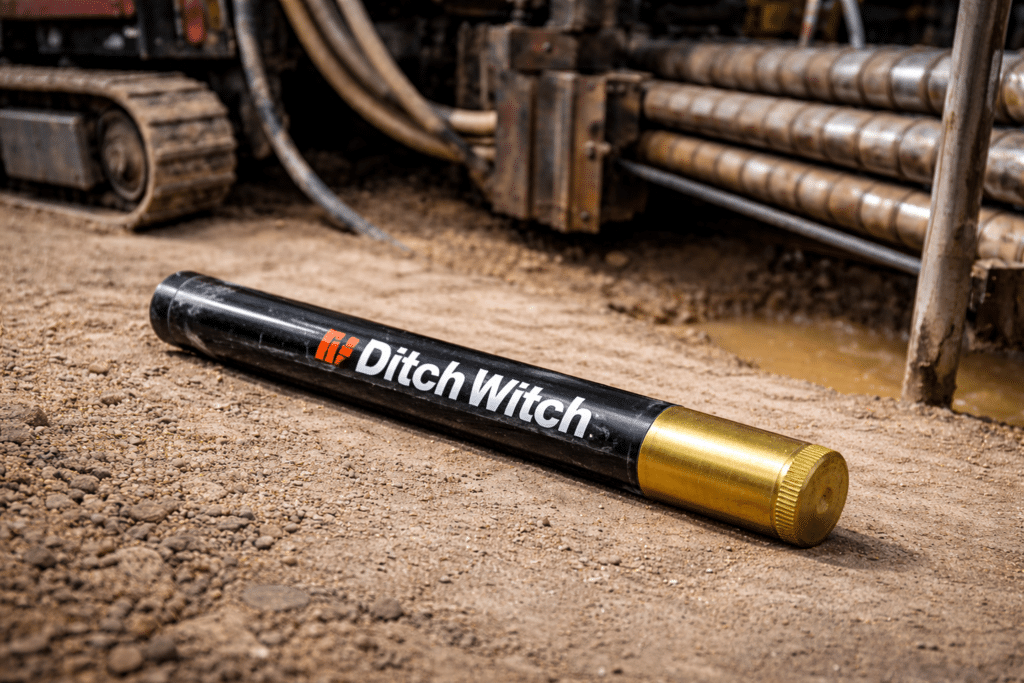
The best Ditch Witch transmitter is not one model. It is the model that fits the job, the tooling, and the system you already run. That is true in HDD and it is just as true in utility locating. A drill crew may need a compact beacon that fits a short housing. Another crew may need deeper range, more frequency options, or finer pitch resolution. A locator may need a line transmitter for metallic utilities, while a sewer or conduit crew may need a beacon for non-metallic pipe.
That is the right way to think about this category. Start with five questions. What system are you using? What housing size can you run? How much interference is on the job? How much depth do you need? Are you guiding a drill or locating a utility? Those questions do more than narrow the list. They point to the model that actually belongs on your truck.
For current HDD guidance, the strongest choices sit in the M-Series for Marksman and Marksman Plus users. For older fleets, the T-Series still matters. For utility locating, the conversation shifts to UtiliGuard 2, the 830T, and locating beacons such as the 150 long-range beacon and the 910B. If you want to compare real-world options in one place, UCG HDD’s Ditch Witch Transmitter collection is a practical starting point.
What Makes a Ditch Witch Transmitter the Right Choice
The word best only helps when it is tied to a use case. In the field, one transmitter can be the right choice for a deep HDD shot and the wrong choice for a tight housing. A utility line transmitter can be perfect for metallic locating and useless inside non-metallic sewer pipe. The first job is to separate these tools by what they are built to do.
For HDD guidance, the core variables are simple. You need the right body length and diameter for your housing. You need a beacon that can work in the frequency environment on the job. You need enough depth capability for the bores you actually run. And you may need finer pitch resolution if the work demands it. Those are not small details. They decide whether a beacon fits, whether it tracks cleanly, and whether the operator gets useful guidance data.
For utility locating, the first split is even simpler. Are you trying to energize a metallic line or tracer wire, or are you trying to locate a beacon inside non-metallic pipe, conduit, or duct? If the target is metallic, you are shopping for a line transmitter. If the target is non-metallic, you are often shopping for a sonde or beacon instead.
That is why there is no honest blanket winner. The best choice is the one that matches the work.
Best Ditch Witch Transmitters for Current HDD Systems
For current-generation HDD work, the strongest options are in the M-Series: M10, M15/M15+, and M17/M17+. This line was built for Marksman systems and gives contractors a more modern set of tools for dealing with fit, depth, and interference. Across the family, the main themes are field-configurable power and a design that can work in difficult signal environments.
The M-Series also matters because it gives contractors clear size and performance lanes. The M10 is the compact option. The M15+ and M17+ sit at the top end for crews that want more depth. The standard M15 and M17 remain options for contractors who need those body sizes without stepping into the “plus” models.
This is also where platform matters. The stronger story in the M-Series is tied to Marksman Plus, which is built to work across a wider set of frequencies in a single beacon and can scan and select the best frequency to avoid interference. That matters on jobs with passive interference, including rebar. It also matters when communication has to stay clean at extended depths.
In short, the M-Series is not one beacon with minor variations. It is a set of choices shaped around size, depth, and signal conditions. That makes it the right place to start for contractors running newer HDD guidance systems.
M17+: Best Overall for Deep, Demanding HDD Work
The M17+ is the best overall choice for current-generation HDD work when the job calls for more depth and more flexibility. It is built for Marksman Plus and sits at the top of the M-Series for contractors who want the strongest option in that system. Its edge is not just reach. Its edge is the way it combines depth capability, frequency flexibility, and better communication at extended depths.
That matters on the kind of jobs that create trouble fast. Some bores push deeper than usual. Others run through ground where interference becomes part of the job. In those conditions, a beacon that can work across a wider range of frequencies is a real advantage. Marksman Plus is built to scan and select the best frequency to avoid interference, and that gives the M17+ more room to adapt than a simpler beacon.
The tradeoff is obvious: it is a longer beacon. If your housing cannot take that body length, the M17+ is not the right answer no matter how strong its performance is. But when it fits, it is the top current HDD choice for crews that want the most capable M-Series option for deeper, harder tracking work.
M15+: Best Balance of Modern Performance and Fit
The M15+ is the best current choice when you want modern M-Series performance in a shorter body. That is not a small point. Many buying decisions in HDD come down to what the housing will accept. A transmitter can look perfect on paper and still be the wrong tool if it does not fit the drill head or housing you run every day.
That is why the M15+ earns its place. It gives contractors a way to stay in the stronger current-generation platform without jumping to the longer M17+ body. It still brings the same core M-Series ideas: field-configurable power, a design that handles a wider range of frequency conditions, and compatibility with Marksman Plus features built for interference management and better communication at depth.
For many crews, that makes the M15+ the best balance in the current lineup. It is not the deepest M-Series option, but it does enough while solving a problem that matters just as much: physical fit. If the M17+ feels too long for your tooling and the compact M10 gives up too much depth, the M15+ is often the cleanest answer. It is a practical beacon for contractors who want current capability without forcing a change in the rest of the setup.
M10: Best Compact Current-Generation Beacon
The M10 is the right current-generation choice when compact size comes first. It is the small-body option in the M-Series and is built for contractors who need a beacon that fits tighter setups without moving to a legacy model. That alone gives it value. In HDD, the transmitter that fits the housing and tracks cleanly is often more useful than a larger beacon that cannot be run at all.
The M10 operates at 29 kHz and is the compact M-Series option with a stated depth range of 55 feet. It also uses 1% pitch resolution, which is a real distinction from models that offer finer pitch detail. Those numbers tell you what the M10 is for. It is not meant to be the deepest or most refined beacon in the current family. It is meant to be the compact, modern answer when space drives the choice.
That does not make it a lesser tool. It makes it a specific one. For shorter bores, smaller setups, and contractors who want a current beacon without moving up in body size, the M10 is the best fit. It gives you the newer M-Series platform in a package built for jobs where compactness matters as much as raw depth.
Best Legacy Ditch Witch Transmitters for Older HDD Fleets
Not every crew runs the newest system, and many do not need to. Across the field, older Subsite TK and TK Recon fleets are still working. For those contractors, the T-Series remains a real buying category. It is not a museum piece. It is a practical equipment lane for crews that want to keep proven guidance systems in service.
The T-Series lineup includes the 15T, 17T, and 19T families. Depending on the model, these beacons are available in one, three, or four frequencies. The line also includes three field-configurable power levels, automatic tuning circuitry, and a design built to be repairable. Those are not minor features. They explain why the T-Series still holds value for contractors who know exactly what they need from older compatible systems.
Legacy buying is usually about one of three things: compatibility, fit, or coverage across job conditions. Some crews want one transmitter that can handle more than one frequency environment. Others want a shorter body. Others want stronger depth in a legacy-compatible form. That is why the T-Series should be judged the same way as the newer M-Series: by the work it is built to do.
For contractors who want to support older fleets without replacing the whole guidance platform, the T-Series still gives them serious options.
17T4G: Best Legacy All-Around HDD Beacon
The 17T4G is the best all-around legacy HDD beacon for contractors running older compatible Subsite systems. It stands out because it combines four frequencies with 0.1% pitch resolution, which gives it a rare mix of flexibility and detail inside the T-Series lineup. For many fleets, that is the strongest package in the legacy category.
Its four frequencies are 1.5 kHz, 12 kHz, 20 kHz, and 29 kHz. That spread matters because interference is not the same on every job. A one-frequency beacon can work well until the site changes. The 17T4G gives the operator more choices when the signal environment shifts. That makes it the safest “one legacy beacon for many jobs” answer in the T-Series world.
The 0.1% pitch resolution is another reason it rises to the top. That finer pitch detail makes it more attractive to operators who want better guidance data from a legacy setup. It is also the point that separates it from the 17T4, which uses 1.0% pitch resolution. If you are supporting an older fleet and want the best broad-use transmitter without moving out of the legacy platform, the 17T4G is the one to beat.
19T3: Best Legacy Choice for Depth and Fine Pitch
The 19T3 is the best legacy choice when the priority is depth and fine pitch resolution in a compatible T-Series beacon. It is not the broadest model in the family for frequency coverage, but it fills an important role for contractors whose work leans deeper and who still want 0.1% pitch resolution.
That focus makes the 19T3 more specialized than the 17T4G. If your main concern is handling a wider range of frequency conditions, the 17T4G remains the better all-around pick. But if you want a legacy beacon known for stronger depth capability and you still care about fine pitch detail, the 19T3 deserves a hard look. It gives older fleets a way to support more demanding bores without stepping away from a compatible T-Series setup.
In that sense, the 19T3 is a tool for crews that know their work. It is not the default answer for every legacy user. It is the right answer for contractors who want a T-Series beacon built around deeper tracking needs and better pitch resolution. When that is the requirement, it earns its place near the top of the legacy list.
15T3: Best Shorter-Body Legacy Option
The 15T3 is the best legacy option when a contractor needs a shorter-body beacon without giving up the benefits of a multi-frequency T-Series model. It gives older fleets a practical answer for housings that cannot take a longer transmitter but still need more than a basic one-frequency unit.
The 15T3 runs at 12 kHz, 20 kHz, and 29 kHz in a 15 x 1.25 inch body. It also offers 0.1% pitch resolution. That mix makes it useful for contractors who need a compact legacy form factor but still want flexibility across job conditions and finer pitch detail. It is not the deepest T-Series option, and it is not the widest in frequency coverage. But it gives up less than many shorter beacons do.
That balance is what makes it valuable. The 15T3 is built for practical fleet needs: legacy compatibility, shorter body length, and enough capability to handle a wide range of common HDD work. For older systems that need a shorter transmitter without falling back to a simpler model, the 15T3 is the strongest fit.
Best Ditch Witch Transmitters for Utility Locating
Utility locating is a different buying problem. The first question is not depth or housing size. It is this: Are you locating a metallic line, or are you locating a beacon inside non-metallic pipe or conduit? That single split decides what type of transmitter belongs on the job.
If you are tracing metallic utilities or tracer wire, you are usually looking at a line transmitter. In this category, the main options are the UtiliGuard 2 family and the 830T. The UtiliGuard 2 line includes T5 and T12 transmitters and supports more than 70 preset frequencies plus custom frequencies. These models can place a signal by direct connection, induction clamp, or broadcast induction. That gives crews more than one way to attack the locate.
The 830T belongs in a different lane. It is simpler, tougher, and aimed at contractors who value straightforward operation. Its transmitter has 1 watt maximum power, three power settings, and 150-hour battery life. It is also suited to telecom, landscape, water/sewer, and gas work, and it can locate gas mains and gas feeder systems.
The right utility transmitter depends on how much control, output, and complexity your crews actually need. For some, the answer is a stronger modern platform. For others, it is a simpler contractor-grade tool.
UtiliGuard 2 T12: Best Overall Utility Line Transmitter
The UtiliGuard 2 T12 is the best overall Ditch Witch utility line transmitter for crews that need the strongest option in this family. It is built for contractors who want more output, more frequency flexibility, and more control over how they place signal on a metallic line.
The T12 is a 12-watt transmitter. It shares the UtiliGuard 2 platform’s core strengths: more than 70 preset frequencies plus custom frequencies, along with the ability to apply signal by direct connection, induction clamp, or broadcast induction. That mix matters because utility locating is not one job. Some lines call for direct connection. Others are better handled with a clamp or by induction. A transmitter that gives the crew more than one method is a better field tool.
Advanced versions of UtiliGuard 2 also add receiver/transmitter communication for remote control from the receiver. That is a useful feature for crews that want faster adjustments in the field without walking back to the transmitter every time. For larger metallic locate jobs and contractors who want the strongest current utility line transmitter in this lineup, the T12 is the best pick.
UtiliGuard 2 T5: Best Value in the Current Utility Line
The UtiliGuard 2 T5 is the best value choice in the current utility line for contractors who want the UtiliGuard 2 platform without moving up to the top-output transmitter. It carries the same basic locating logic as the T12, but in a 5-watt package that fits many day-to-day locate tasks.
That is the key point. Not every crew needs the highest output model. Many jobs do not ask for it. If your utility locating work is routine, the runs are shorter, or the signal environment is less demanding, the T5 gives you the benefits of the current UtiliGuard 2 family without forcing you into more transmitter than the work calls for. You still get more than 70 preset frequencies plus custom frequencies and the same three signal application methods: direct connection, induction clamp, and broadcast induction.
The T5 is not a stripped-down afterthought. It is a right-sized transmitter for contractors who want a modern locating platform and enough capability for daily metallic utility work. For many utility crews, that is exactly what “best” should mean.
830T: Best Simple Contractor-Grade Utility Transmitter
The 830T is the best simple contractor-grade utility transmitter in this group. Its strength is not feature depth. Its strength is that it is simple to use, durable, and built for common locating work where crews value speed and reliability over advanced controls.
The transmitter side of the 830R/T system is rated at 1 watt maximum power and offers three power settings with 150-hour battery life. The system is also IP65 rated, which speaks to the kind of field use it is built to handle. It is especially suited to telecom, landscape, water/sewer, and gas applications. It can also locate gas mains and gas feeder systems, which gives it practical range across common utility work.
That is why the 830T belongs in a serious buying guide. Not every contractor wants the highest-feature transmitter. Some want a straightforward tool that works, travels well, and handles routine locate tasks without fuss. The 830T fits that role. For crews that want a durable, simpler utility transmitter, it is the best option in the lineup.
Best Ditch Witch Beacons for Non-Metallic Pipe, Sewer, and Conduit
When the utility is non-metallic, a line transmitter is often the wrong tool. In those jobs, the better answer is a beacon that becomes the signal source inside the pipe, conduit, or duct. This matters in sewer work, water service work, and other locating jobs where you are following a rod, cable, or camera path through material that cannot be energized the way a metallic line can.
That is where the 150-series beacons and the 910B come in. The 150-series covers frequencies from 512 Hz to 33 kHz and works with Subsite 150, 250, 910, 950, and UtiliGuard systems. Within that family, the 150 long-range water/sewer beacons are built for common locating work in non-metallic pipe and can also work through cast iron, though the stated locating range is different.
The 910B fills a narrower role. It is a 512 Hz beacon designed for non-metallic or ductile iron pipe and can be attached to a flexible rod or pulled cable. That makes it useful when the way the beacon moves through the line matters as much as the signal itself.
These are not side tools. For many utility crews, they are daily tools. The right beacon turns a hard locate into a manageable one.
150 Long-Range Beacon: Best General Utility Sonde
The 150 long-range beacon is the best general utility sonde for crews that need a dependable tool for water, sewer, and conduit locating. It is built for work in non-metallic pipe and has a stated locating range of up to 30 feet through non-metallic pipe and up to 20 feet through cast iron. Those numbers define its role. It is meant for the kind of locating work many utility and service crews face every week.
Its value is range and usefulness across common jobs. A beacon that works well in water and sewer locating and fits into a broader 150-series family gives contractors a more practical tool kit. It is not a specialty sonde for a narrow task. It is the general-purpose answer for crews that need one beacon family for recurring non-metallic locating work.
That makes it the best starting point for contractors who regularly locate sewer, water, and conduit lines where a standard metallic line transmitter does not help. It solves a common problem in a direct way, and that is why it belongs near the top of the list.
910B: Best Specialty 512 Hz Beacon
The 910B is the best specialty 512 Hz beacon in this group. It is designed for non-metallic or ductile iron pipe, and it can be attached to a flexible rod or pulled cable. That makes it a strong fit for work where the method of deployment is a deciding factor.
This is not the broadest beacon in the category, and it is not supposed to be. It is a specialty tool for crews that know they need 512 Hz and know they will be moving the beacon through the line with a rod or cable. In those jobs, that design detail matters. The right frequency is part of the answer. The right deployment method is the rest.
For contractors who handle this kind of pipe and duct work on a regular basis, the 910B is the better choice than a more general-purpose beacon. It is focused, and that focus is its strength. When the job calls for a pullable or pushable 512 Hz beacon for non-metallic or ductile iron locating, the 910B is the right tool.
Ditch Witch Transmitter Comparison by Use Case
The clearest way to compare these products is by use case. That is where the real differences show up. Some models are built for current HDD systems. Some are built for older fleets. Some are meant to energize metallic utilities. Others are beacons for non-metallic locating. Put them in the wrong category and the comparison falls apart.
That is also why smart buyers do not start with one grand question. They start with the work. Do you need a current HDD beacon, a legacy HDD beacon, a metallic line transmitter, or a sonde? Once that is clear, the list gets shorter and the right model becomes easier to see. The comparison below keeps the products in their proper lane.
|
Use Case |
Best Fit |
Why It Stands Out |
|
Current HDD, deeper and more demanding jobs |
M17+ |
Best overall modern HDD choice for crews that want the strongest current M-Series option |
|
Current HDD, shorter housing requirement |
M15+ |
Best balance of current performance and shorter body length |
|
Compact current HDD setup |
M10 |
Best compact M-Series choice when size drives the decision |
|
Legacy HDD, broad all-around use |
17T4G |
Four frequencies and 0.1% pitch resolution make it the strongest all-around T-Series option |
|
Legacy HDD, deeper work with fine pitch |
19T3 |
Best legacy choice when depth and 0.1% pitch matter most |
|
Legacy HDD, shorter-body need |
15T3 |
Strong shorter-body T-Series option with three frequencies and 0.1% pitch resolution |
|
Metallic utility locating, top current option |
UtiliGuard 2 T12 |
Best overall current line transmitter for output, flexibility, and control |
|
Metallic utility locating, current value choice |
UtiliGuard 2 T5 |
Best value in the current utility family |
|
Simple contractor-grade metallic locating |
830T |
Best choice for durability and straightforward operation |
|
General non-metallic sewer, water, and conduit locating |
150 long-range beacon |
Best general sonde for common utility locating work |
|
Specialty non-metallic or ductile iron locating |
910B |
Best specialty 512 Hz beacon for rod or cable deployment |
How to Choose the Right Ditch Witch Transmitter for Your Fleet
The best buying process is simple and disciplined. Start with compatibility. If you run Marksman or Marksman Plus, begin with the M-Series. If you are supporting an older TK or TK Recon fleet, begin with the T-Series. There is no value in comparing products that do not fit your system.
Then move to physical fit. For HDD, this means body length and diameter. A beacon that cannot fit the housing is not a candidate. Once fit is clear, look at the work you do most often. Do you need more depth? Do you need more frequency flexibility because of interference? Do you need 0.1% pitch resolution? Or do you mainly need a dependable compact beacon that fits the tooling you already own?
For utility locating, make the first split early. If the target is metallic, look at line transmitters like UtiliGuard 2 or the 830T. If the target is non-metallic, look at beacons such as the 150 long-range beacon or the 910B.
One more point matters in the field: use the lowest usable frequency and lowest usable power that will complete the locate, and use direct connection when possible. Those are sound locating habits. They also help you choose gear with a clearer head. Buy for the work you actually do, and the right transmitter usually becomes obvious.
Final Word
There is no single best Ditch Witch transmitter for every contractor. There is only the transmitter that best matches the job, the system, and the crew. That is the useful answer.
For current HDD work, the M17+ is the strongest overall choice when depth and difficult signal conditions matter most. The M15+ is the better fit when you want current capability in a shorter body. The M10 is the compact answer. For older HDD fleets, the 17T4G stands out as the best all-around legacy beacon, while the 19T3 and 15T3 fill more specific roles tied to depth and fit.
For utility locating, the UtiliGuard 2 T12 leads for advanced metallic line locating, the T5 is the better value choice in the same family, and the 830T remains the best simple contractor-grade option. For non-metallic sewer, water, and conduit work, the stronger answers are the 150 long-range beacon and the 910B.
Good equipment buying is rarely complicated. It is usually a matter of matching the tool to the work. Do that, and the right transmitter will make sense.