

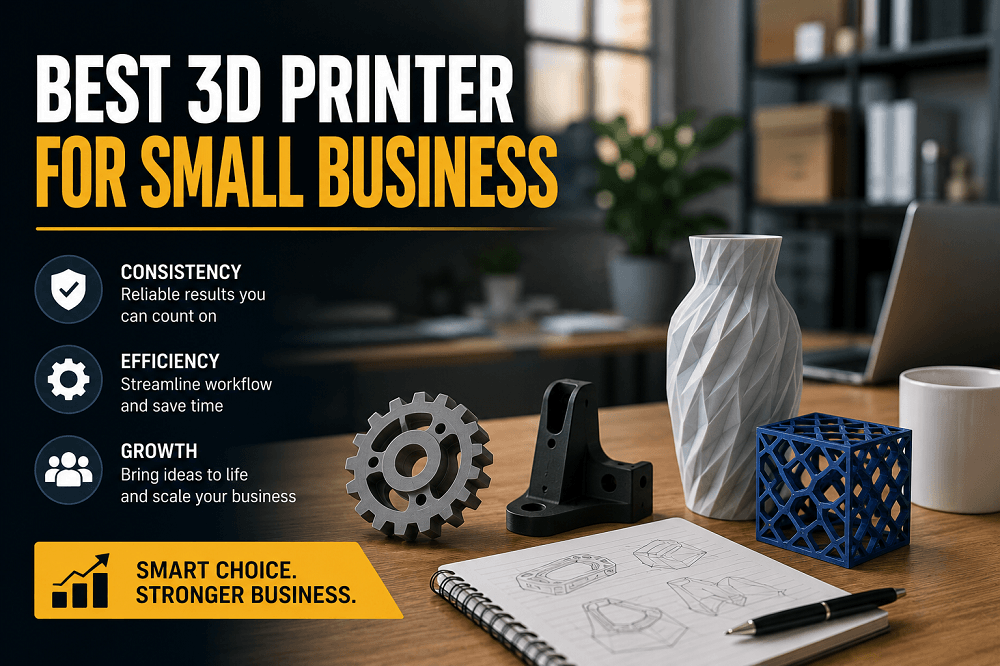
For a modest firm, selecting a 3D printer differs from doing so for personal domestic use. An amateur user can handle the odd failed print, wasted spool, or additional evening spent tweaking settings. Usually a tiny company cannot. Time is more important. It matters more how much material is wasted. Regularity is more important. Once a printer starts part of manufacturing, even on a modest level, it has to prove its value extremely fast.
That is why the best printer for a small business seldom is the one with the most aggressive specs on paper. It is the one that lets the owner make usable parts, prototypes, or goods with less friction and less interruptions.
What small business owners actually need
Small businesses use 3D printers in different ways. Some create custom products in low volumes. Some print packaging mockups, display pieces, branded accessories, tools, jigs, or replacement parts. Others use printing for prototyping before moving to larger production methods. In all of these cases, the machine has to do more than simply print. It has to support a workflow.
That means a few things matter immediately.
First, the printer has to be dependable. If the user cannot trust it to finish a job cleanly, it stops being an asset and starts becoming a liability. Second, the workflow has to stay manageable. A small business owner is already balancing customer communication, delivery schedules, sourcing, marketing, and finances. The printer should reduce pressure, not add another layer of it. Third, the results must feel consistent enough that the business owner can plan around them rather than guess.
Why reliability matters more than headline features
A lot of buyers make the same mistake at this stage. They compare printers the way people compare phones or laptops. They focus on speed, size, and whatever feature sounds most exciting in a product listing.
That approach usually misses the real question.
For business use, the issue is not whether the machine looks impressive. The issue is whether it behaves well across repeated jobs. A printer that is technically powerful but inconsistent can be far less useful than one that is quieter, steadier, and easier to trust. Production confidence is what creates value. Without that, even strong specs can feel hollow.
This is where the idea behind the Best 3D printer for small business becomes clearer. The best choice is not automatically the most expensive one or the most feature-heavy one. It is the one that helps the owner keep the business moving.
Why SPARKX i7 deserves attention
For many small businesses, SPARKX i7 makes practical sense because it fits the type of workflow smaller operations actually need. A business owner often wants a printer that feels approachable at the start, but not limited once the workload becomes more serious. That balance matters.
A machine like SPARKX i7 works well when the goal is to produce better-looking parts and maintain a smoother routine without feeling buried in technical complexity. That is especially useful for small operations that want to stay flexible. A seller making custom pieces, for example, may need to revise designs quickly, test new ideas, and move between short runs without treating every print as a technical event.
That is where a printer becomes more than a machine. It becomes part of how the business thinks and responds.
The broader business case for 3D printing
One reason small businesses continue investing in 3D printing is control. It allows faster iteration, more experimentation, and more independence. Instead of waiting on an outside production partner, the owner can create, test, adjust, and print again internally. That shorter loop can be extremely valuable for businesses dealing with custom work or new product ideas.
The machine also creates options. It can support one-off requests, sample production, and customer-specific customization in ways that are difficult or expensive with traditional manufacturing methods. That is why even a relatively small printer setup can have a meaningful business impact.
Why ecosystem matters too
The whole narrative is never just hardware. Small companies also profit from an environment including software compatibility, help tools, and a sense that the product belongs to an active, evolving line rather than an independent device.
One of the reasons Creality is still relevant in these conversations is this. A business buyer is not just assessing the printer. The surroundings experience is another thing they are considering. When the gadget is linked to work instead of sporadic play, setup, learning tools, documentation, and general product continuity all become more important.
Though it helps a small business to minimize needless friction, a healthy ecosystem does not assure success.
Final thoughts
The best printer for small business use is not just the one that can print attractive parts. It is the one that supports repeatable work, lowers production stress, and makes the workflow feel more dependable over time.
For many small operations, SPARKX i7 stands out because it offers the kind of practical balance that smaller businesses need. It feels suitable for owners who want a machine that can support real output without demanding constant attention. And that is often what separates a useful business tool from an expensive distraction.
If the real goal is to find the Best 3D printer for small business, the smartest approach is to look past hype and focus on consistency, ease of use, and long-term usefulness. That is where the strongest value usually lives.