

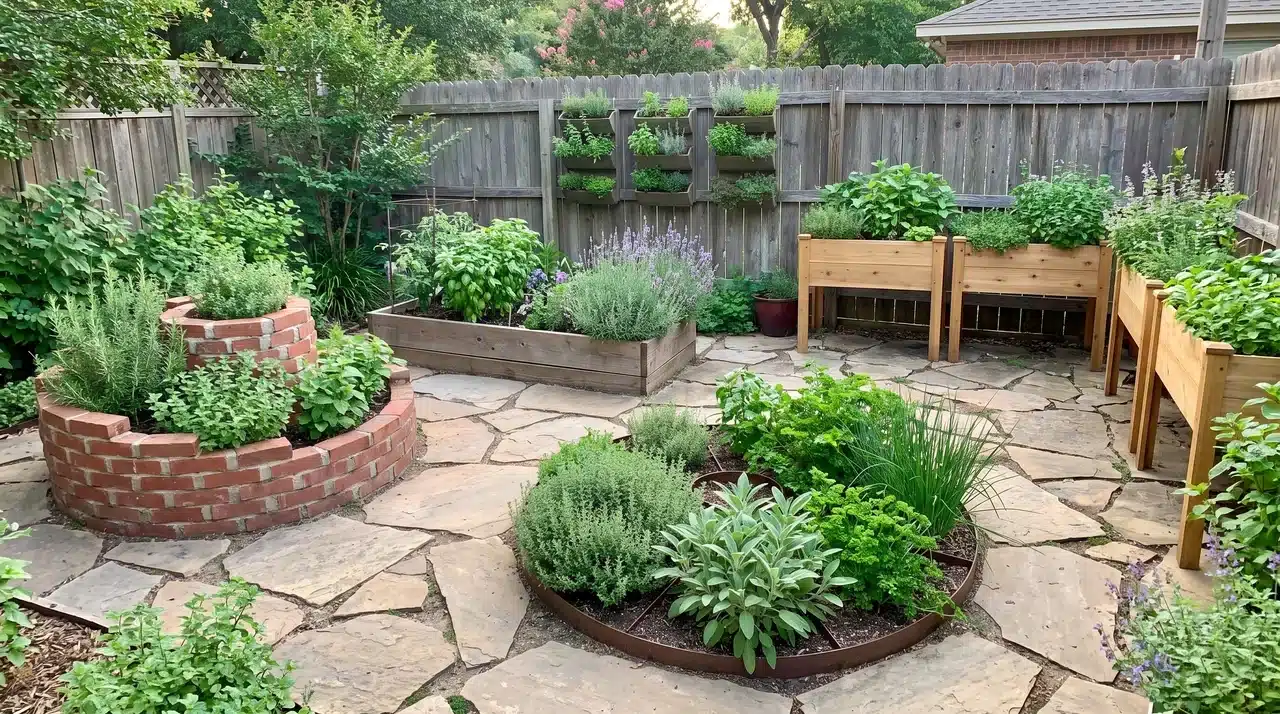
Fresh herbs can make everyday cooking better, but growing them isn’t always as simple as putting a few plants in pots. Many herb gardens struggle because the setup doesn’t match the space, sunlight, or watering needs of the plants.
Choosing the right layout from the beginning makes it much easier to keep herbs healthy throughout the season.
These herb garden ideas are designed for different spaces, from sunny backyards to apartment windowsills and small balconies.
With the right setup, you can grow herbs that stay productive and look attractive throughout the season. You’ll also have fresh leaves ready whenever you need them.
Before You Pick an Idea: Two Decisions that Matter Most
The biggest decision in herb gardening happens before you buy a single seed or pot.
How Much Light Does Your Space Actually Get?
Most herbs need at least six hours of direct sun each day. A shaded balcony or dim windowsill will limit what you can grow, no matter how good the setup looks.
Check your space before choosing an idea. The amount of direct sunlight should guide your decision.
What Kind of Space Are You Working With?
A backyard, balcony, and apartment all have different limits. Some spaces suit raised beds, while others work better with containers, vertical planters, or indoor herb gardens.
Choose a setup that fits your space, not just one that looks good. It’s much easier to grow herbs in a garden designed for the space you actually have.
Container & Small-Space Herb Garden Ideas
Container growing isn’t a fallback for people without a garden. It’s the most controllable on this list; you choose the soil, you control the drainage, and you can move things when the light shifts.
These ideas work across balconies, countertops, windowsills, and small patios.
1. Window Box Herb Garden
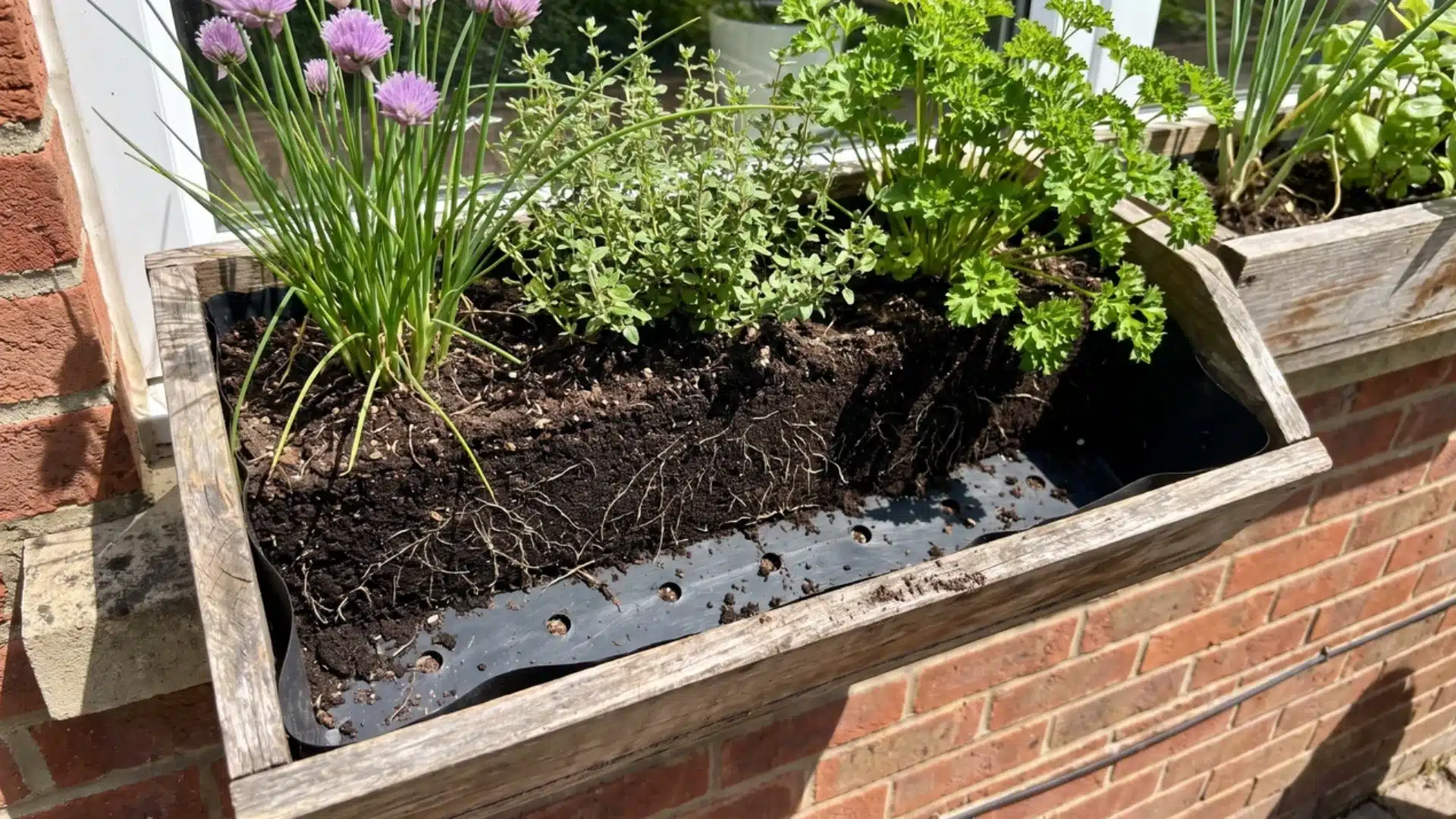
Root depth is the first constraint. Window boxes are shallow, usually six to eight inches deep. Chives, thyme, and parsley handle that fine. Rosemary and fennel don’t.
Orientation is the second: a south-facing box suits almost any culinary herb; a north-facing one narrows your options fast.
Drainage is where most window boxes fail. A liner with no holes turns the box into a slow-drowning chamber for roots. If your liner doesn’t drain, drill it or replace it. There’s no workaround.
2. Kitchen Countertop Hydroponic System
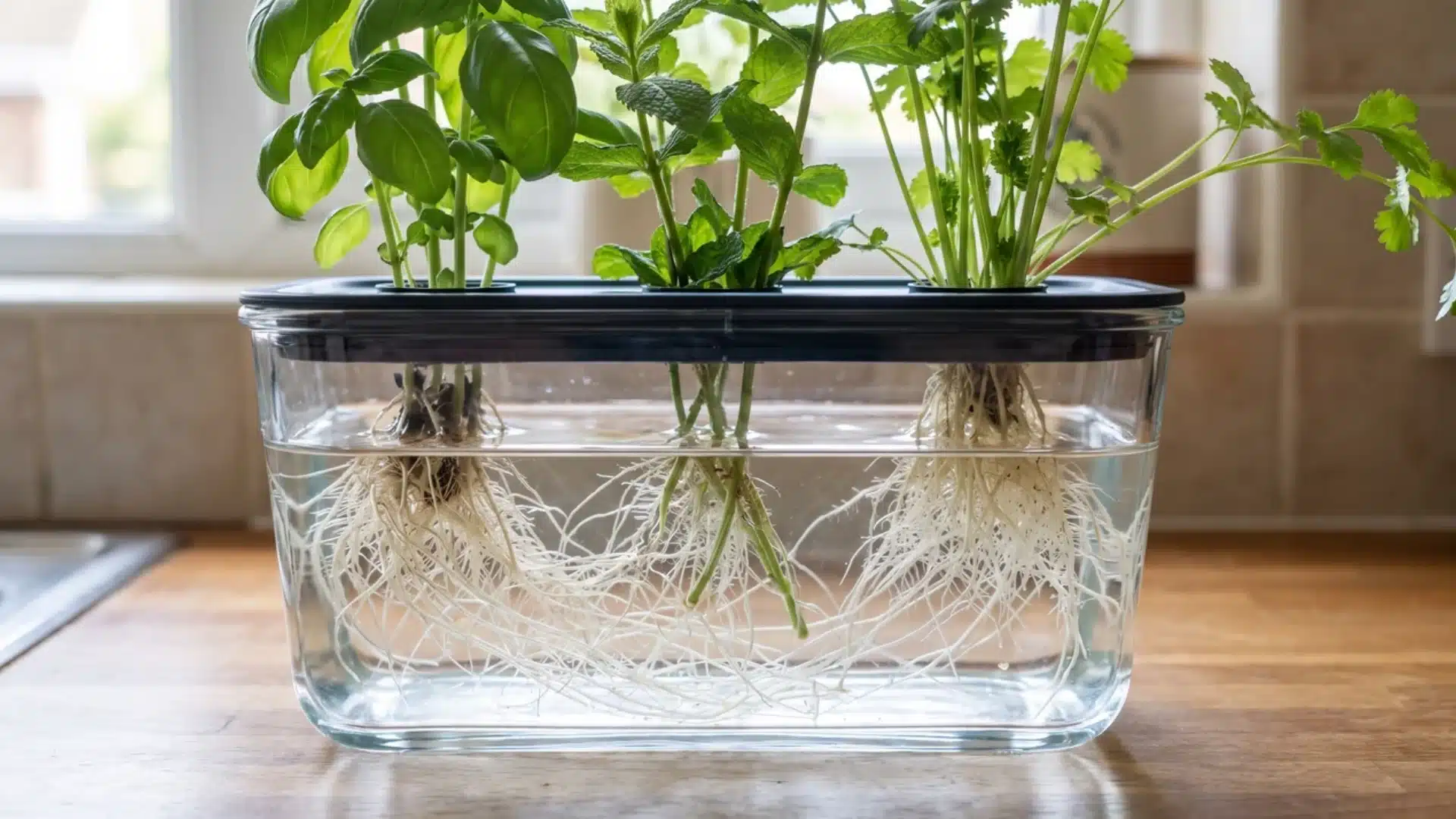
In a passive hydroponic system, roots sit directly in water and absorb nutrients without any growing medium in between. That works brilliantly for basil, mint, and cilantro, herbs that want consistent moisture and rich nutrients. It doesn’t work for Mediterranean herbs.
Rosemary, thyme, and oregano evolved in dry, well-drained soils and generally perform poorly in simple countertop hydroponic systems where roots stay constantly wet.
They can be grown hydroponically under carefully managed conditions, but they’re usually better suited to soil-based containers for home gardeners.
Stick to the moisture lovers, and this system will outperform soil on your countertop year-round. Add a Mediterranean herb to the mix, and you’ll lose it within a few weeks.
3. Tiered Strawberry Planter Repurposed for Herbs
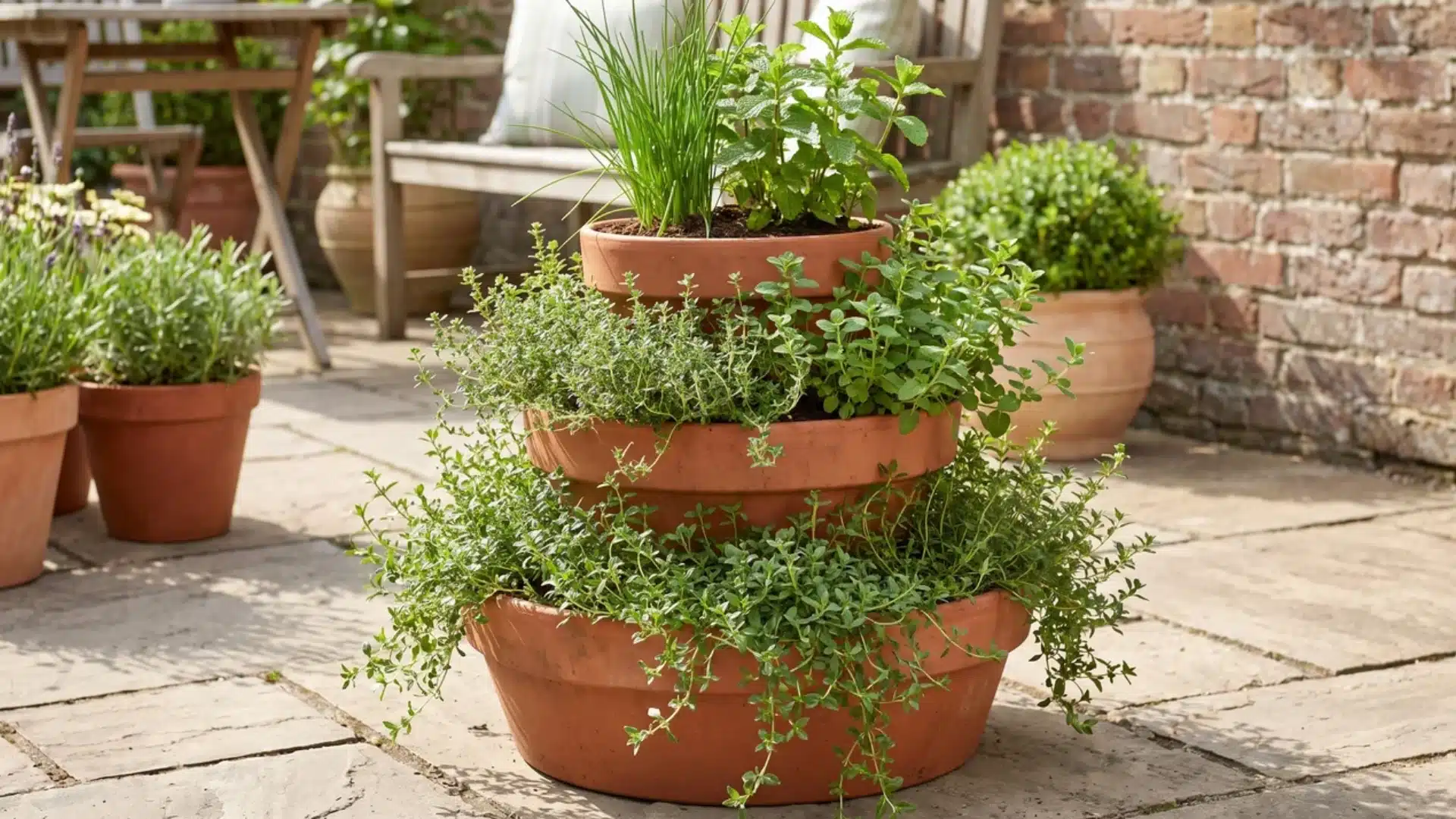
A tiered planter solves sun competition in a small footprint. Taller, upright herbs go at the top where light hits first. Trailing varieties, thyme, oregano, and creeping savory, go on the lower rungs where they can spill naturally.
Material matters; terracotta dries out faster, which suits Mediterranean herbs well. Plastic retains moisture longer, making it useful for basil and parsley, but it can encourage fungal problems in drought-tolerant varieties.
4. Single Large Pot with Companion Grouping
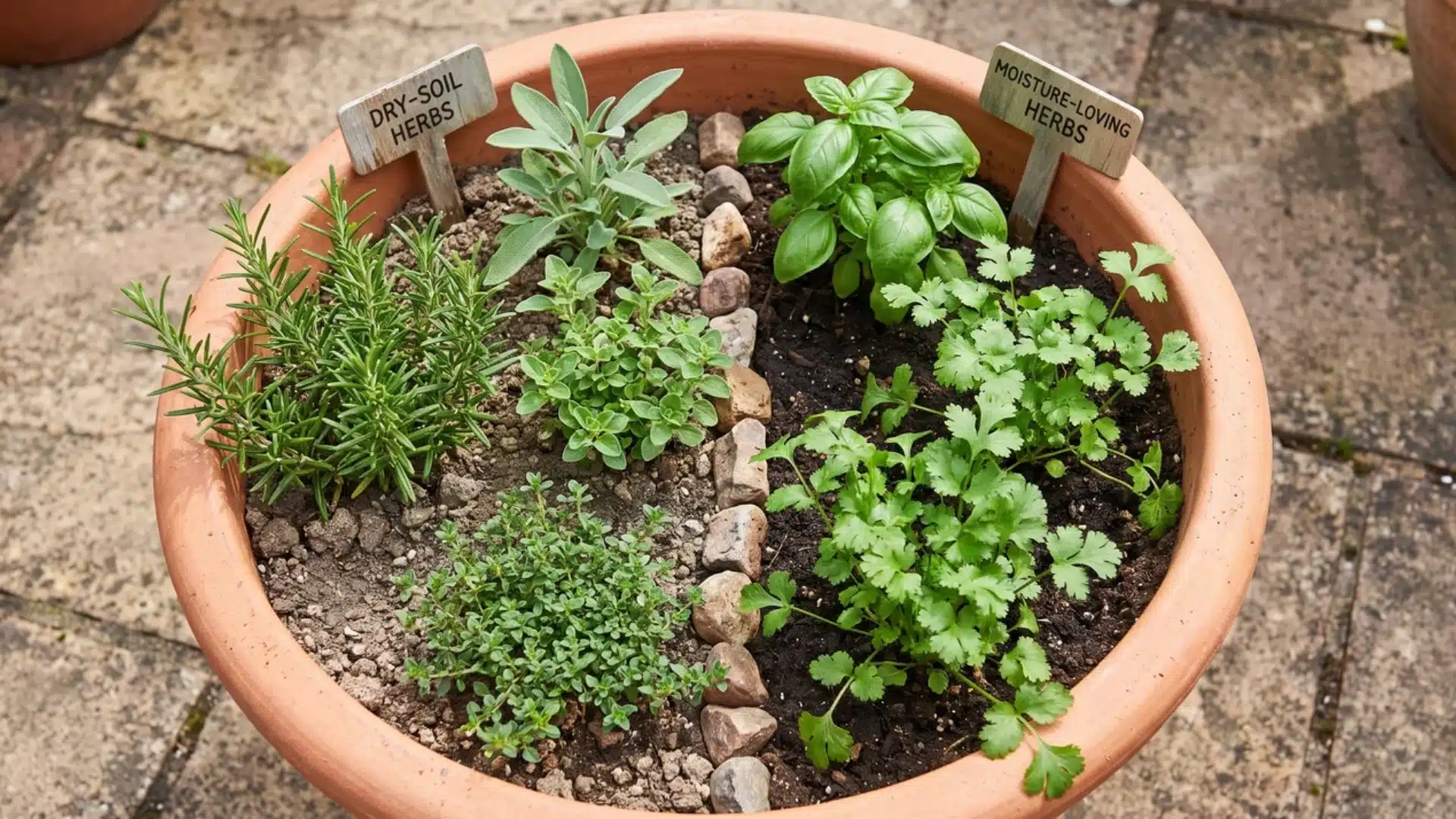
Group by water need, not by cuisine. Rosemary, thyme, oregano, and sage share the same preferences: dry soil, full sun, and frequent watering.
Basil, cilantro, and parsley want consistent moisture. Mix the two groups in one pot, and you’re running two incompatible watering schedules in the same container.
Keep them separate, and give each grouping room, a three-herb mix needs at least a 12-inch diameter pot. Crowded roots compete for moisture, and the weakest herb always loses first.
5. Hanging Basket Herb Garden
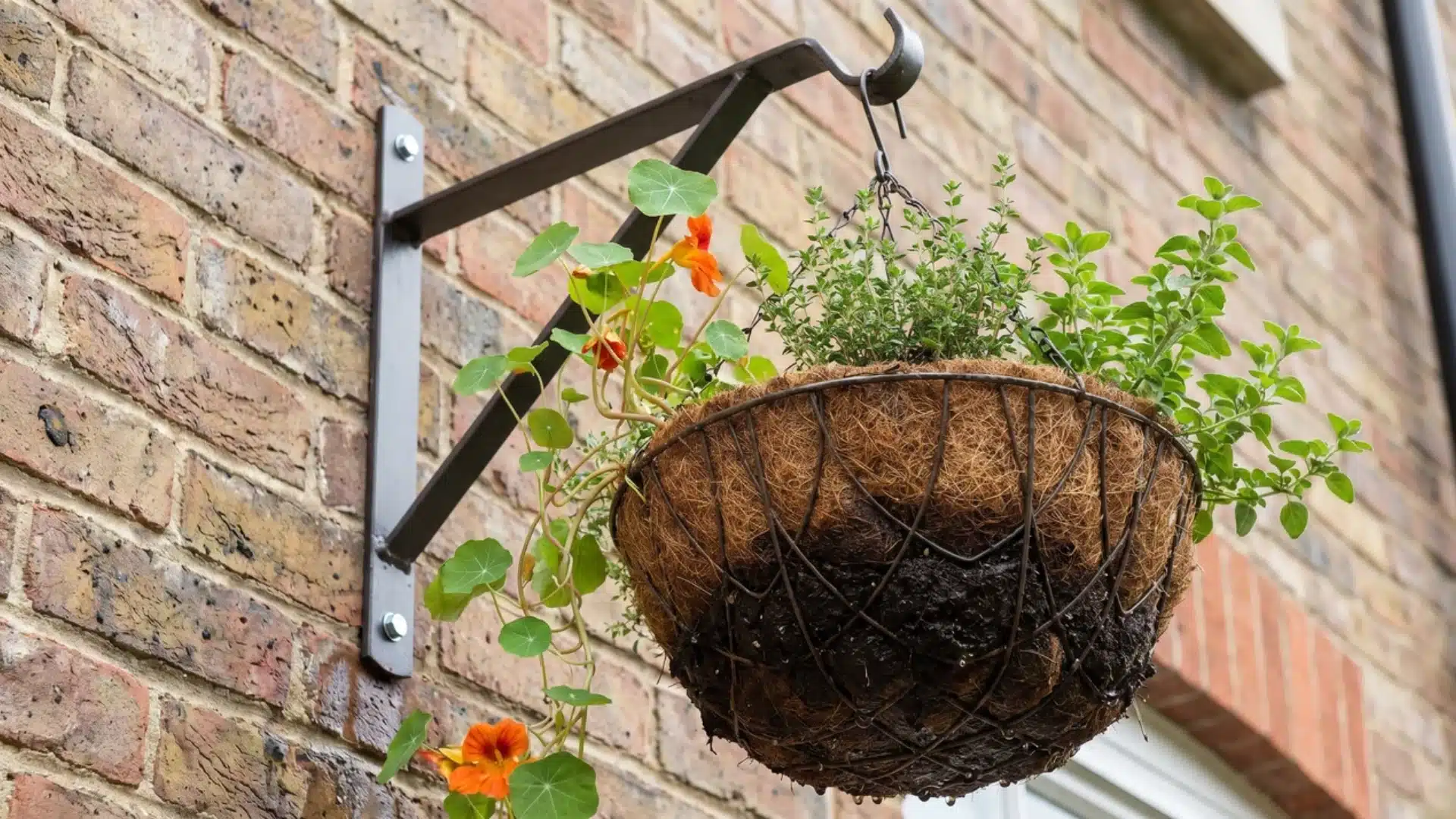
A hanging basket dries out much faster than a ground-level container because it is exposed to more air and wind from all sides. Check the soil more often, especially during hot or windy weather.
That’s not a problem if you plant accordingly; thyme, oregano, and nasturtium handle the exposure well.
Basil and cilantro don’t. Both bolt quickly under the heat stress of an open hanging position. Weight is the second issue. A saturated coir-lined basket can weigh 10 to 15 pounds.
Check that your bracket and fixing point are rated for it before you hang anything.
6. Repurposed Colander or Strainer
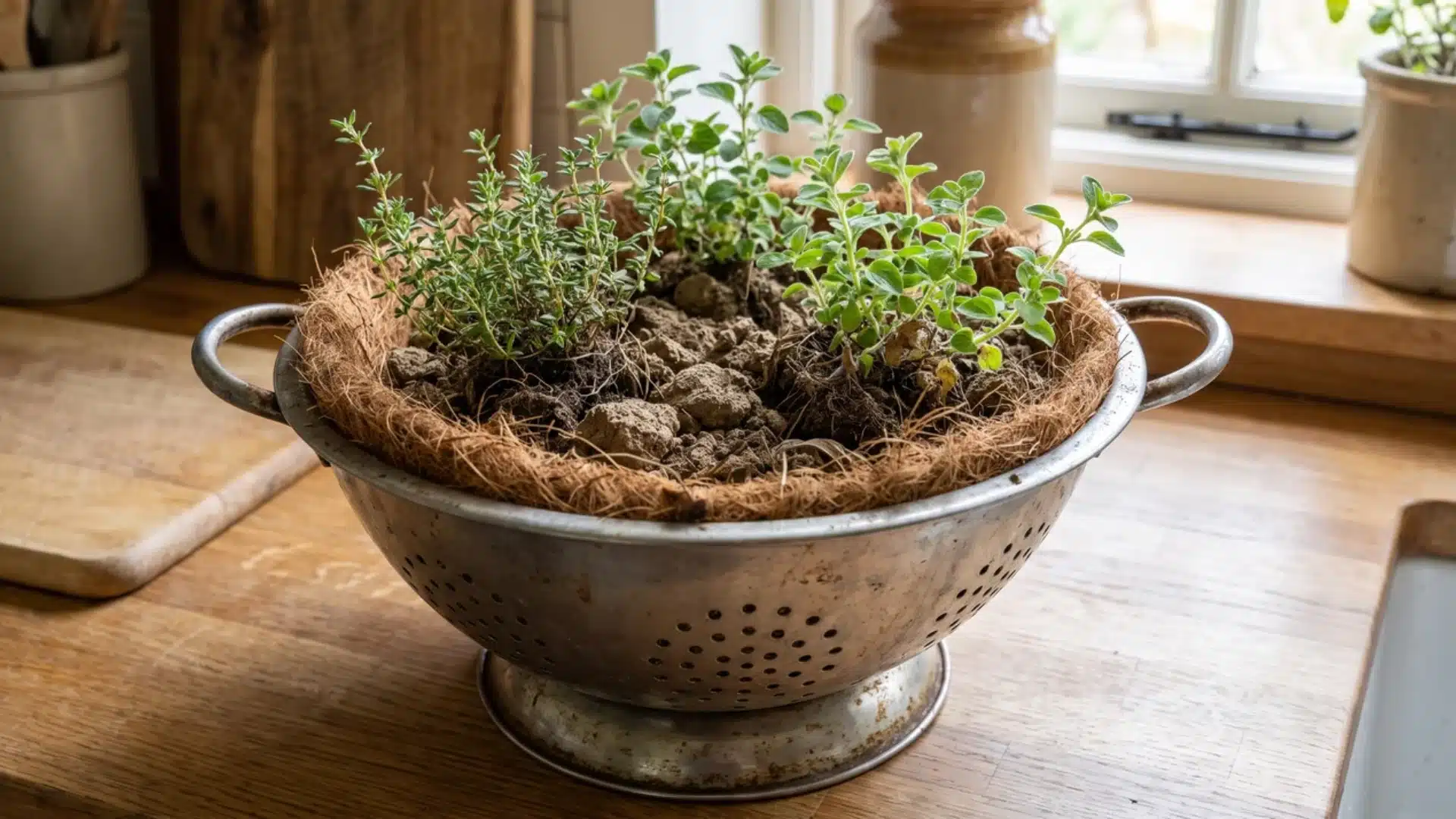
A metal or enamel colander has better drainage than most purpose-built pots, with more holes and better distribution. Line it with coconut coir rather than plastic. Coir holds just enough moisture without trapping it. Plastic sheeting defeats the drainage entirely.
The herbs that do best here want dry feet: thyme, oregano, and marjoram.
They’ll thrive in a container that drains fast and dries between waterings. It also works as a visual piece in a farmhouse or rustic kitchen in a way a standard terracotta pot simply doesn’t.
7. Mason Jar Herb Garden on a Magnetic Strip
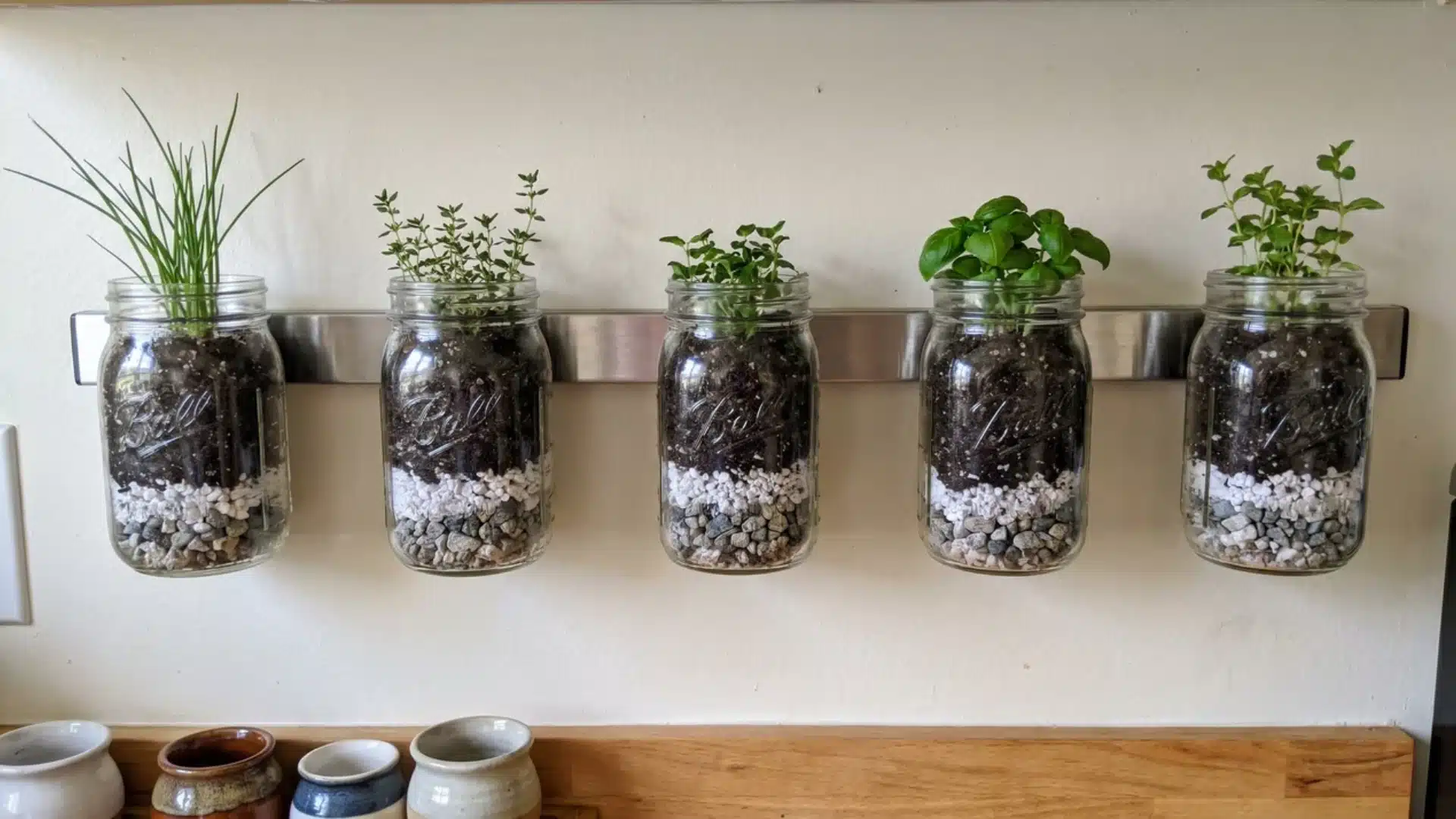
Mason jars have no drainage holes, so use them only for herbs that require careful watering, or place a nursery pot with drainage inside the jar.
If planting directly in the jar, avoid overwatering because excess water has nowhere to escape and can quickly lead to root rot.
Stick to small, slow-growing herbs that won’t need repotting, such as chives, thyme, and compact basil. Anything with a vigorous root system will outgrow a jar in one season.
Also, check the magnetic strip load rating before you fill the jars. Wet soil is heavier than it looks.
Raised Bed & Backyard Garden Ideas
If containers are about control, raised beds are about scale. You’re managing more soil, more herbs, and more variables, but you’re also unlocking setups that a single pot simply can’t do.
8. Classic Rectangular Raised Bed with Zoned Rows
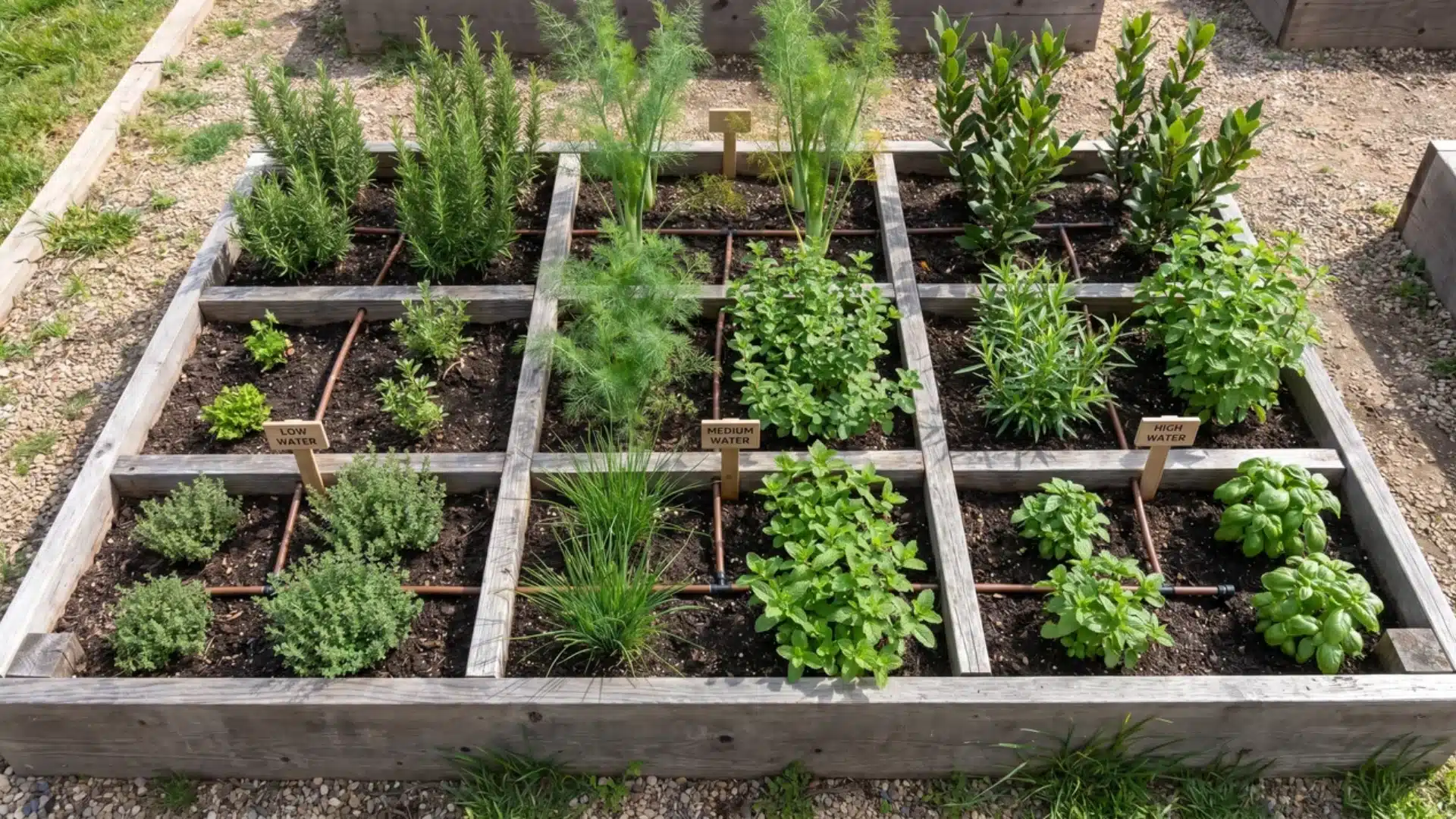
Most beginners fill a bed by working through seed packets in order or placing herbs wherever there’s a gap.
The result is tall herbs shading short ones, drought-tolerant herbs next to moisture-lovers, and an inconsistent harvest by midsummer. Zoning fixes it. Divide the bed before you plant: tall herbs at the north end, shorter herbs in the south-facing rows.
Then zone by water need within each row. Mediterranean herbs in one section, moisture-lovers in another. One watering schedule can serve each zone without stressing the other.
Ten minutes of planning before planting saves an entire season of uneven growth.
9. Wheel or Cartwheel Herb Garden
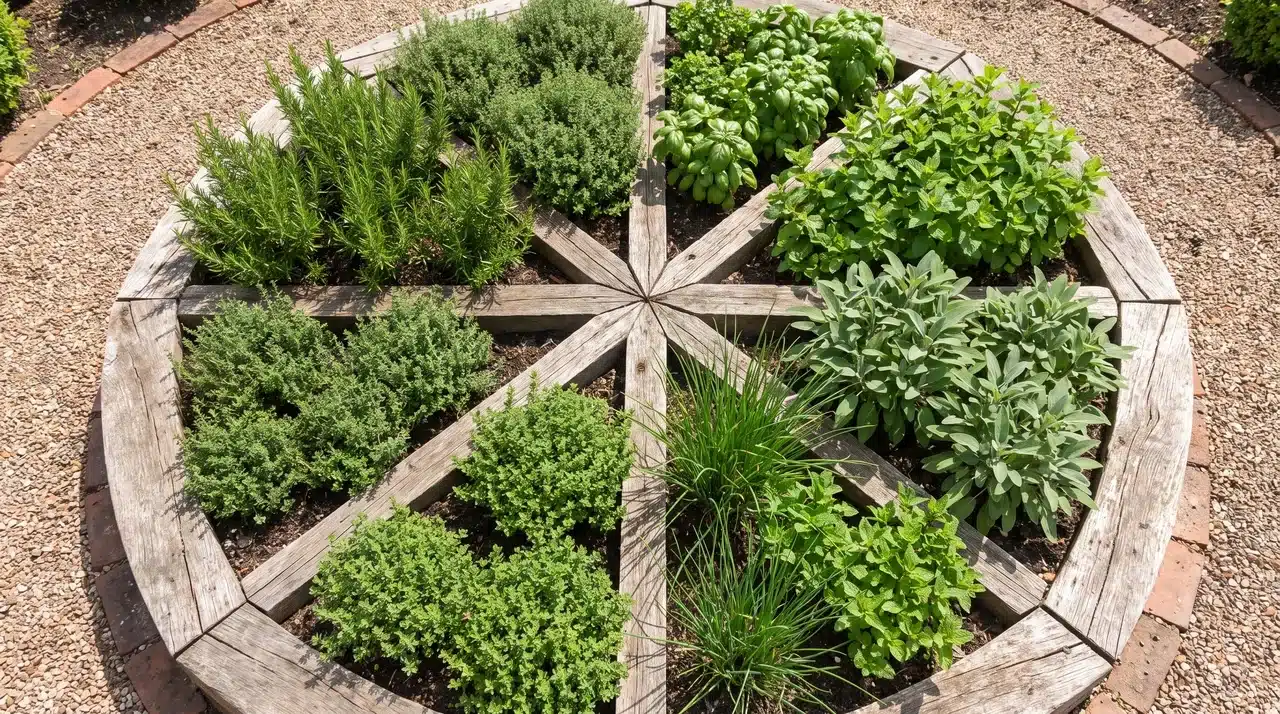
Each spoke of the wheel creates a physical section. Herbs stay in their segment; runners hit the boundary and stop. Mint, lemon balm, and other aggressive spreaders can share a bed with everything else, just not the same section.
You don’t need an actual wagon wheel. Timber lengths, brick rows, or bamboo laid as spokes all work. The geometry is the point.
Position spreaders in sections that back onto a hard edge, a path, or a wall, so runners have nowhere to go even if they clear the spoke. Assign every segment before you plant anything.
10. Herb Spiral
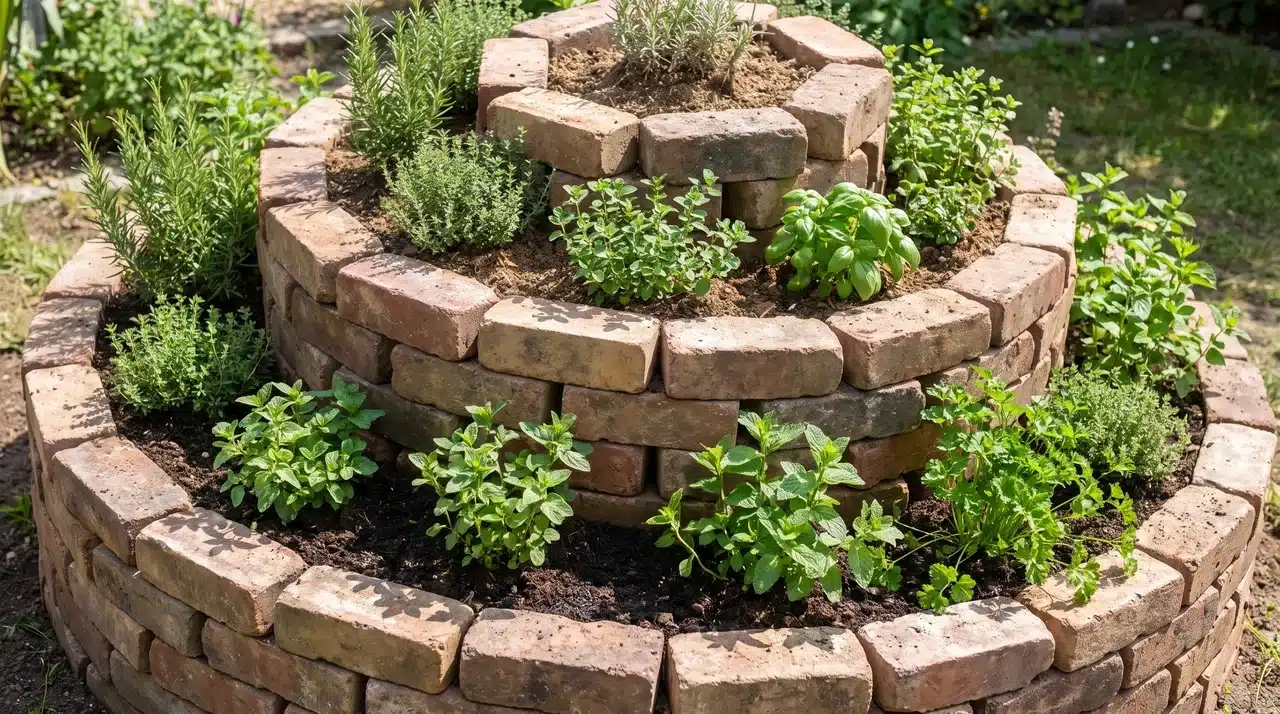
As the spiral rises from ground level to its peak, usually around three feet, growing conditions change dramatically. The top is warm, exposed, and drains fast. Mediterranean herbs belong here.
The base stays cooler and retains more moisture; parsley, chervil, and chives belong down there. One structure, two completely different growing environments. Building one doesn’t require specialist skills.
Around 30 to 40 bricks or stones without mortar are enough. Fill each section with appropriate soil as you go, gritty and free-draining at the top, richer and moisture-retentive at the base.
11. Raised Bed with Buried Mint Containment
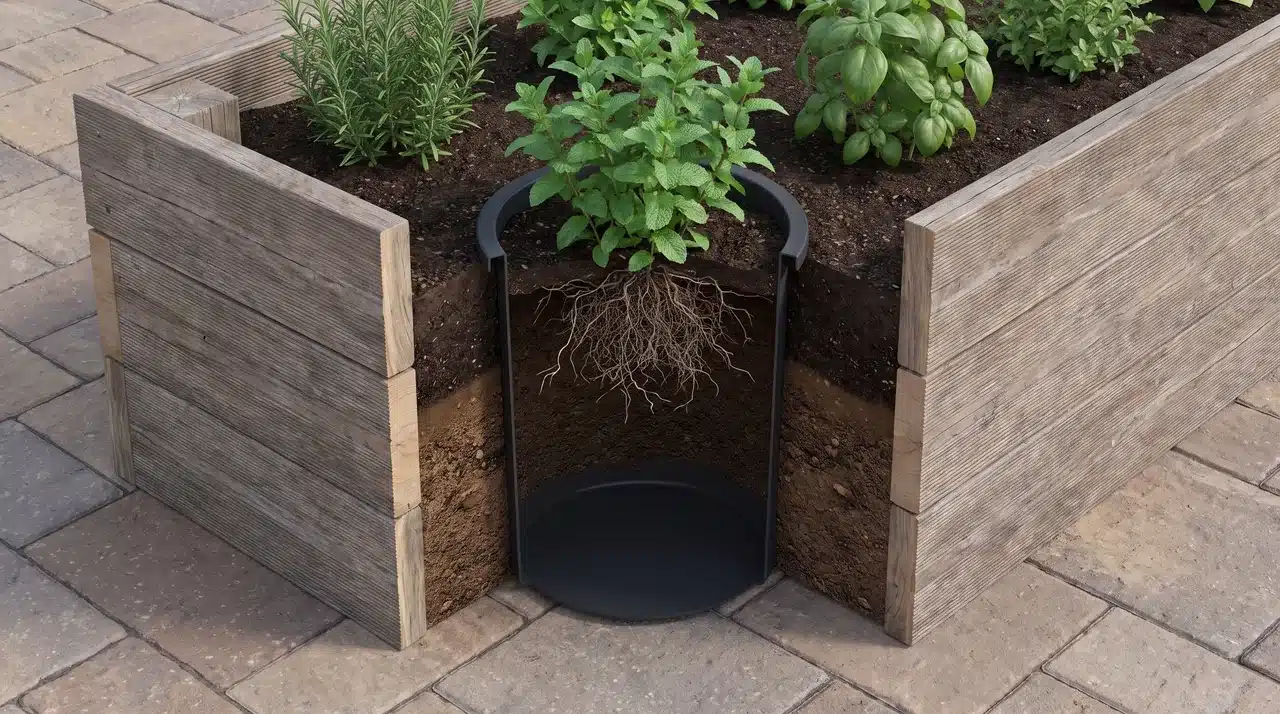
Mint, lemon balm, and tarragon spread via underground runners. Plant any of them loose in a raised bed, and within a single growing season, runners can travel two feet in every direction and emerge through the root systems of everything nearby. This isn’t a gradual problem; it’s a fast one.
Sink a container into the bed soil before planting: a bottomless pot, a cut-down bucket, or a section of pipe. The rim sits two inches above the surface. Runners hit the wall and stop.
This is the only way to grow mint in a shared raised bed without letting it take over the bed.
12. L-Shaped Corner Raised Bed
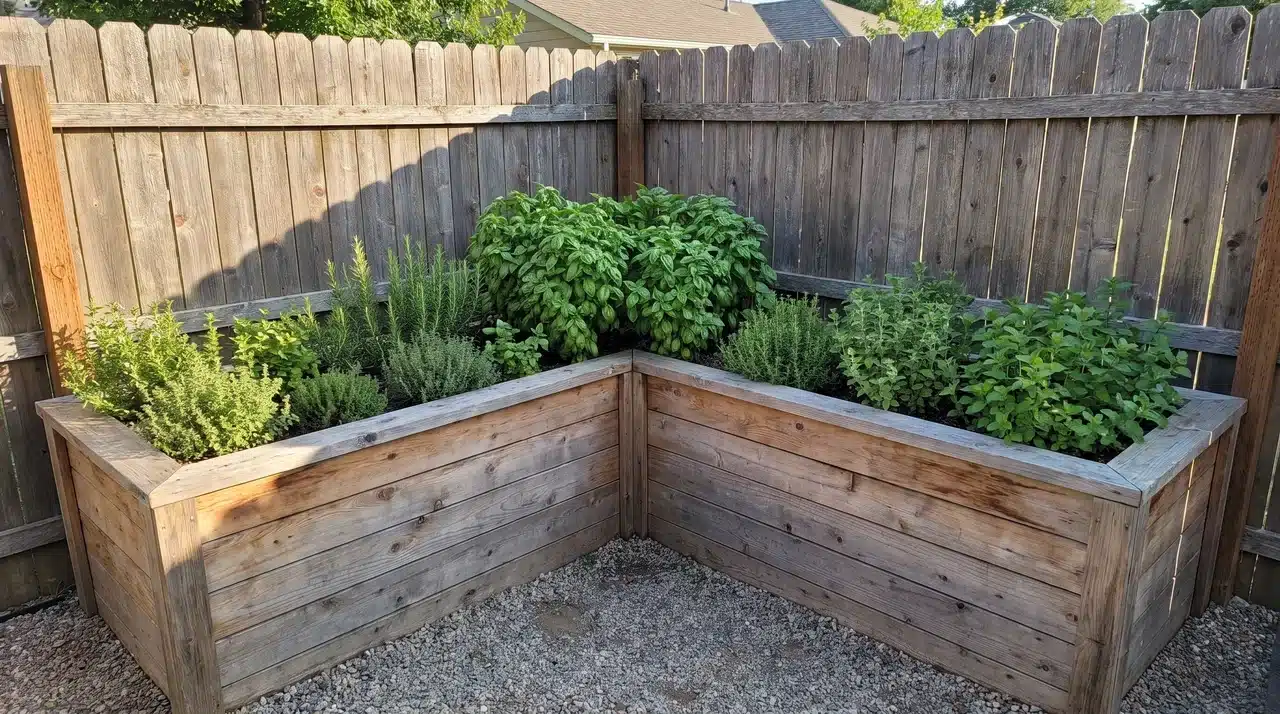
A corner bed turns the dead zone where two fence lines meet into a productive growing space. The inner corner acts as a natural windbreak, useful for basil, especially, which is more sensitive to cold and wind than most culinary herbs.
Design it for reach. The maximum comfortable distance into a raised bed without stepping in is around 24 inches. Build the L so both arms stay within that reach from the outside edge.
A bed you can’t reach the back of is a bed you’ll eventually neglect.
13. Waist-High Planter (VegTrug-Style)
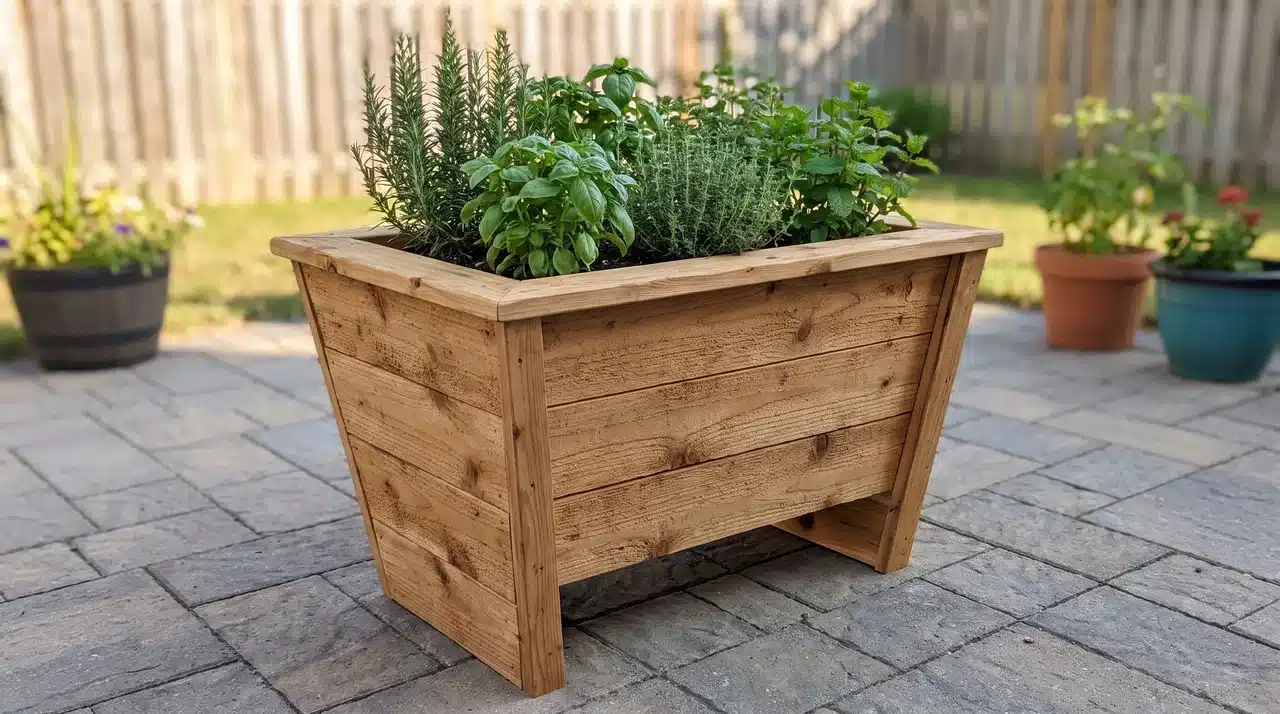
Elevation removes two quiet killers of ground-level herb gardens. The first is a slug; a waist-high planter puts soil out of reach for most ground-level pests without any additional intervention.
The second is drainage: if your garden sits on clay, ground-level beds still interact with the soil beneath. A fully elevated planter sits clear of all of that.
Most waist-high planters taper toward the base, which creates natural drainage without a separate gravel layer.
That taper is worth checking before you buy; flat-bottomed elevated planters don’t offer the same benefit. Verify current dimensions and pricing before publishing; specs in this category update regularly.
14. In-Ground Border Herb Strip Along a Path or Fence
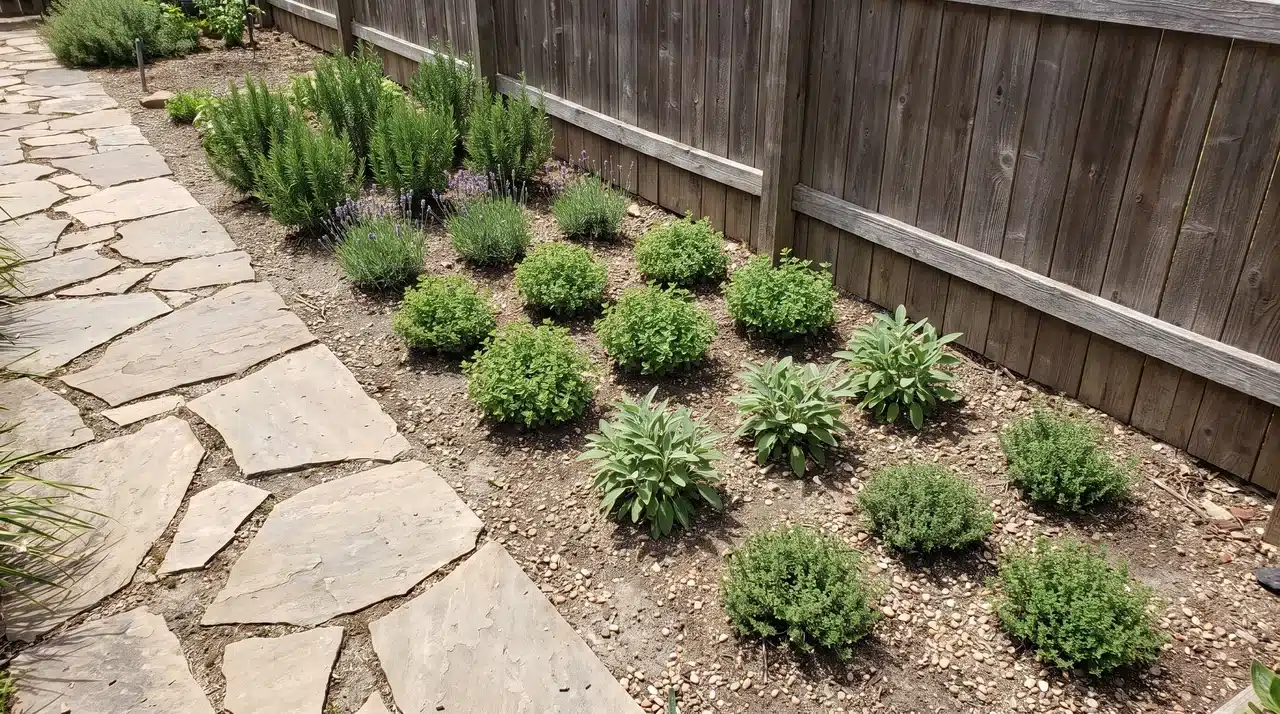
Stone and gravel paths absorb heat during the day and release it slowly after dark. Herbs planted within 12 inches of a path benefit from that radiated warmth for Mediterranean varieties.
It extends the season at both ends. Plant in odd-numbered groups of three or five rather than single specimens. It reads as naturalistic rather than regimented.
One step most people skip: if your soil is clay-heavy, amend it before planting. Dig in grit and compost to improve drainage. Herbs planted in waterlogged clay will struggle regardless of how much sun they get.
Vertical & Wall-Mounted Ideas
A wall or fence can grow more herbs than most people expect. This solves floor-space problems that containers can’t, but it introduces one discipline that catches almost everyone out the first time.
Vertical planters dry out faster than any other setup. That single fact should shape every decision you make in this category, from which herbs you plant to how often you check the soil.
15. Pallet Herb Garden
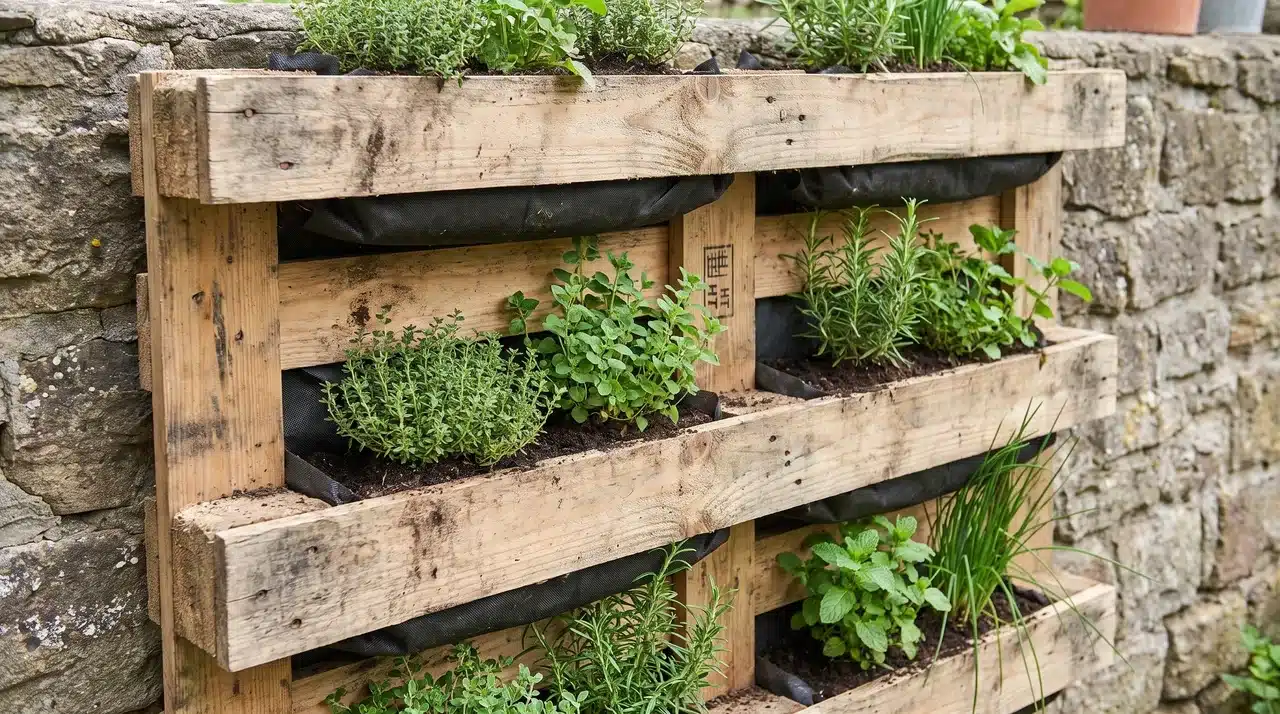
Not all pallets are safe for growing food. Pallets treated with methyl bromide are marked MB; they leach methyl bromide into soil and edible crops. Only use heat-treated pallets stamped HT.
That’s the only marking you can trust before you build anything you plan to eat.
Once the pallet is confirmed safe, line each pocket with landscape fabric before adding soil. Without it, soil washes out through the slats every time you water. Stick to shallow-rooted herbs, thyme, oregano, and chives.
Deep-rooted varieties hit the pallet structure before they establish.
16. Vertical Pocket Planter on a Fence or Wall
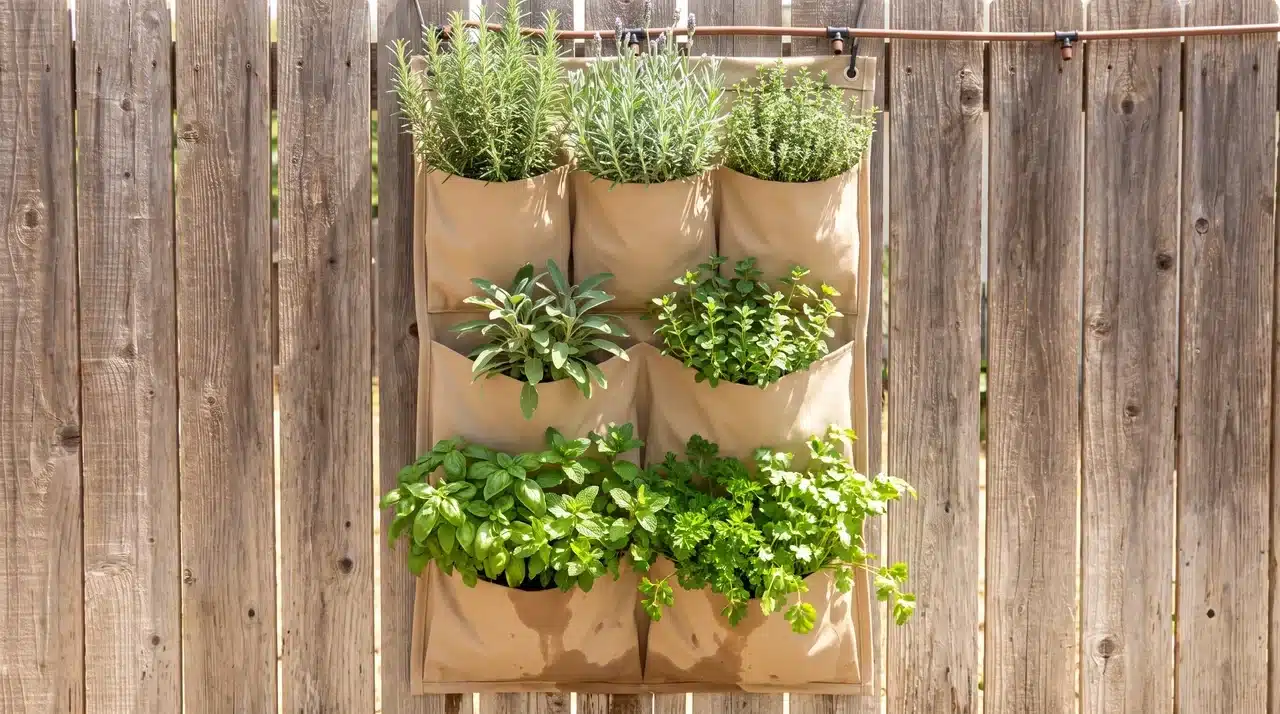
Gravity pulls water downward. Every time you water a pocket planter, the top row absorbs first, and the excess moves down. By the time water reaches the bottom, the top is already drying out again, two to three times faster than the lowest row.
Plant drought-tolerant herbs at the top, moisture-lovers at the base. That’s not a preference; it’s the physics of the setup.
Fabric pockets outperform plastic for root health; they breathe, and roots don’t circle and suffocate. South- or west-facing walls only. A north-facing fence is the wrong wall for this setup entirely.
17. Mounted Horizontal Gutter Planters
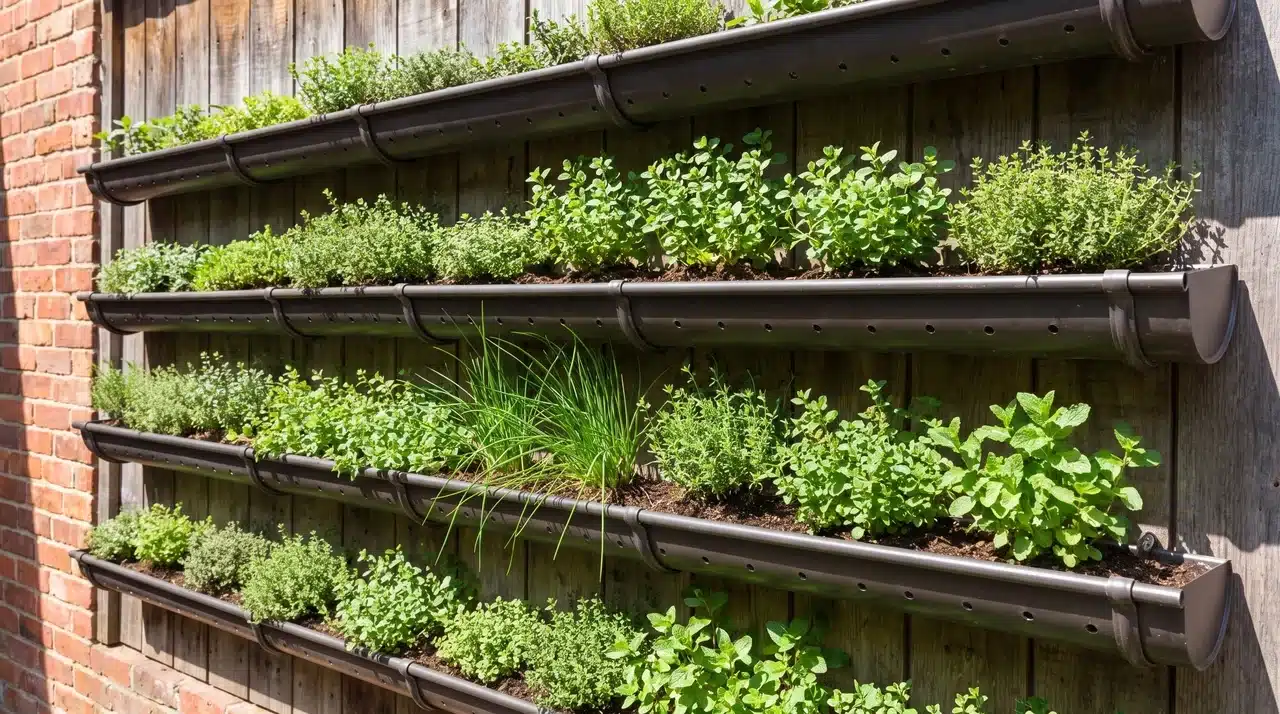
Repurposed guttering suits shallow-rooted herbs perfectly: chives, lettuce-leaf basil, and flat-leaf parsley. These herbs don’t need depth.
They need consistent moisture and good light, both of which a horizontal channel provides well. Drill drainage holes every six to eight inches before mounting.
A sealed channel becomes a trough of standing water after the first rain. Also, leave at least eight inches of vertical gap between rows, enough so the upper row doesn’t shade the one below.
18. Ladder Shelf Herb Display
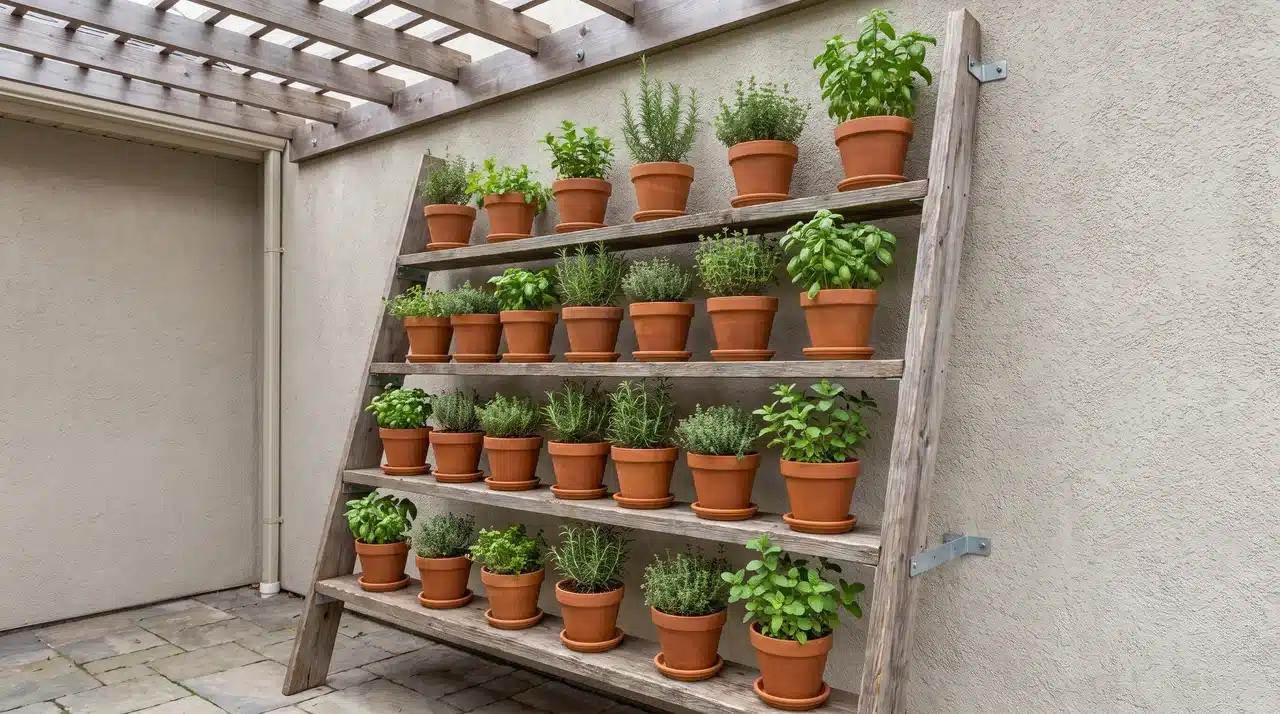
A ladder shelf needs no wall fixings, no drilling, no permanent commitment. Lean it against a wall, add pots, done. The tiered structure gives each shelf enough clearance for herbs to grow without competing for light.
Two things matter before you load it. Secure the top rung to the wall; a fully loaded shelf is heavy and top-heavy, and one gust is enough to bring it down. Keep it in a covered or sheltered position.
The top shelf in the open air gets wind exposure that small pots can’t handle.
19. Living Herb Wall Panel (Frame + Soil Mat)
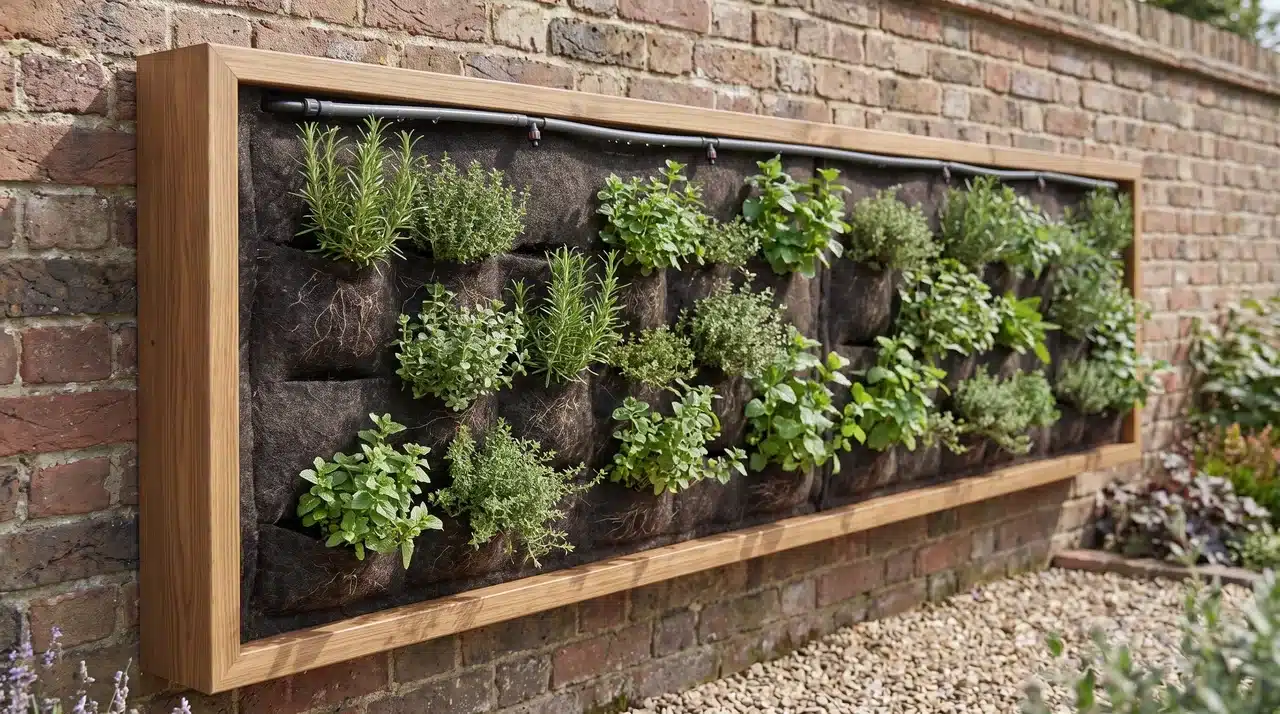
A framed panel filled with compressed soil mats or felt medium lets roots grow horizontally rather than downward. It works, but only if the irrigation is right.
Passive watering suits low-demand herbs like thyme, oregano, and mint. Basil and cilantro need consistent water delivered to the root zone. A basic drip system is the minimum required to make this setup reliable for a mixed planting.
Themed & Purpose-Built Garden Ideas
These ideas organize herbs by what you want from them, not by where they grow. If you’ve already worked out your space, this is the layer that makes it personal.
20. Italian Culinary Herb Garden
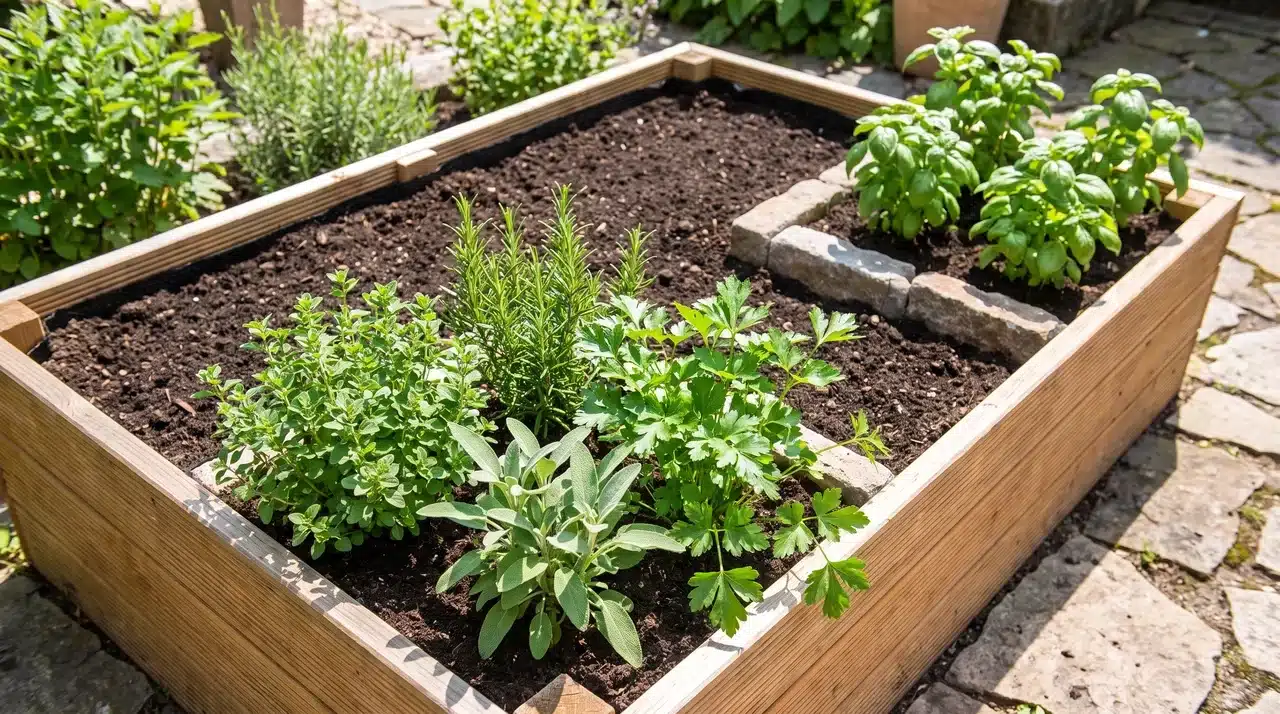
Oregano, rosemary, sage, and flat-leaf parsley all prefer full sun and well-drained soil. Plant them together, and one watering schedule covers all four.
Basil is the exception; it needs more moisture and warmth than the others. Give it its own section or pot within the grouping.
Harvest timing matters. Pick basil before it flowers; once it bolts, leaves turn bitter, and production slows. Oregano and thyme are the opposite, their flavor peaks after flowering, when the oils in the leaves are most concentrated.
21. Tea Herb Garden
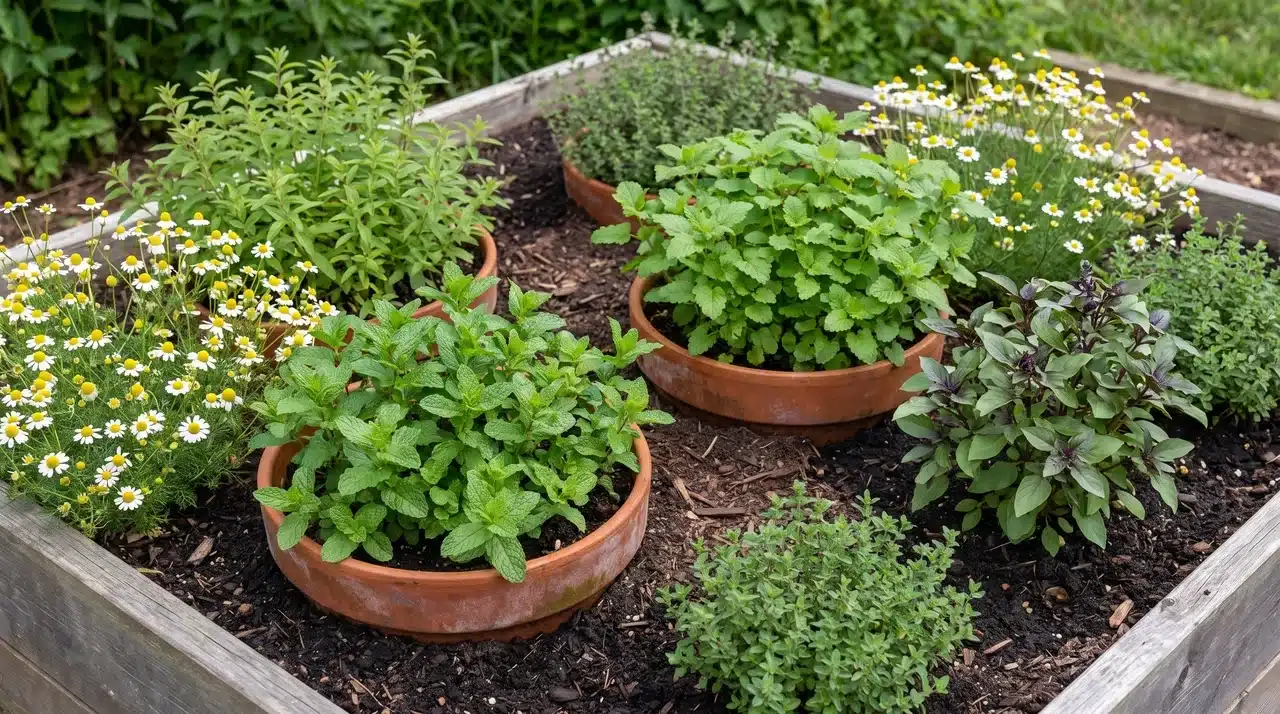
Chamomile, lemon verbena, mint, lemon balm, and holy basil cover floral, citrus, cooling, and spiced profiles.
Enough variety for a serious tea habit without overcomplicating the garden. The challenge isn’t keeping them alive; it’s keeping mint and lemon balm contained. Both spread via underground runners and will take over a bed fast.
Sink a container into the soil for each of them, rim two inches above the surface.
The same containment rule applies here as in any other bed, themed or not; the runners don’t care. For harvest, dry before peak flowering; pick fresh after flowering has begun.
22. Medicinal Herb Garden
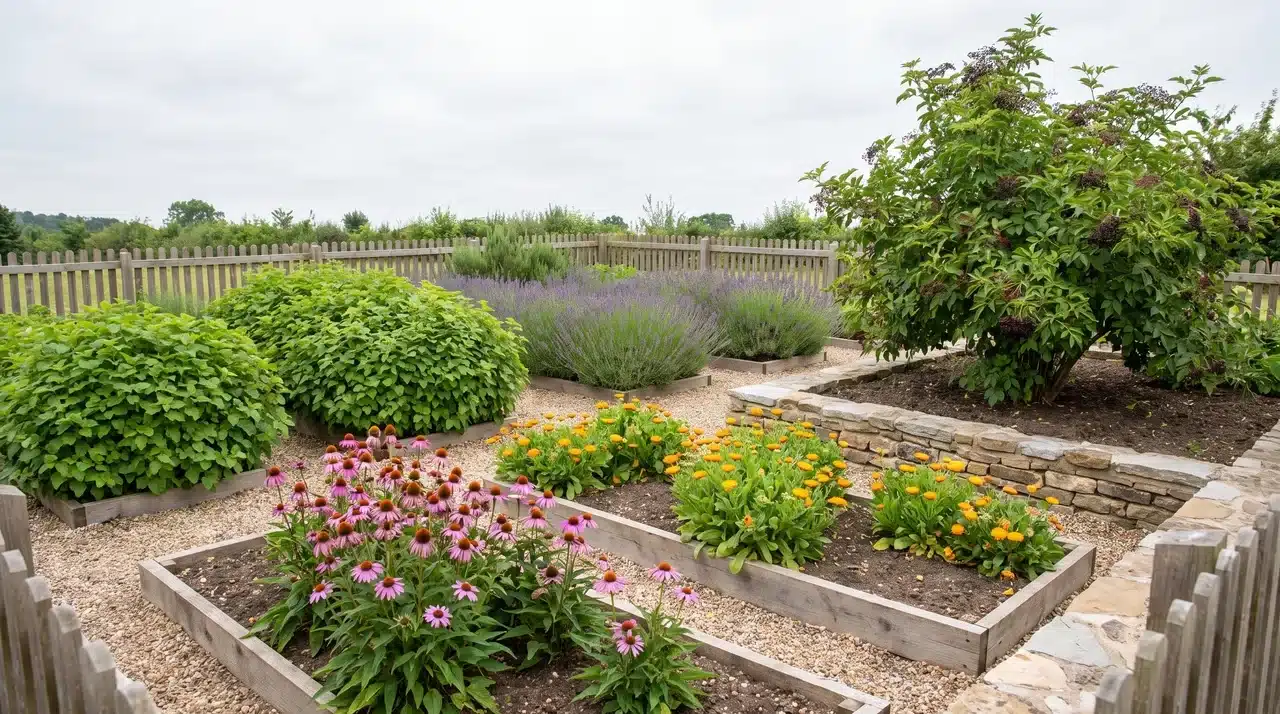
Grow what your household will actually use. Three to five herbs chosen for real, regular use will outperform a twelve-herb bed planted from a list.
Echinacea, calendula, lavender, lemon balm, and elderberry cover a practical range, all beginner-friendly, visually attractive, and genuinely useful.
Keep the language grounded in traditional and historical use. Regulatory guidance on health claims for herbs shifts across markets.
Describe what these herbs have been used for, not what they treat. Note also that elderberry is a shrub; factor in the space it needs before recommending it for a small plot.
23. Pollinator Support Herb Garden
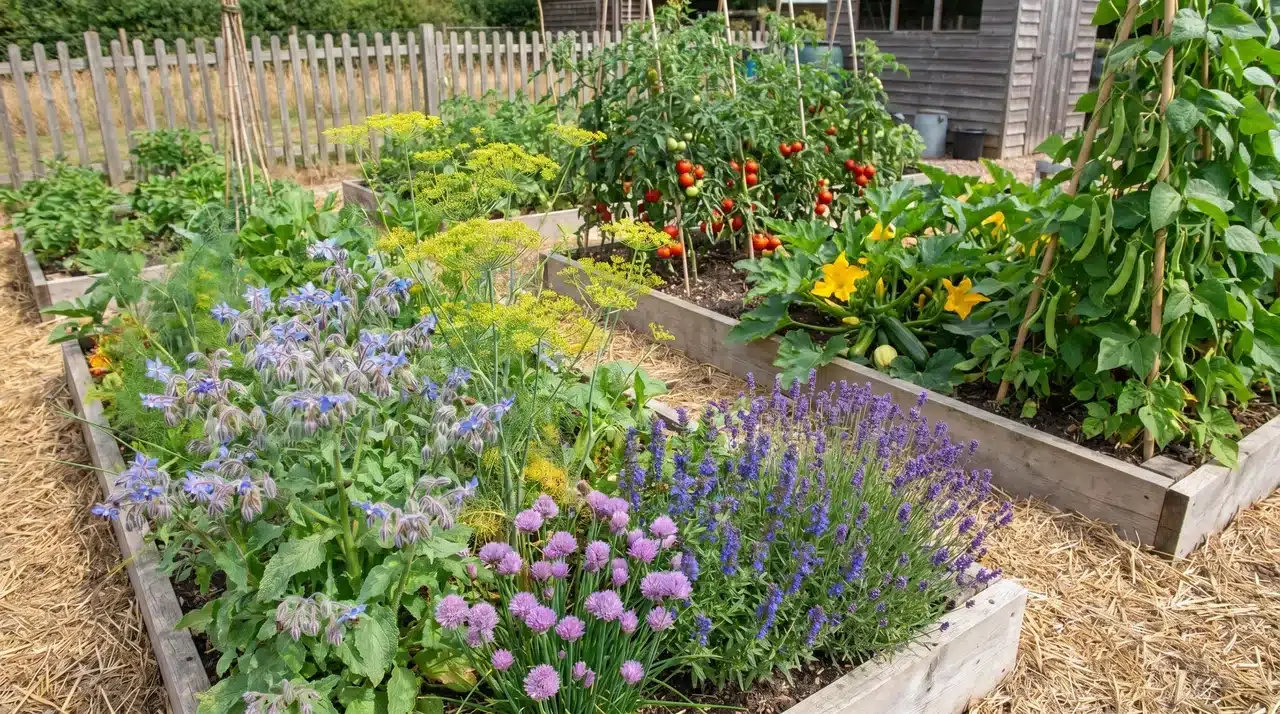
Bolting is usually treated as a failure. In a pollinator garden, it’s the whole point. Borage, fennel, chives, lavender, and hyssop all produce flowers that bees and pollinators rely on heavily.
Letting them flower doesn’t mean abandoning the harvest; grow more plants than you need, harvest from some, and let others flower fully.
Position this bed near fruiting vegetables if you have them. The pollinator traffic increases fruit set on tomatoes, courgettes, and beans. It’s doing measurable work in the wider garden, not just adding color.
24. Sensory or Tactile Herb Garden (Accessibility-Focused)
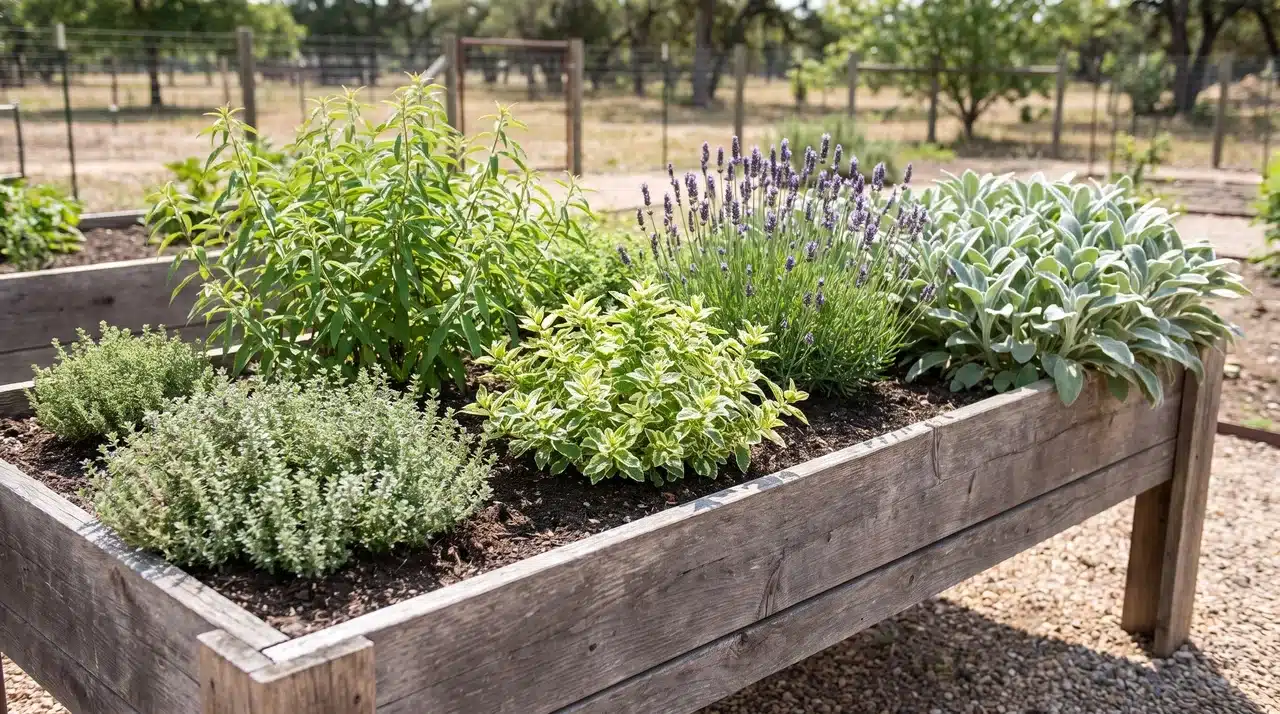
This garden is designed to be experienced through touch and smell. That changes almost every decision, plant selection, bed height, layout, and spacing.
Waist-high growing at 75 to 90 centimeters is not optional here. It’s the design. Ground-level beds exclude the people this garden is built for.
Plant selection leans toward texture and scent. Woolly thyme, lemon verbena, pineapple mint, lavender, and lamb’s ear all offer strong tactile or aromatic interest.
Space them generously; clear separation lets each variety be identified and appreciated on its own.
25. Cut-and-Come-Again Harvest Garden
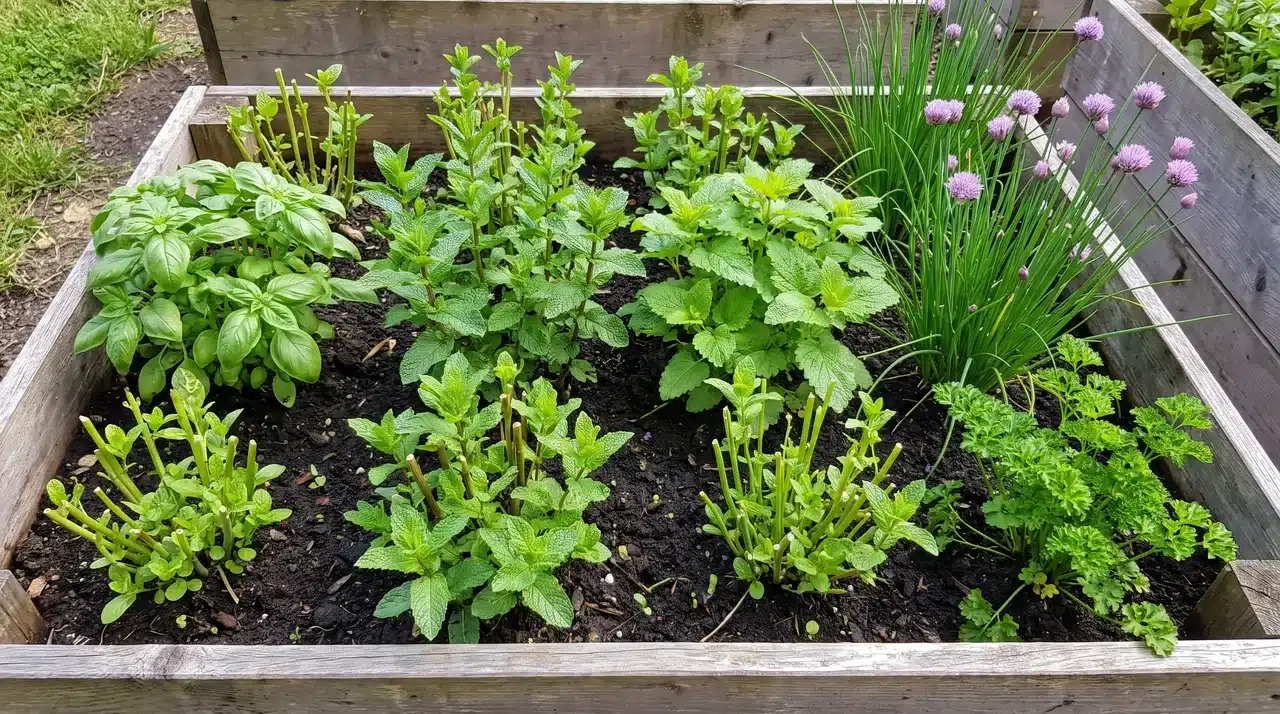
Lightly picking a few leaves here and there is the fastest way to end a herb’s productive season early. It allows the plant to redirect energy toward flowering. Once it flowers, leaves lose flavor, and the plant begins to wind down.
Regular, hard cutting is what keeps herbs in their productive, leafy stage. Cut back by a third each time, do it often, and the plant keeps pushing out new growth instead.
The herbs that respond best are basil, mint, lemon balm, chives, and parsley. Plant two or three of each rather than one; this garden needs volume because you’re harvesting aggressively from the start.
Conclusion
The best herb garden ideas are the ones that fit your available space, sunlight, and the herbs you want to grow.
Matching plants with similar water and light needs helps reduce problems and keeps your garden easier to care for throughout the year.
From simple containers to raised beds and vertical planters, there is a layout for almost every home.
Start with one idea that suits your space, then add more as your confidence grows. Have a favorite herb garden setup or a helpful tip? Share it in the comments so others can learn from your experience.