

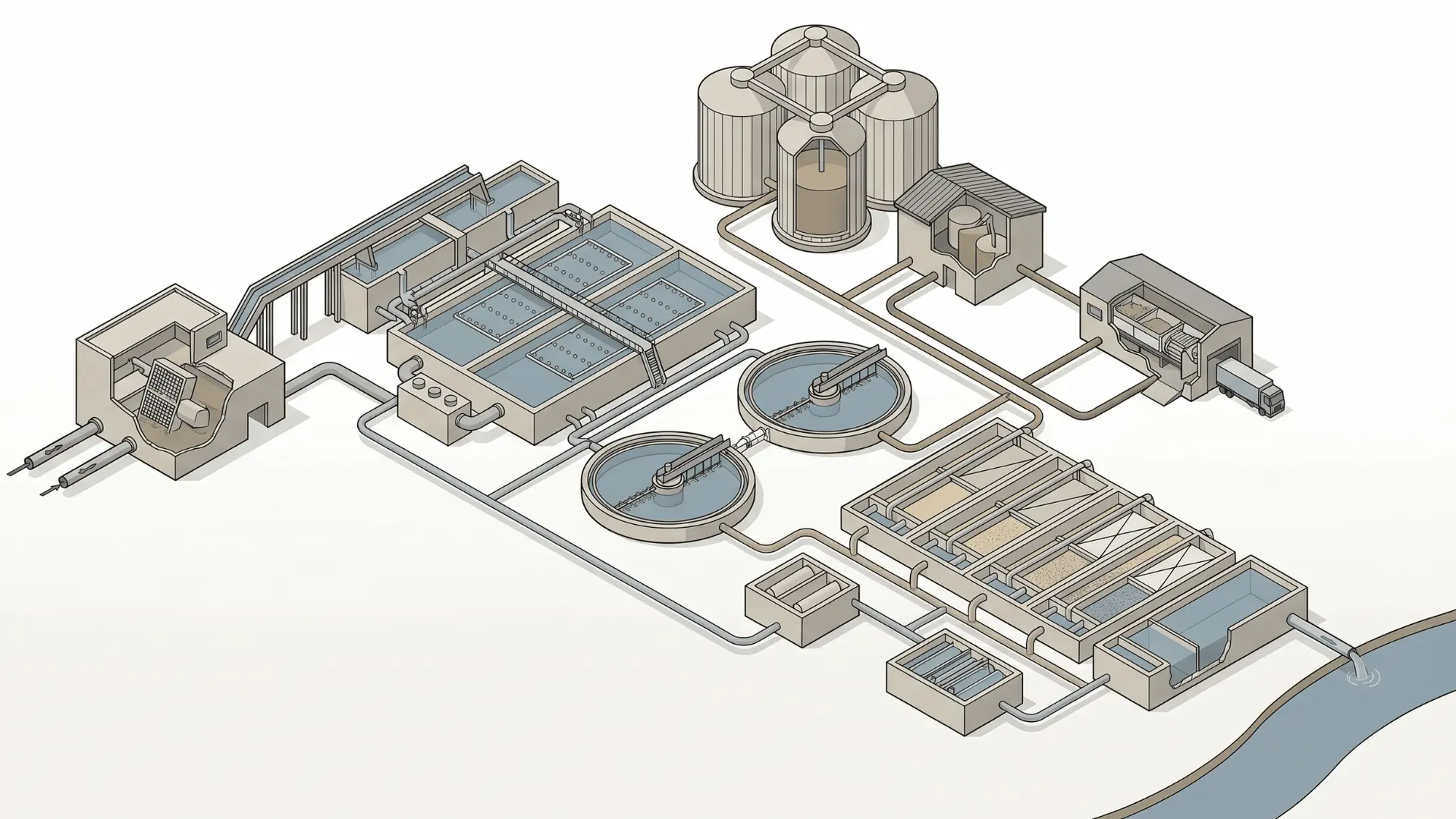
A sewage treatment plant does more than clean dirty water. It runs wastewater through a carefully ordered sequence of stages, each one targeting what the last couldn’t remove.
People usually picture a single filtration step. The reality is closer to four, running in parallel across both the liquid and the solids.
Understanding how it works matters more than it might seem. The stages explain why untreated discharge causes algal blooms, why aeration tanks aren’t optional, and why modern facilities are increasingly referred to as resource recovery plants.
Today, I’ll go over the full process, from the moment wastewater enters a facility to the point treated water leaves it, and what happens to everything pulled out along the way.
What is a Sewage Treatment Plant?
A sewage treatment plant is a facility that removes contaminants from wastewater through a series of physical, biological, and chemical stages before the cleaned water is returned to the environment.
It receives mixed wastewater from homes and businesses. That includes everything that goes down your drains, toilets, sinks, and washing machines.
A large municipal works serving a city and a small on-site unit serving a single property are both sewage treatment plants. What separates both from a septic tank is that they actively treat the waste. A septic tank settles and stores; a treatment plant processes.
Solids removed during treatment become sludge. That sludge can be processed into biogas and biosolids.
Newer facilities are increasingly built around recovering those materials, which is why you’ll sometimes see them called water reclamation facilities instead.
How the Treatment Process Works: Stage by Stage
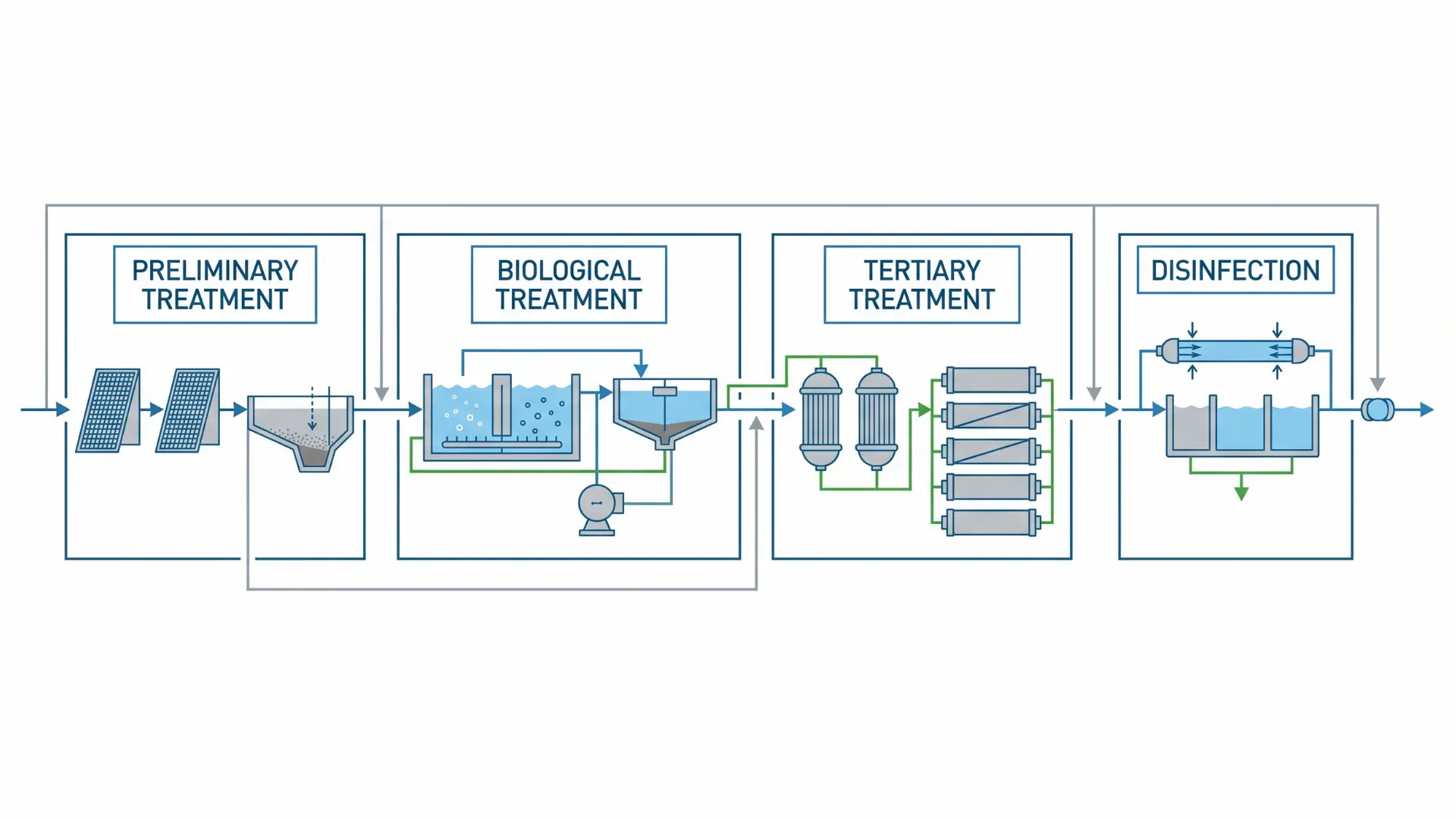
Sewage treatment isn’t one process. It’s a sequence, and the order isn’t arbitrary. Each stage removes what the previous one couldn’t. Skip a stage, and the contaminants it targets pass straight through.
| Stage | What it removes | How it works | What’s left after |
|---|---|---|---|
| Preliminary & Primary | Large solids, grit, fats, oils | Screening, grit chambers, settling tanks | Dissolved organic matter, nutrients, pathogens |
| Secondary (Biological) | Dissolved organic matter (BOD) | Aerobic bacteria oxidize organics in aeration tanks; clarifiers settle out the bacteria. | Nutrients, pathogens |
| Tertiary | Nutrients (phosphorus, nitrogen) | Chemical precipitation or biological nutrient removal | Pathogens |
| Disinfection | Pathogens (bacteria, viruses, protozoa) | UV light or chlorine | Clean effluent ready for discharge |
One thing you need to know: not every facility runs all four. Smaller plants typically stop after secondary treatment. Facilities under heavy load during storms sometimes bypass the tertiary entirely. When that happens, nutrients and pathogens can reach waterways untreated.
What Happens to the Sludge
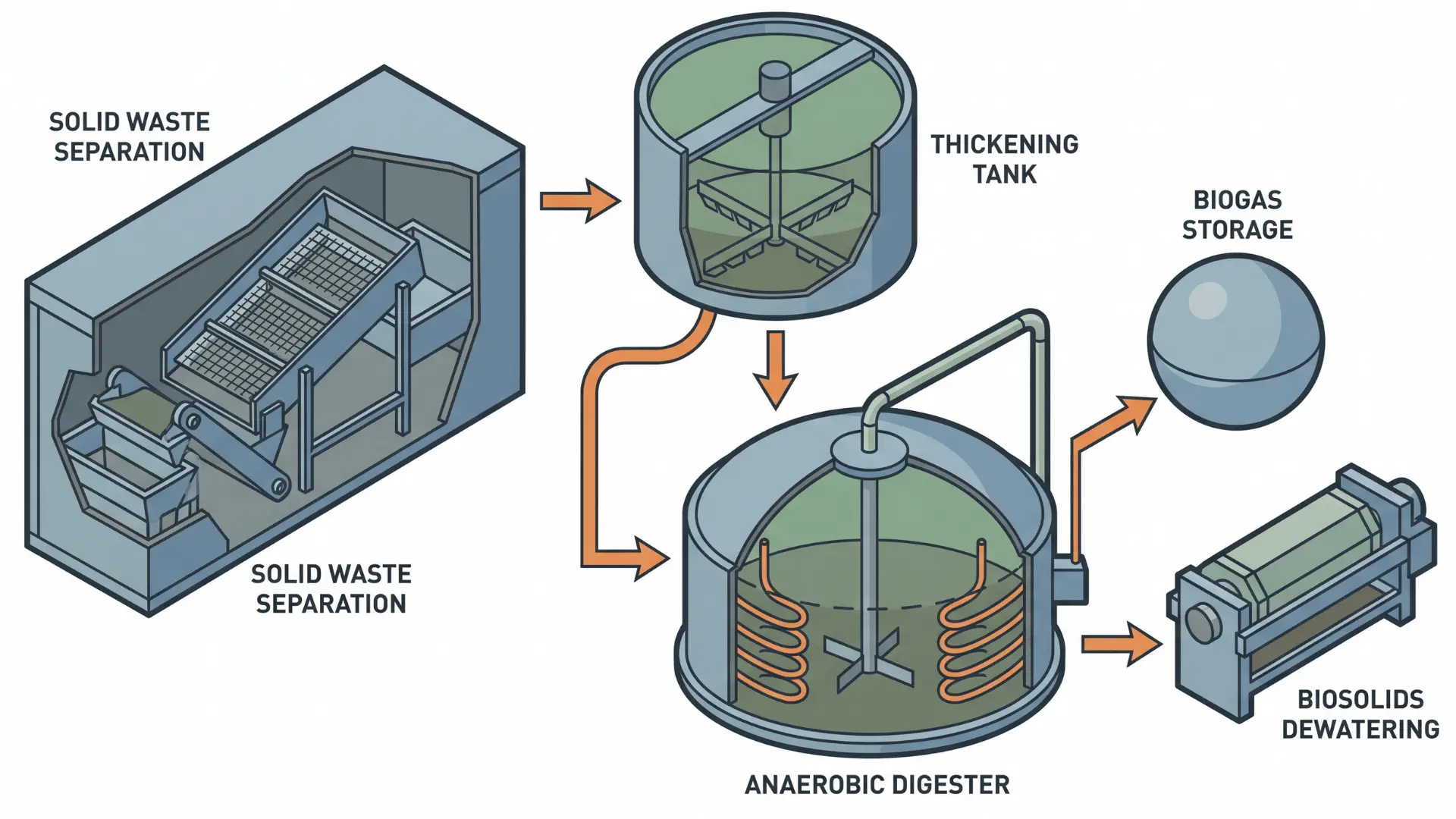
While liquid moves through the treatment stages, the solids follow a separate track entirely.
Sludge collected at the primary and secondary stages gets thickened first. From there, larger facilities feed it into anaerobic digesters, sealed tanks where bacteria break it down without oxygen.
That process produces two outputs:
- Biogas, primarily methane, which many plants use to generate their own electricity
- Biosolids, the stable material left after digestion
Where biosolids meet safety standards, they’re applied to agricultural land as a nutrient-rich soil conditioner.
That’s the resource-recovery side of modern sewage treatment. Not a byproduct to dispose of, a material with a second use.
Centralized vs. Decentralized Systems: What Changes at Different Scales
Treatment systems behave differently depending on scale, from household septic setups to large municipal plants.
| Septic Tank | Domestic STP | Municipal Plant | |
|---|---|---|---|
| Treatment type | Passive settling and storage | Active aeration | Full treatment chain |
| Treatment level | Primary only | Secondary | Secondary + tertiary |
| Nutrient removal | No | Limited | Yes |
| Discharge quality | Not suitable for watercourses | Safe for local watercourses | Meets regulatory standards |
| Infrastructure needed | Minimal | Moderate | High |
| Staffing required | None | None | Yes |
Overall, moving from decentralized to centralized systems improves treatment quality and control, but it also increases infrastructure needs and operational complexity.
Who Regulates Sewage Treatment Plants and What Standards Must They Meet?
In the United States, the EPA oversees sewage treatment through the Clean Water Act. Every plant that discharges treated water must hold a National Pollutant Discharge Elimination System (NPDES) permit.
That permit isn’t a formality. It sets hard numeric limits on what the plant can release, such as biological oxygen demand (BOD), suspended solids, nitrogen, phosphorus, and pathogen levels.
Those numbers are specific to each facility and the waterway it discharges into.
Plants monitor their effluent continuously. If they exceed a limit, say, after a storm surge overwhelms the system, they’re required to report it. That report triggers a formal violation, and depending on the severity, enforcement action can follow.
That accountability is exactly what pushes municipalities to invest in upgrades. The permit doesn’t just set a standard. It creates a consequence for missing it.
Why Sewage Treatment Matters Beyond “cleaning Water”
- Common framing: Sewage treatment gets sold as pollution prevention; accurate, but it massively undersells what’s actually on the line
- The nutrient problem: Untreated sewage dumps excess phosphorus and nitrogen into waterways, triggering algae blooms that strip oxygen and kill aquatic life
- The process: That oxygen depletion cycle is called eutrophication, and tertiary treatment exists specifically to stop it
- Active disease risk: Cholera, typhoid, and cryptosporidiosis aren’t historical footnotes; they remain live threats wherever adequate treatment is absent
- Disinfection’s real role: Not an upgrade or optional extra, it’s the final barrier before treated water re-enters the environment
- Energy recovery: Anaerobic digestion produces biogas that can power treatment facilities entirely, turning waste into a fuel source
- Material recovery: Biosolids pulled from the process get returned to farmland as fertilizer, useful output rather than discarded waste
- The bigger picture: Modern treatment plants aren’t just cleaning water, they’re recovering resources that would otherwise be lost
Conclusion
Sewage treatment is a sequence, not a single step. Each stage exists because the one before it couldn’t finish the job, and together they turn wastewater into something safe enough to return to the environment.
You now know what happens at each stage, why the order matters, and what modern facilities recover from the process along the way.
Most people never think twice about where wastewater goes. Now you’re not like most people.
If you found this useful, share it with someone who’d appreciate knowing what actually happens when they flush.
Frequently Asked Questions
What is the difference between a sewage treatment plant and a wastewater treatment plant?
The terms refer to the same facility. “Wastewater treatment plant” is the more current technical term, reflecting that the input includes greywater from sinks and washing machines, as well as blackwater from toilets. The treatment processes are identical regardless of which term is used.
What happens to the solids removed during sewage treatment?
Solids follow a parallel track to the liquid stream. Sludge from the primary and secondary stages is thickened and fed into anaerobic digesters, producing biogas for energy. What remains: biosolids are tested and, where they meet safety standards, applied to agricultural land as a soil conditioner.
Why does sewage treatment require aeration?
Aeration supplies the oxygen aerobic bacteria need to break down dissolved organic matter. Without it, the biological process stops entirely. No aeration means no secondary treatment, and the dissolved contaminants that only bacteria can remove pass straight through.
Can a sewage treatment plant handle stormwater?
Some older systems use combined sewers that carry sewage and stormwater in the same pipe. During heavy rainfall, this can overload the treatment plant and cause partially treated water to enter waterways. Modern systems increasingly separate the two networks to protect treatment performance.