

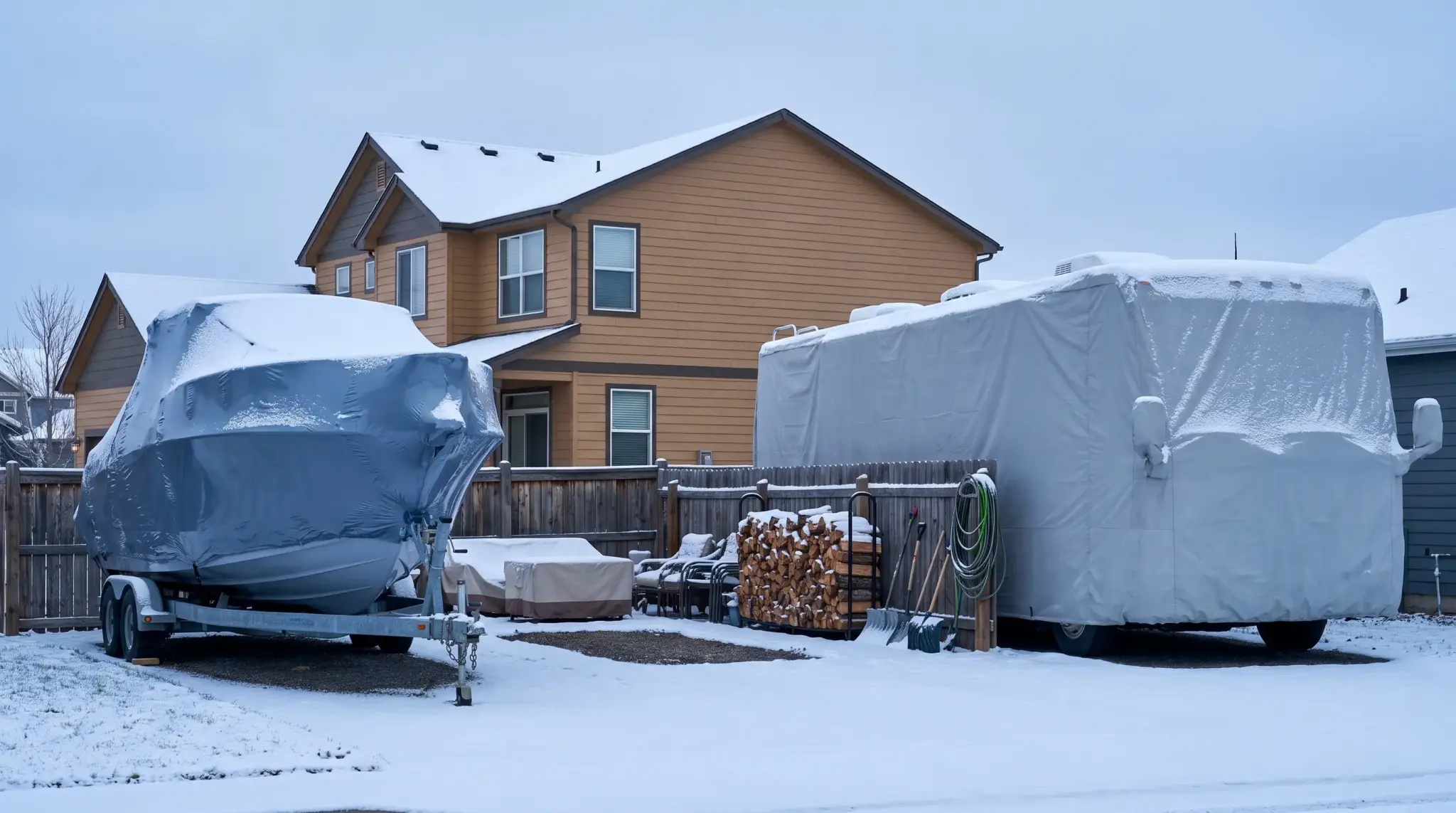
If you own a boat, an RV, or anything else that sits outside nine months a year, winter is the season that decides how much that equipment costs you down the road.
A hull that freezes with water still in the lines, an engine left un-fogged, or a canvas top that spends four months under snow load will all cost more to fix in spring than they would have to protect in November.
Most homeowners already know they should winterize. Where people get stuck is deciding where everything goes once it is prepped, especially when a detached garage or a paid storage unit is not in the budget this year.
Below is a practical rundown of what actually needs to happen to boats, RVs, and other big outdoor gear before the cold sets in, and how to store it at home without turning your yard into a junkyard or your basement into a repair shop.
What Needs to Happen Before Anything Goes Into Storage
Winterizing is not optional busywork. Water left in an engine block, a water heater, or a plumbing line will freeze, expand, and crack the housing around it.
That single mistake accounts for a large share of the spring repair bills marinas and RV shops see every year.
Before anything gets covered or tucked away, handle these steps:
- Drain and flush all water systems, including engines, water heaters, and holding tanks;
- Run fuel stabilizer through the tank and let the engine circulate it before shutdown;
- Change the oil and filter, since old oil holds moisture that causes corrosion over an idle winter;
- Disconnect the battery or hook it to a trickle charger so it holds a charge through spring;
- Clean out food, trash, and anything that attracts rodents looking for a warm place to nest.
Skip any one of these and you are gambling that nothing goes wrong for four to six months with no one checking. Most of the time it works out. The times it does not are expensive.
Where Should a Boat Actually Go for the Winter?
A boat is the hardest item on this list to store well, mostly because of size. Indoor storage keeps a hull in the best shape, but a slip at a marina or a spot in a heated warehouse runs several hundred dollars a month in most regions, and that adds up fast over a full winter.
The realistic middle ground is outdoor storage on a trailer or stands, combined with real protection over the hull.
A basic tarp will keep the worst of the snow off, but tarps sag, pool water, and rarely seal tight enough around the bow and stern to keep out wind-driven rain and drifting snow.
For boat owners without covered storage, boat shrink wrap is one of the most cost-effective ways to protect a hull through winter.
It forms a tight, vented seal around the entire boat, which keeps snow load off the deck, blocks moisture from getting into seams and hardware, and holds up through wind that would tear a standard tarp loose by January.
Shrink wrapping a boat yourself takes a heat gun, the right film, and a free Saturday, or you can have it done professionally in a couple of hours if you would rather not deal with the learning curve on your own hull.
Storing an RV or Camper Without a Garage

RVs face a different set of problems than boats. The tires bear a lot of stationary weight over months of freezing and thawing, the roof seams take direct sun and ice, and rodents love the insulation inside the walls.
A few things make a real difference for RVs left outside:
- Use tire covers or plywood pads under each tire to reduce cracking and flat-spotting;
- Choose a breathable RV cover instead of a plastic tarp, since trapped moisture under plastic causes mold faster than open air does;
- Seal roof vents, seams, and any gaps around slide-outs before the first hard freeze;
- Park on a slight grade or use leveling blocks so water runs off the roof instead of pooling.
If you have room along a side yard or behind a fence line, that is usually enough. Zoning in a lot of neighborhoods restricts how visible a parked RV can be from the street, so check local rules before you settle on a spot.
What About Smaller Seasonal Gear?
Mowers, patio furniture, grills, and garden tools do not need the same level of prep as an engine or a hull, but they still deteriorate fast if they sit outside uncovered.
Gas-powered equipment should get the same fuel stabilizer treatment as a boat or RV engine, since ethanol-blended gas left sitting all winter gums up carburetors by spring.
Store what you can inside a shed, garage bay, or even a covered porch. For anything that has to stay outside, a fitted cover beats a generic tarp every time, since tarps shift in wind and let water in at the seams exactly where you need protection most.
Making the Most of the Storage Space You Already Have
Most people do not actually need more square footage. They need to stop treating the garage as an overflow closet for things that belong in a proper storage setup.
Once boats, RVs, and bulky seasonal gear have a real winter plan, the space that used to disappear under tarps and boxes opens back up for the vehicles and tools it was meant for.
Walk through what is currently crowding your garage or side yard before winter hits. A lot of it is stuff that has never had a real storage plan, just a spot where it landed one season and never left. Fixing that takes an afternoon, and it pays off every year after.