

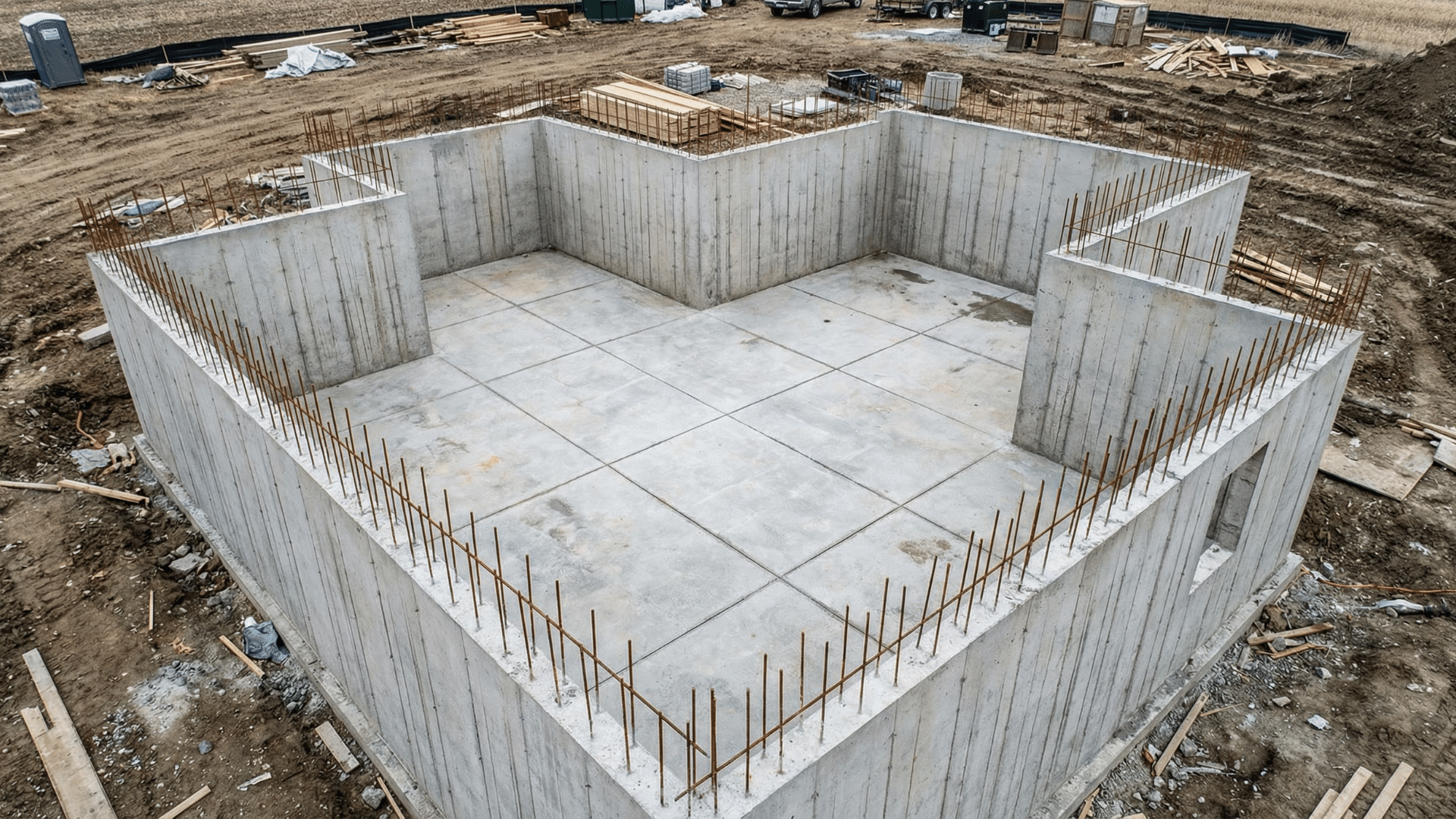
A basement foundation forms the structural base of a building. It carries the weight of the entire structure and helps resist soil pressure and ground moisture.
Today, builders can choose from several construction methods, including custom-built and precast systems.
The decision can influence cost, build time, and overall performance. Because of this, early planning is important to the success of any project.
This guide outlines the main types of basement foundations and explains their benefits to support informed choices in residential and light commercial construction.
What is a Basement Foundation?
A basement foundation is the structural base that supports a building and creates usable space below ground level.
It transfers the weight of the structure into the soil and resists lateral pressure from the surrounding earth.
In colder climates, it also extends below the frost line to prevent movement caused by freeze-thaw cycles. Beyond structural support, it acts as a barrier against moisture and groundwater.
Because it sits below grade, a basement foundation must be engineered carefully. Soil type, groundwater level, building load, and local climate all influence the design.
When properly planned and installed, it provides stability, durability, and additional living or storage space for decades.
The Importance of a Strong Basement Foundation
The performance of the entire building depends on the quality of its foundation. Cracks, settlement, or water intrusion often begin at this level and can affect floors, walls, and even roofing systems. Repairing foundation problems later can be costly and disruptive.
A well-designed basement foundation improves:
- Structural integrity
- Moisture control
- Energy efficiency
- Property value
- Long-term maintenance costs
For builders and property owners evaluating custom or precast solutions, understanding these performance factors is essential before construction begins.
Main Types of Basement Foundation Systems
Several systems are commonly used in residential and light commercial construction. Each has distinct structural properties, installation methods, and cost considerations.
1. Poured Concrete Basement Foundations
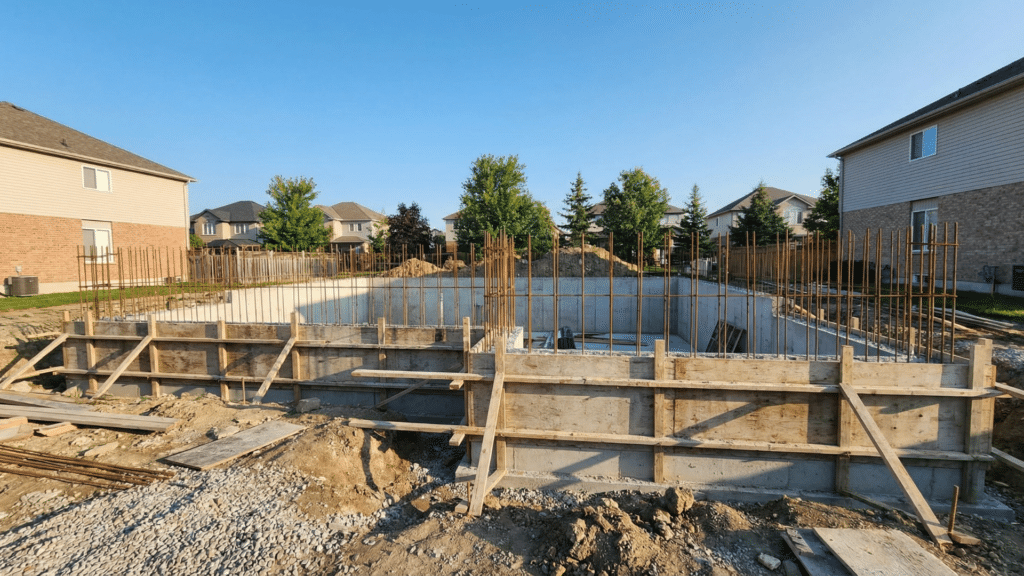
Poured concrete is one of the most common systems used today. It involves setting up formwork on-site and pouring liquid concrete into the forms. Once cured, it forms solid, continuous walls.
Key Characteristics:
- Monolithic wall construction
- High compressive strength
- Fewer joints compared to block systems
- Strong resistance to soil pressure
Benefits of Poured Concrete Basement Foundations:
- High structural strength and durability
- Fewer joints, reducing leak risks
- Strong resistance to soil and hydrostatic pressure
- Long service life with proper maintenance
- Flexible design for different basement layouts
However, the quality depends heavily on on-site workmanship, curing conditions, and weather. Construction schedules may be affected by rain or low temperatures.
2. Concrete Block (CMU) Basement Foundations
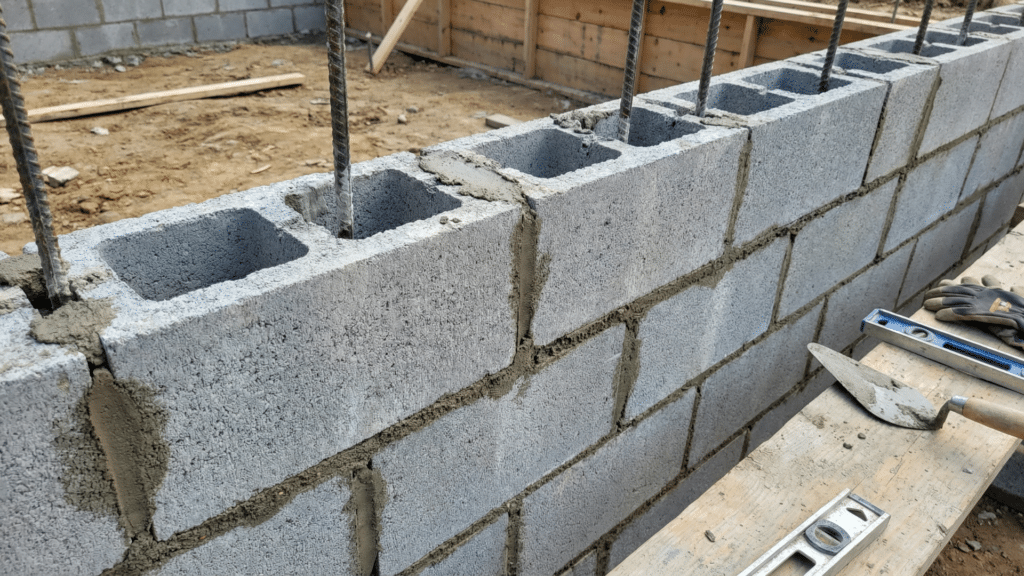
Concrete masonry units (CMU), commonly known as concrete blocks, are stacked and bonded together with mortar. Steel reinforcement and grout may be added to strengthen the wall.
Key Characteristics:
- Modular block construction
- Visible mortar joints
- Flexible design options
Benefits of Concrete Block Basement Foundations:
- Cost-effective for many residential projects
- Easier to handle and transport compared to large panels
- Flexible design for custom layouts
- Simple repair process if individual sections are damaged
- Suitable for smaller homes and low-rise structures
Concrete block systems are practical and widely used. However, the presence of multiple mortar joints creates more potential paths for moisture intrusion.
3. Precast Basement Foundations
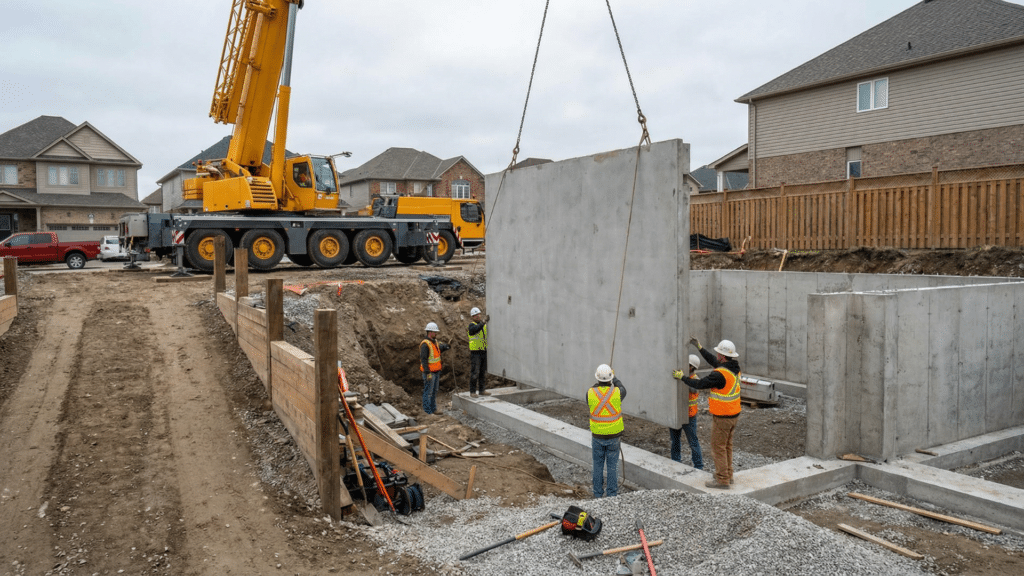
A precast basement foundation is manufactured in a controlled factory environment and delivered to the construction site as completed wall panels. These panels are then set in place using cranes and secured to the footing system.
Key Characteristics:
- Factory-controlled production
- Integrated insulation and waterproofing options
- Rapid installation
Benefits of Precast Basement Foundations:
- High and consistent quality due to controlled manufacturing
- Faster installation, reducing construction timelines
- Less weather-related delay during wall production
- Built-in insulation and vapor barriers in many systems
- Pre-cut openings for doors, windows, and utilities
- Reduced on-site labor requirements
Because precast panels are cured indoors, weather conditions do not interfere with strength development. This improves consistency and reliability.
4. Insulated Concrete Form (ICF) Foundations
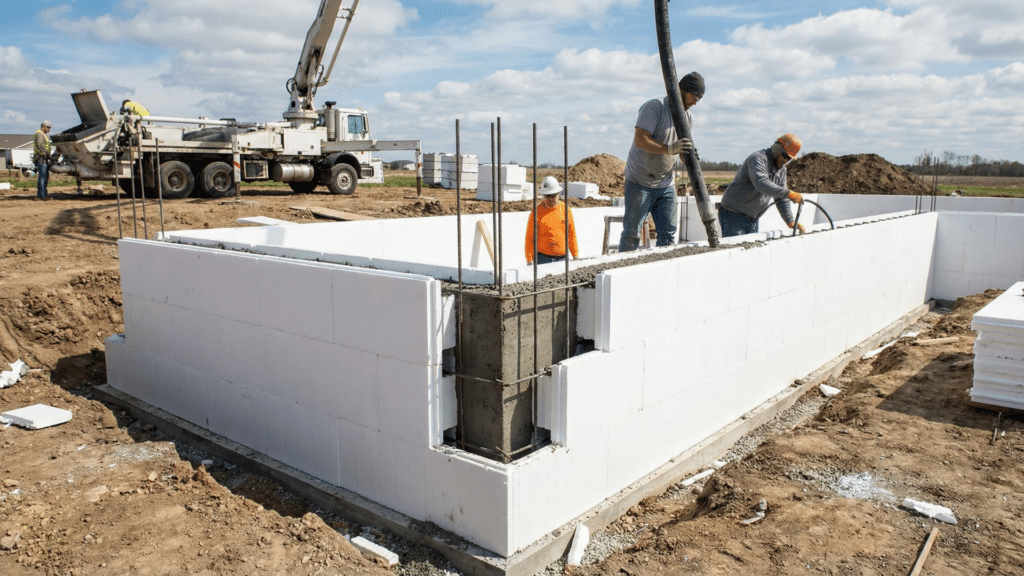
ICF systems use rigid foam blocks that are stacked to form walls. Concrete is then poured into the hollow core. The foam remains in place, providing permanent insulation.
Key Characteristics:
- High energy efficiency
- Strong structural core
- Built-in insulation
Benefits of ICF Basement Foundations:
- Excellent energy efficiency and thermal performance
- Strong resistance to wind and seismic forces
- Improved indoor comfort due to stable temperatures
- Reduced heating and cooling costs over time
- Enhanced sound insulation
- Lower risk of condensation inside walls
ICF systems combine structural strength with insulation into a single integrated assembly. Although initial material costs may be higher than those of traditional systems, improved energy savings and long-term performance often offset the investment over time.
Comparing Custom and Precast Basement Foundations
Choosing between a custom-built system and a precast basement foundation requires careful evaluation of design flexibility, construction time, cost, and long-term performance.
| Factor | Custom Basement Foundation | Precast Basement Foundation |
|---|---|---|
| Design Flexibility | Fully tailored to site conditions and structural needs | Available in standard sizes, with some customization options |
| Engineering Control | Designed specifically for project soil and load conditions | Engineered in advance based on the manufacturer’s specifications |
| Installation Time | Slower due to on-site forming, pouring, and curing | Faster installation with factory-made panels |
| Quality Control | Dependent on on-site workmanship and weather conditions | Produced in a controlled factory environment for consistent quality |
| Weather Impact | Can be delayed by rain, cold, or humidity | Minimal impact on panel production; installation is still weather-dependent |
| Labor Requirements | Higher on-site labor demand | Reduced on-site labor; requires a crane for placement |
| Upfront Cost | Varies depending on complexity and labor | May have higher material cost but lower labor cost |
| Waterproofing Options | Applied on-site after wall construction | Often integrated during manufacturing |
| Insulation Options | Typically added separately after wall construction | Frequently includes built-in insulation systems |
| Project Suitability | Ideal for complex layouts or challenging soil conditions | Suitable for projects with tight timelines or repetitive designs |
Core Performance Factors
A basement foundation must perform well in three critical areas: structural strength, moisture control, and energy efficiency. Each directly affects long-term durability, safety, and operating costs.
Structural Performance and Load Capacity
The foundation must support vertical loads from the structure above while resisting lateral soil pressure from the surrounding ground.
Key structural factors include:
- Concrete compressive strength
- Steel reinforcement spacing
- Wall thickness
- Footing design
- Soil bearing capacity
Precast basement foundation panels are engineered to meet strict load requirements before leaving the factory, ensuring consistent structural performance.
Custom foundations can be reinforced based on project-specific calculations and soil reports. Proper engineering reduces the risk of settlement, cracking, and wall bowing over time.
Moisture Control and Waterproofing
Water management is one of the most critical aspects of any basement foundation. Poor drainage can result in leaks, mold growth, and long-term structural damage.
Effective moisture control methods include:
- Exterior waterproof membranes
- Interior vapor barriers
- Drain tile systems
- Sump pumps
- Proper grading around the structure
Many precast basement foundation systems include factory-applied waterproof coatings. Custom systems require on-site waterproofing, which can vary depending on the workmanship.
Drainage planning should always be addressed during the design stage, not after construction.
Energy Efficiency and Insulation
Basement walls can account for significant heat loss if not properly insulated. Insulation improves interior comfort and reduces heating and cooling costs.
- Precast systems often include factory-installed insulation panels.
- ICF foundations provide continuous insulation through permanent foam forms.
- Traditional poured concrete or block systems typically require separate insulation layers.
Energy performance should be evaluated in accordance with local building codes and climate zone requirements to ensure long-term efficiency.
Basement Foundation Installation Process
Installing a basement foundation requires careful coordination, proper sequencing, and strict attention to engineering standards.
Site Preparation
The site must be excavated to the correct depth, accounting for frost line requirements and drainage slope. Soil compaction and leveling are critical.
Footing Construction
Footings distribute the load of the basement foundation evenly into the soil. They must be properly sized and reinforced.
Wall Installation
- Poured concrete walls are formed and poured on-site.
- Block walls are assembled unit by unit.
- Precast panels are delivered and set in place with cranes.
Backfilling
Soil is carefully placed and compacted around the walls to prevent uneven pressure. Each stage must be executed correctly to ensure long-term stability.
Code Compliance and Engineering Requirements
Local building codes regulate foundation depth, reinforcement, drainage, and insulation standards. Frost depth requirements vary by climate.
Professional engineering review ensures compliance with:
- Structural load standards
- Soil bearing capacity
- Seismic considerations
- Flood zone regulations
Both custom and precast basement foundation systems must meet these requirements. Reputable manufacturers and contractors provide documentation and engineering certification.
Final Considerations
Choosing the right basement foundation involves balancing structural performance, cost, timeline, and long-term durability. Both custom and precast solutions can provide reliable results when properly engineered and installed.
A careful review of soil reports, design goals, budget constraints, and construction schedule will guide the decision.
Consulting with structural engineers and experienced contractors ensures that the selected system aligns with project requirements.
A strong basement foundation supports not only the structure above it but also the long-term value and safety of the property. Thoughtful planning at this stage sets the foundation for lasting performance.