

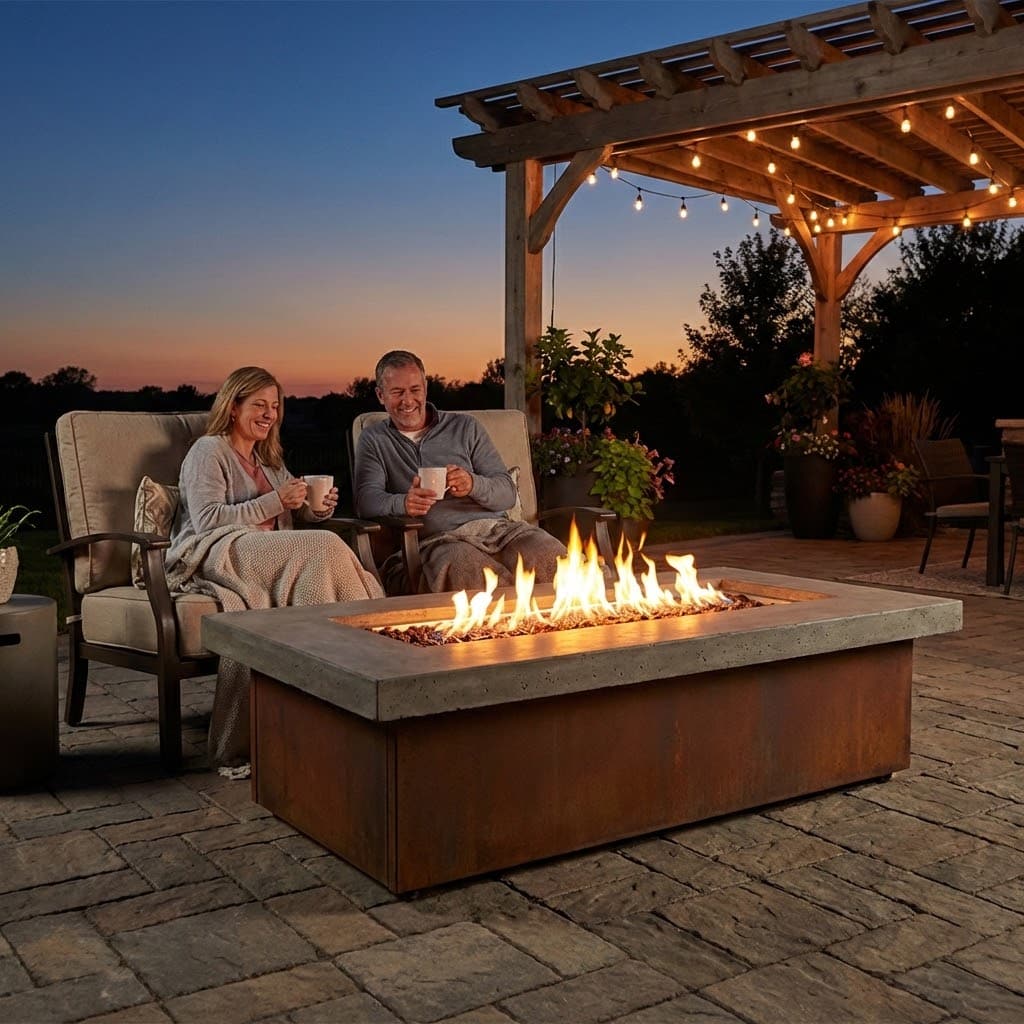
I was over at a neighbor’s place last spring for what was supposed to be the first real outdoor evening of the year. He had just finished a full patio renovation and was particularly proud of a new fire pit he’d found online for a suspiciously good price.
It looked the part for the first twenty minutes, but as the night went on, the flame started thinning out into a weak flicker that barely put off enough heat to justify sitting near it. We ended up moving back inside before ten because the centerpiece of the yard just couldn’t keep up with even a light breeze.
That night was a clear reminder that there is a massive gap between what looks good in a catalog and what actually performs when the sun goes down.
If you are trying to figure out how to create a cozy outdoor living room that people genuinely want to use, the hardware you choose matters more than the aesthetic. From my perspective, many homeowners are starting to look at commercial standards as a baseline for reliability.
If you spend any time looking at professional setups, you will notice that the fire pits for your business usually prioritize burner engineering and material gauge over flashy, low-cost designs. That same logic applies to a backyard. It seems to me that many people buy for the price tag and end up paying for it later in frustration.
The problem with residential-grade durability
A lot of the fire pits you find at big-box retailers are designed for what I call “occasional ambiance.” They are built to be light enough to ship cheaply and easy enough for anyone to assemble in twenty minutes. While that sounds convenient, it usually means the manufacturers are using thinner metals and simplified gas components that just aren’t intended to last.
I have a hunch that this is why so many people end up replacing their fire features every other year. You see things like:
- Burner ports that clog or corrode after a winter outside
- Thin-walled steel that warps under high heat
- Ignition systems that require constant troubleshooting
- Finishes that peel when exposed to UV and rain
The U.S. Consumer Product Safety Commission notes that poorly constructed or maintained outdoor heating equipment can pose significant fire or gas leak risks if components degrade. It is a safety issue as much as a performance one. In our estimation, when you move to a commercial-grade unit, you are moving toward a standard of construction that assumes a much higher level of wear and tear.
Why commercial specs make sense for a patio
When a hotel or a restaurant installs a fire feature, they need it to run for six hours a night, every night, without a technician having to come out once a week. To make that happen, the internal components have to be significantly more robust. We are talking about 304 or 316-grade stainless steel rather than painted carbon steel. We are also talking about sophisticated brass burners that provide a much fuller flame.
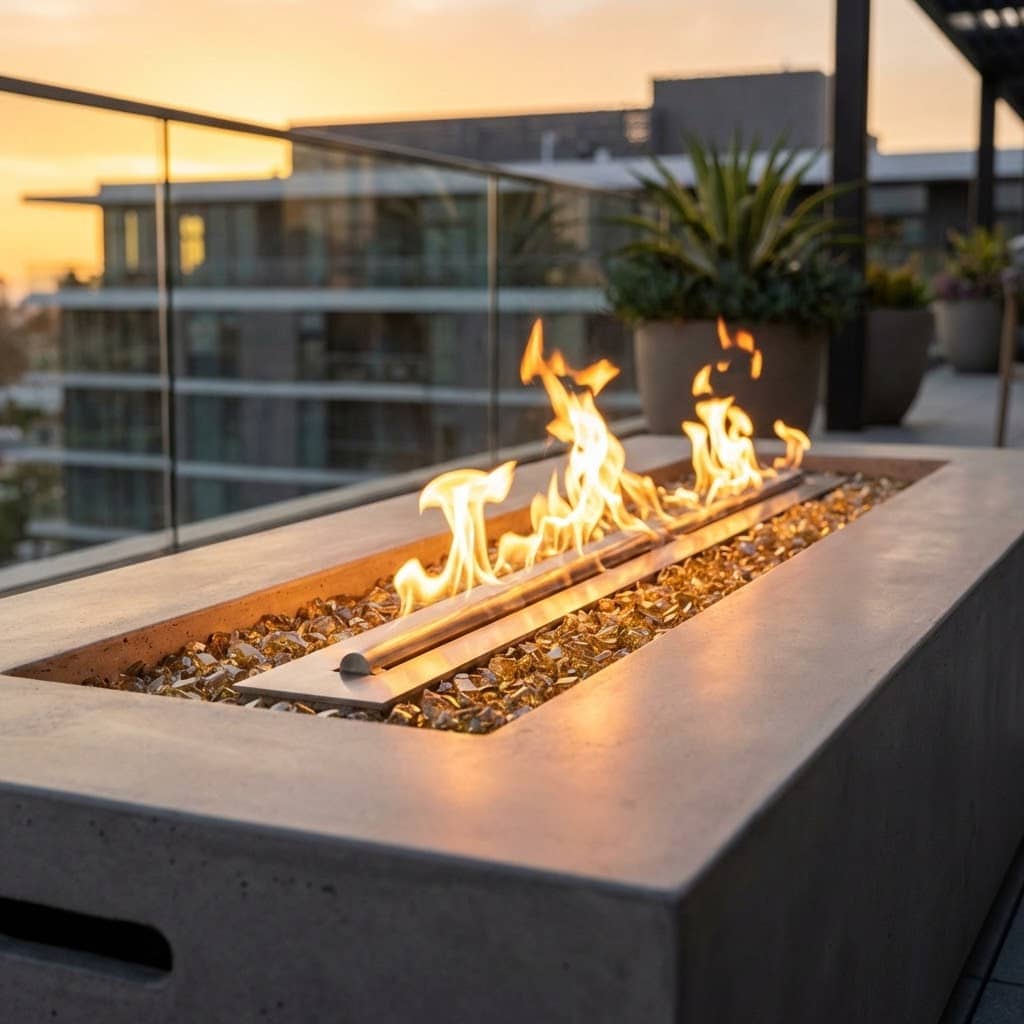
These systems are also built with a higher BTU capacity. The American Society of Heating, Refrigerating and Air-Conditioning Engineers notes that thermal comfort is the primary factor in how long people stay in an outdoor space. If your fire pit is only putting out 30,000 BTUs, it might look pretty, but it isn’t actually keeping anyone warm once the temp drops below sixty degrees. Commercial units often double that output.
From our expert perspective, the safety features are also on a different level. The National Fire Protection Association focuses heavily on proper ventilation and automatic shut-off systems for gas fire features to prevent unburned gas from accumulating. These “flame sensing” technologies, which cut the gas if the wind blows the fire out, are standard in commercial equipment but often absent in budget residential models.
The logistics of low-worry heating
If you look at professionally designed patio plans to inspire your outdoor space, you will see that the fire feature is almost always the anchor of the layout. But an anchor only works if it’s reliable.
One of the biggest benefits of stepping up to a commercial-grade system is the integration. These units are often designed to be hard-piped into a natural gas line rather than relying on propane tanks. This removes the “running to the store at 8 PM” friction that ruins a lot of outdoor evenings. It is about creating a space where the technology works in the background so the social side of the evening can stay in the foreground.
The U.S. Department of Energy points out that well-designed heating systems can significantly improve the usability of a space during “shoulder seasons” like early spring or late autumn. If you live in a climate with real winters, a cheap fire pit is basically a summer-only decoration. A high-output commercial system can give you another two or three months of outdoor time every year.
Designing for guest experience
Personally, I believe that the quality of the flame itself changes the psychology of the yard. There is something about the way a high-quality burner interacts with the air that creates a more rhythmic, soothing fire. Research in environmental psychology, often summarized by institutions like the University of Minnesota’s research initiatives, suggests that ambient lighting and natural fire elements can significantly improve social cohesion in a group setting.
When the fire is weak, people tend to hunch in toward it. When the fire is strong and consistent, people relax back into their chairs. It changes the posture of the room. It makes the entire environment feel more like a destination and less like a deck with some chairs on it.
Thinking back to that night at my neighbor’s house, the problem wasn’t that the fire pit was ugly. The problem was that the fire pit was a chore. He was so busy trying to keep it lit that he wasn’t part of the conversation. When he finally upgraded to a commercial-grade unit, the fire became a background element again. It just worked. And that is when we started staying outside until midnight. Utility, when done right, is what actually creates the comfort people are looking for.